

Wearable Tech for Diabetics: Monitoring Glucose with a 3D Printed E-Ring and Your Smartphone
The landscape of diabetes management is undergoing a significant transformation, driven by a global demand for more patient-friendly, less invasive, and highly convenient monitoring solutions. At the forefront of this innovation are researchers from the National and Kapodistrian University of Athens, who have successfully developed a groundbreaking 3D printed electrochemical ring, aptly named the “e-ring.” This ingenious device offers diabetics an unprecedented ability to monitor their glucose levels effortlessly, simply by connecting the ring to their smartphone. This advancement marks a crucial step away from the traditional, often cumbersome, blood-sample-based methods, ushering in an era where managing blood sugar can be as simple as wearing a piece of jewelry. The design philosophy behind the e-ring emphasizes a user-oriented approach, reflecting a deep understanding of the challenges faced by individuals living with diabetes and striving to provide a truly accessible and comfortable monitoring experience.
The Urgent Need for Non-Invasive Glucose Monitoring
For millions worldwide, daily life with diabetes involves a constant vigilance over blood glucose levels. Historically, this has meant frequent finger pricking to obtain blood samples for analysis with a blood glucose meter, or the use of continuous glucose monitors (CGMs) that involve a small sensor inserted under the skin. While these methods are effective, they come with significant drawbacks. The repeated pain and discomfort associated with finger pricking can act as a substantial deterrent, leading to infrequent monitoring. This reluctance to check blood sugar levels regularly can have severe health consequences, increasing the risk of both hyperglycemia (dangerously high blood sugar) and hypoglycemia (dangerously low blood sugar), both of which can lead to serious complications if not promptly addressed. Beyond the physical discomfort, the psychological burden of constant needle pricks and the visibility of medical devices can also impact a patient’s quality of life.
Recognizing these challenges, the medical community and technological innovators have increasingly focused on developing non-invasive alternatives, particularly wearable sensors that can monitor crucial biomarkers through bodily fluids like sweat. Sweat, often overlooked, presents a rich source of physiological information, including glucose concentrations, which can correlate with blood glucose levels. The development of such wearable technology promises to remove the physical and psychological barriers to consistent glucose monitoring, empowering individuals with diabetes to take better control of their health without disrupting their daily routines. The 3D printed e-ring embodies this vision, representing a significant leap forward in the quest for truly non-invasive and user-friendly diabetes management tools.
Introducing the 3D Printed Electrochemical Ring (e-ring)
The 3D printed e-ring stands as a testament to the power of modern additive manufacturing in creating personalized and functional medical devices. Unlike its invasive predecessors, this innovative wearable sensor relies entirely on sweat to noninvasively detect glucose levels. This fundamental shift eliminates the pain and inconvenience associated with traditional methods, thereby encouraging more frequent and consistent monitoring. The core principle of the e-ring’s design is not only its technological sophistication but also its unwavering commitment to user-friendliness and accessibility. From its materials to its connectivity, every aspect has been tailored to ensure that diabetics can integrate this device seamlessly into their lives, fostering better adherence to monitoring protocols and ultimately leading to improved health outcomes.
The researchers’ focus on creating a truly accessible solution is evident in multiple facets of the e-ring’s development. Not only has the device been designed for broad compatibility with most Android smartphones, making it accessible to a vast user base, but its manufacturing process itself is also designed for ease. The e-ring can be fabricated using a commercial dual-extrusion 3D printer, meaning that its production is not confined to highly specialized laboratories. This widespread accessibility, both in terms of user interface and manufacturing, positions the e-ring as a potential game-changer in personalized diabetes care, moving beyond prototype stages towards wider adoption and impact.
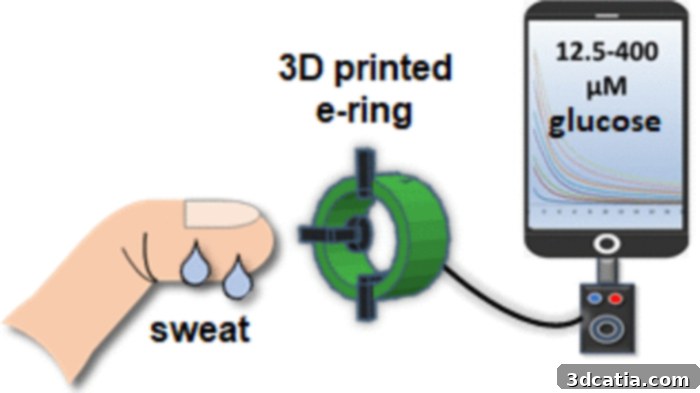
The e-ring can be connected to most Android smartphones to monitor glucose levels. (Photo Credit: American Chemical Society)
How the e-ring Works: A Technological Deep Dive
The engineering marvel behind the e-ring lies in its ability to accurately and reliably detect glucose in sweat. To achieve this, the researchers meticulously crafted four distinct prototypes, experimenting with various materials to optimize performance and durability. The primary materials chosen were Thermoplastic Polyurethanes (TPUs) and carbon-based polylactide (PLA). These materials were selected for their biocompatibility, flexibility, and suitability for 3D printing processes, ensuring both comfort for the wearer and structural integrity of the device. The iterative prototyping process allowed the team to refine the design and material composition, leading to a robust and efficient final product.
Materials and Fabrication for Precision Monitoring
Each prototype of the e-ring incorporates a sophisticated sensor array comprising three carbon-based plastic electrodes. These electrodes are meticulously fabricated using a conductive filament, ensuring optimal electrical signal transmission. The integration of these crucial sensing elements occurs directly at the inner side of a plastic ring, which itself is fabricated using a non-conductive filament. This dual-extrusion 3D printing technique is pivotal, allowing for the precise placement and insulation of the conductive components within the wearable structure. The use of 3D printing not only facilitates rapid prototyping but also enables custom sizing, potentially leading to more personalized and comfortable devices for individual users.
The Amperometric Detection Mechanism
At its core, the 3D printed e-ring functions as an amperometric device. Amperometry is an electrochemical technique used to detect the concentration of specific ions or molecules in a solution by measuring changes in electric current at a fixed potential. In the context of the e-ring, the “solution” is human sweat, and the target molecule is glucose. When glucose is present in the sweat and comes into contact with the electrodes, an electrochemical reaction occurs, producing a measurable electric current. The magnitude of this current is directly proportional to the concentration of glucose in the sweat, allowing for precise quantification of blood sugar levels.
To enhance the sensitivity and specificity of the glucose detection, the e-ring’s electrodes were further modified with an electrodeposited gold film. Gold is an excellent choice for biosensors due to its high electrical conductivity, inertness, and biocompatibility, as well as its ability to facilitate specific electrochemical reactions crucial for glucose sensing. This gold film acts as a crucial interface, ensuring accurate and consistent signal generation from the glucose present in sweat. Once these modifications are complete, the e-ring is designed to be fitted to a miniature potentiostat – a specialized electrical hardware device used to control three-electrode cells. This potentiostat is the bridge, addressable to a smartphone, enabling users to receive real-time glucose readings directly on their mobile device through a dedicated application. The seamless integration of hardware, electrochemical principles, and smartphone technology creates a powerful, yet user-friendly, glucose monitoring system.
Accessibility and User-Friendliness: A Game-Changer for Diabetics
The design philosophy underpinning the e-ring places paramount importance on accessibility and user-friendliness, recognizing that the most advanced technology is only truly impactful if it can be easily adopted and consistently used by its target audience. The decision to make the e-ring compatible with most Android smartphones is a strategic one, opening up its benefits to a vast global population. This widespread compatibility removes significant barriers to entry, as users do not need to purchase specialized, expensive companion devices. Instead, their existing smartphone becomes an integral part of their diabetes management toolkit, providing a familiar and convenient interface for data visualization and tracking.
Furthermore, the ability to 3D print the e-ring using a commercial dual-extrusion 3D printer highlights its potential for scalable and localized manufacturing. This democratic approach to production not only reduces manufacturing costs but also paves the way for greater customization. Future iterations could potentially involve personalized ring sizes or even aesthetic variations, further enhancing user comfort and acceptance. By reducing the physical and financial hurdles associated with glucose monitoring, the e-ring promises to significantly improve patient adherence to monitoring schedules, a critical factor in preventing diabetes-related complications. This innovation moves beyond mere convenience; it aims to profoundly improve the daily quality of life for individuals with diabetes by offering a discreet, comfortable, and reliable means of managing their condition.
3D Printing’s Transformative Role in Healthcare Innovation
The development of the 3D printed e-ring is just one compelling example of how additive manufacturing technology is revolutionizing the medical sector. 3D printing offers unparalleled capabilities for creating highly customized, complex, and functional medical devices, often at a lower cost and with greater speed than traditional manufacturing methods. From patient-specific surgical guides and prosthetic limbs to custom implants and bioprinted tissues, the applications of 3D printing in healthcare are expanding rapidly, promising more personalized and effective treatments. The ability to rapidly prototype and iterate designs, as demonstrated with the e-ring, significantly accelerates the research and development cycle for new medical innovations.
Beyond glucose monitoring, 3D printing is addressing other critical challenges in diabetes care. For instance, a notable Polish initiative has set an ambitious goal to 3D print a functional bionic pancreas by 2022, an organ capable of secreting insulin to combat diabetes directly. Such groundbreaking projects underscore the immense potential of 3D printing to create not just monitoring devices, but also fully functional biological components that could potentially cure or drastically mitigate chronic diseases. The e-ring, while a monitoring device, paves the way for even more sophisticated and integrated solutions, demonstrating the versatility and power of 3D printing in advancing medical technology.
The Future of Diabetes Management with Wearable Technology
The introduction of the 3D printed e-ring represents a significant leap forward in diabetes management, offering a glimpse into a future where personal health monitoring is seamless, comfortable, and integrated into daily life. This innovation addresses several long-standing challenges associated with traditional glucose monitoring methods, primarily the discomfort and inconvenience that can lead to inconsistent patient adherence. By leveraging sweat-based sensing and smartphone connectivity, the e-ring empowers individuals with diabetes to maintain tighter control over their blood sugar levels, reducing the risk of both acute and chronic complications associated with the disease.
As wearable technology continues to evolve, we can anticipate further refinements in devices like the e-ring, including enhanced accuracy, longer battery life, and even more sophisticated data analytics capabilities. The integration of artificial intelligence and machine learning could potentially allow these devices to not only monitor but also predict glucose trends, offering proactive alerts and personalized advice. The impact of such accessible and non-invasive technologies extends beyond individual patient care; it contributes to a broader public health goal of improving the quality of life for millions affected by diabetes worldwide. The work by the researchers at the National and Kapodistrian University of Athens is a beacon of hope, illustrating how innovative design and advanced manufacturing can come together to create transformative solutions for chronic health conditions. You can read the full paper on this pioneering glucose monitoring e-ring HERE.
What do you think of this revolutionary 3D printed e-ring and its potential to change diabetes management? Share your thoughts and insights in a comment below or connect with us on our Facebook, Twitter, and LinkedIn pages! Don’t miss out on the latest advancements in additive manufacturing – sign up for our free weekly Newsletter here to get the freshest 3D printing news delivered straight to your inbox!