
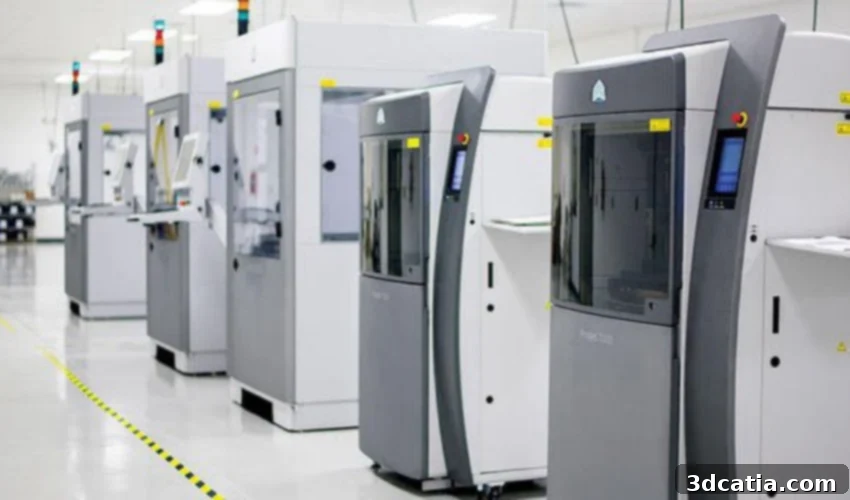
3D Systems Unveils High-Speed Fusion: Revolutionizing Industrial Additive Manufacturing
3D Systems, a global leader in additive manufacturing solutions, has officially announced the impending introduction of its next-generation ‘High Speed Fusion’ (HSF) 3D printing system. This groundbreaking platform, developed in close collaboration with Jabil Inc., a renowned manufacturing solutions provider, is poised to redefine industrial production capabilities. The High Speed Fusion system integrates novel printer technology with advanced materials systems, promising capabilities that significantly surpass currently available solutions in the market. 3D Systems projects that the existing market for such high-performance industrial additive manufacturing solutions already exceeds $400 million, and this new offering is expected to unlock substantial new markets and opportunities across various high-demand sectors. The High Speed Fusion (HSF) system is specifically engineered to address the rigorous requirements of demanding aerospace and automotive applications, providing direct printing solutions for critical components.
Within the aerospace industry, the HSF system will be instrumental in manufacturing applications such as interior parts and complex ducting systems, crucial for lightweighting initiatives and performance optimization. For industrial applications, it will facilitate the rapid production of robust tooling and fixtures, essential for automation and robotics tooling, thereby enhancing manufacturing efficiency and flexibility. Furthermore, the system is designed to accelerate prototyping efforts across a broad spectrum of industries, including automotive, aerospace, medical, heavy equipment, and general industrial support, enabling faster design iterations and product development cycles. This strategic move marks a significant expansion of 3D Systems’ portfolio, traditionally known for its diverse range of professional 3D printing technologies, into the realm of industrial fused filament fabrication (FFF) with unparalleled speed and precision.
Strategic Collaboration and Market Impact
Dr. Jeffrey Graves, President and CEO of 3D Systems, emphasized the strategic importance of this new development, stating: “By introducing our High Speed Fusion filament printer, 3D Systems will build on the organizational focus that we adopted in 2020, and expand our presence in growing markets that demand high reliability products such as aerospace and automotive.” He further elaborated on the company’s vision and the transformative potential of the HSF platform: “Our investments in this solution, and collaboration with Jabil, will allow our customers to increase productivity and performance by using additive manufacturing with a hardware, software, and materials platform that is uniquely designed for the rigors and requirements of an industrial setting. The value proposition, which we believe is compelling, will open new markets for our company that are estimated to be over $400 million, with the promise of new markets, beyond these current opportunities, as the economics of this new technology platform are fully demonstrated.” This statement underscores 3D Systems’ commitment to delivering robust, production-ready additive manufacturing solutions that meet the stringent demands of high-value industrial applications, paving the way for broader adoption and innovation in sectors where performance and reliability are paramount.
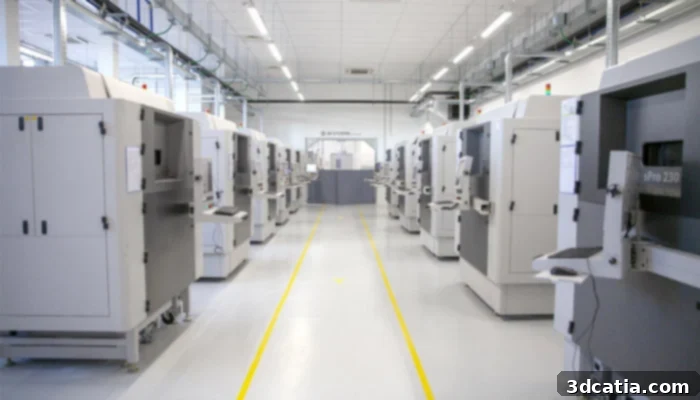
3D Systems’ AM facility in Italy (Photo Credit: 3D Systems)
Unprecedented Speed, Precision, and Economic Advantages
The High Speed Fusion 3D printing system is engineered to dramatically exceed the capabilities of existing industrial FFF solutions in multiple critical areas. HSF products, exemplified by the upcoming Roadrunner 3D printer, are designed to offer superior economics compared to any other high-throughput industrial fused filament offering currently available. This economic advantage translates into lower operational costs and a more attractive return on investment for manufacturers seeking to integrate additive manufacturing into their production workflows. The revolutionary combination of new technology, advanced materials systems, and precision electric motion control empowers users to print with unprecedented accuracy and at speeds up to three times faster than contemporary state-of-the-art industrial systems. This significant increase in speed and precision addresses long-standing limitations in industrial FFF, which have often been characterized by high production costs and relatively low throughput, hindering its widespread adoption for high-volume manufacturing applications.
Beyond speed and cost-effectiveness, the HSF system boasts exceptional material versatility. It will be compatible with a diverse range of high-performance, high-temperature engineering-grade materials, including ULTEM and PA CF (Carbon Fiber filled Nylon). ULTEM is renowned for its high heat resistance, mechanical strength, and chemical resistance, making it ideal for aerospace and automotive components exposed to harsh environments. PA CF, a carbon fiber reinforced nylon, offers excellent stiffness-to-weight ratio and strength, perfect for lightweighting applications and demanding structural parts. In addition to these advanced materials, the system will also support a broad spectrum of general-purpose filaments like ABS (Acrylonitrile Butadiene Styrene), known for its good mechanical properties and ease of use, and PETg ESD (Electrostatic Discharge), critical for applications requiring protection against static electricity, such as electronics manufacturing and tooling. This wide material compatibility ensures that the HSF system can cater to a vast array of industrial applications, providing flexibility and tailored solutions for diverse manufacturing needs.
Expanding 3D Systems’ Diverse Portfolio
3D Systems has a long-standing reputation as a pioneer in additive manufacturing, known for its extensive portfolio of professional 3D printers utilizing various sophisticated technologies. These include material jetting, which offers exceptional detail and multi-material capabilities; SLA (Stereolithography), recognized for its high resolution and smooth surface finishes; and Laser Powder Bed Fusion, which produces strong, functional metal and plastic parts. With the introduction of the High Speed Fusion system, 3D Systems is strategically entering the industrial FFF market for the first time. This move is particularly significant as it broadens their technological footprint, allowing them to address a wider range of industrial applications that specifically benefit from the robust, cost-effective, and now high-speed characteristics of FFF technology. It represents a comprehensive approach to additive manufacturing, ensuring that customers have access to the optimal technology for their specific application requirements, from highly detailed prototypes to large, end-use industrial components.
The Jabil Partnership: Driving Industrial Readiness
“We are proud of the progress the Jabil and 3D Systems teams have made and the ability of this solution to overcome the historical system and sub-system level limitations of current market offerings,” remarked John Dulchinos, Vice President of 3D Printing and Digital Manufacturing at Jabil. “Jabil understands the needs of a large-scale manufacturing environment and we look forward to continuing to collaborate with 3D Systems to make this new system available to the marketplace while also using it within our own factories.” This strong endorsement from Jabil highlights the deep collaboration and the practical, industrial-focused design principles behind the HSF system. Jabil’s extensive experience in large-scale manufacturing and supply chain management brings invaluable insight into developing a system that is not only technologically advanced but also robust, reliable, and scalable for production environments. The novel High Speed Fusion 3D printing system is engineered to incorporate the highest deposition rates, ensuring rapid part production, in conjunction with excellent dimensional precision, which is critical for functional components. This combination allows for the creation of high-quality parts at minimal cost, maximizing both efficiency and output. The partnership between 3D Systems and Jabil is a testament to the commitment to delivering a truly industrial-grade additive manufacturing solution that can be seamlessly integrated into existing and future smart factory ecosystems. The potential for Jabil to implement this technology within its own vast manufacturing operations further validates its readiness and capability for real-world, demanding applications. You can find out more about the new system HERE.
Transforming Industries with High-Speed Fusion
The implications of 3D Systems’ High Speed Fusion technology extend far beyond incremental improvements in 3D printing. For the aerospace industry, HSF means the ability to produce lighter, more complex, and more efficient parts faster than ever before. This could revolutionize the manufacturing of interior components, air ducts, custom brackets, and even jigs and fixtures for maintenance, repair, and overhaul (MRO). The speed and precision offered by HSF will accelerate certification processes by providing consistent, repeatable part quality. In the automotive sector, from prototyping new designs to producing end-use parts and highly customized tooling for vehicle assembly lines, the HSF system promises to enhance agility and significantly reduce lead times. This enables automakers to respond to market demands more quickly, innovate faster, and potentially facilitate on-demand manufacturing of specialized components or spare parts.
Furthermore, the system’s ability to work with high-performance materials like ULTEM and PA CF opens doors for applications requiring high mechanical strength, thermal stability, or chemical resistance – properties crucial for many industrial applications, including those in medical devices and heavy equipment. Medical device manufacturers could benefit from rapid prototyping of complex geometries and the production of custom surgical guides or patient-specific implants, subject to regulatory approvals. For heavy equipment, the ability to print robust tooling and durable, functional parts on demand could dramatically reduce downtime and supply chain complexities. The overarching benefit of HSF is its potential to make additive manufacturing not just a prototyping tool, but a viable, cost-effective, and high-throughput production method, driving further digital transformation across manufacturing industries worldwide.
What are your thoughts on 3D Systems’ announcement of their High Speed Fusion platform? We invite you to share your insights and comments below or connect with us on our Facebook, Twitter and LinkedIn pages! To stay informed with the very latest news and advancements in the world of 3D printing, remember to sign up for our free weekly Newsletter here, delivered straight to your inbox! Additionally, if you have a keen interest in the evolving role of additive manufacturing within the aerospace sector, be sure not to miss out on our upcoming virtual event, ADDITIV Aerospace! You can register for free and secure your spot HERE.