
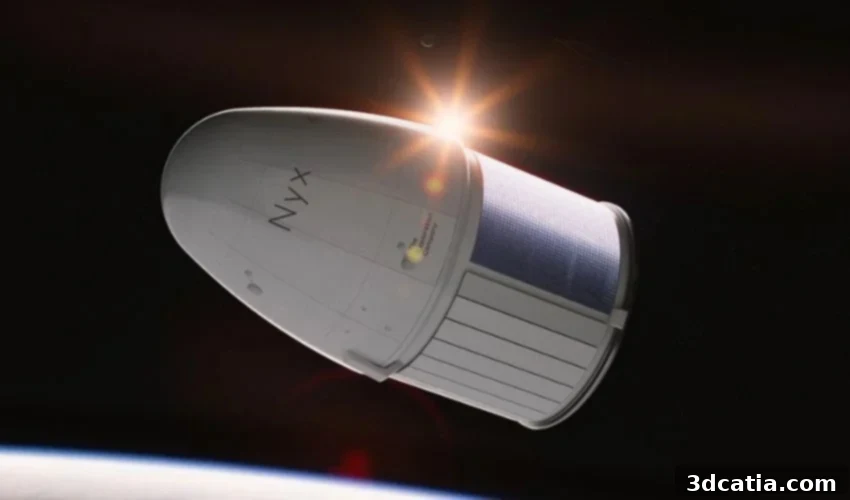
The Exploration Company: Pioneering European Space Logistics with Advanced 3D Printing
The landscape of space freight transport, the critical movement of goods from one point to another in the cosmos, has long been dominated by American innovation, with SpaceX and its formidable Dragon capsule leading the charge. However, a new challenger is emerging from the heart of Europe. A Franco-German enterprise, headquartered in Munich, The Exploration Company, is poised to redefine space logistics, aiming to establish itself as a robust and reliable alternative to the existing paradigms. Central to their ambitious strategy is the revolutionary application of 3D printing, particularly in the production of their advanced engine components.
Founded in July 2021 by space industry veteran Hélène Huby, The Exploration Company has rapidly focused its development efforts on a series of cutting-edge vehicles dubbed “Nyx.” These spacecraft are meticulously designed not merely to compete but to surpass current solutions, thereby significantly bolstering Europe’s independence within the space sector, an arena frequently overshadowed by American prowess. The name “Nyx” itself is a poignant nod to the Greek goddess of night and the cosmos, embodying Europe’s deep-seated quest for exploration and its soaring technological aspirations. The company is strategically developing multiple Nyx variants, each tailored to fulfill a diverse array of missions, from servicing Earth orbit to facilitating lunar exploration.
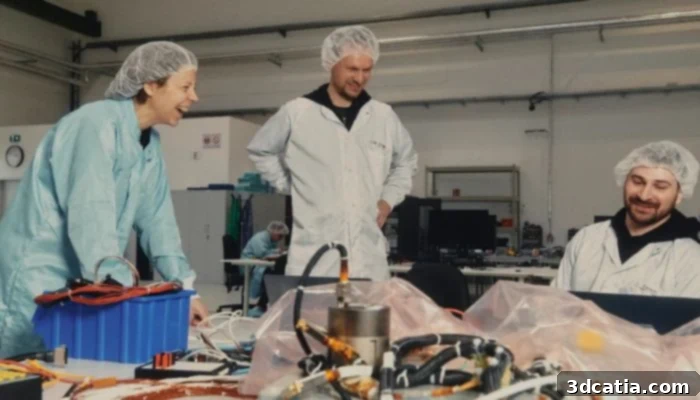
Hélène Huby, founder of The Exploration Company, and her team.
Nyx: Europe’s Versatile Fleet for Space Missions
The Nyx spacecraft family is designed for maximum versatility and mission adaptability. The Nyx Earth capsule is specifically engineered for critical resupply missions to space stations in low-Earth orbit (LEO), ensuring continuous support for human presence in space. Beyond LEO, the company envisions expanding its reach with the Nyx Gateway and Nyx Moon models, which are specifically designed to target the Gateway lunar station and eventually the lunar surface itself. This multi-tiered approach highlights The Exploration Company’s comprehensive vision for future space logistics, covering everything from orbital servicing to deep-space exploration.
The inaugural official mission for Nyx Earth is eagerly anticipated for 2028, with its primary objective being the crucial task of refueling the International Space Station (ISS). This initial mission will serve as a vital demonstration of Nyx’s capabilities and reliability. However, The Exploration Company’s long-term strategic focus extends beyond governmental space agencies. They are actively targeting the burgeoning market of future private space stations as their primary customers, positioning themselves at the forefront of the commercial space industry’s expansion.
Nyx Earth’s Unrivaled Payload Return Capability
Nyx Earth boasts impressive specifications, designed to significantly enhance current space logistics capabilities. It is engineered to carry up to 4,000 kg of vital cargo into space, providing substantial resupply capacity for orbiting outposts. What truly sets Nyx Earth apart, however, is its remarkable ability to return up to 3,000 kg of payload safely to Earth. This payload return capability is currently the highest in the world for a capsule of its type, addressing a critical need for bringing experiments, equipment, and other valuable items back from space. This feature is not just a technical achievement but a strategic advantage, enabling more complex scientific research and commercial operations in orbit.
While the full-scale inaugural launch of Nyx Earth is still several years away, rigorous testing and development are already in full swing. A pivotal moment in this development process is scheduled for mid-June, when a slightly scaled-down prototype of the Nyx Earth capsule will be launched into space aboard a Falcon 9 rocket. This crucial test flight will gather invaluable data on the capsule’s performance, aerodynamics, and systems in a real space environment, paving the way for the full operational vehicle.
Sustainability and Cost-Efficiency: The Nyx Advantage
A cornerstone of The Exploration Company’s strategy is a strong commitment to sustainability and cost-effectiveness in space operations. The company boldly claims that its Nyx vehicle can significantly reduce mission costs by an impressive 25-50% when compared to its primary competitors. This substantial cost reduction is achieved through several innovative design philosophies and operational models. Firstly, Nyx is engineered to be a fully reusable spacecraft. Unlike many existing systems that are expended after a single mission, Nyx can be refurbished and flown multiple times, dramatically lowering the per-mission cost.
Beyond reusability, Nyx also incorporates in-orbit refueling capabilities. This groundbreaking feature allows missions to be extended far beyond their initial planned duration, simply by replenishing propellants in space. This not only enhances mission flexibility but also reduces the need for costly and frequent launches, further contributing to overall cost savings. This dual focus on reusability and in-orbit refueling exemplifies a paradigm shift in space logistics, moving towards more sustainable and economically viable operations. This commitment to sustainability is also profoundly reflected in The Exploration Company’s strategic embrace of additive manufacturing for critical components.
Additive Manufacturing: Revolutionizing Rocket Engine Production
The role of additive manufacturing, commonly known as 3D printing, is not merely supplementary but central to The Exploration Company’s technological edge. Maximilian Strixner, the senior 3D printing engineer overseeing the project, spearheads the production of intricate engine components within a dedicated, state-of-the-art workshop. Here, the Direct Metal Laser Sintering (DMLS) process is employed, a highly advanced additive manufacturing technique. Strixner describes these meticulously crafted parts as some of the most complex designs achievable with 3D printing, pushing the boundaries of what is possible in aerospace engineering.
The DMLS process involves the precise use of powerful lasers to selectively fuse metallic powder, layer by infinitesimal layer, to construct the complex geometries required for high-performance rocket engines. This method allows for the creation of components with internal channels, intricate lattice structures, and optimized weight distribution that would be impossible or prohibitively expensive to produce with traditional manufacturing techniques. The precision and potential of this advanced manufacturing technology are vital for achieving the high-performance, lightweight, and robust engines essential for Nyx’s ambitious missions. Furthermore, the ability to rapidly iterate on designs and produce prototypes quickly significantly accelerates the development cycle, a crucial advantage in the fast-paced space industry. By utilizing additive manufacturing for these critical components, The Exploration Company not only reduces manufacturing complexity and lead times but also ensures that their thrusters are designed with a low environmental impact, aligning with their broader sustainability goals.
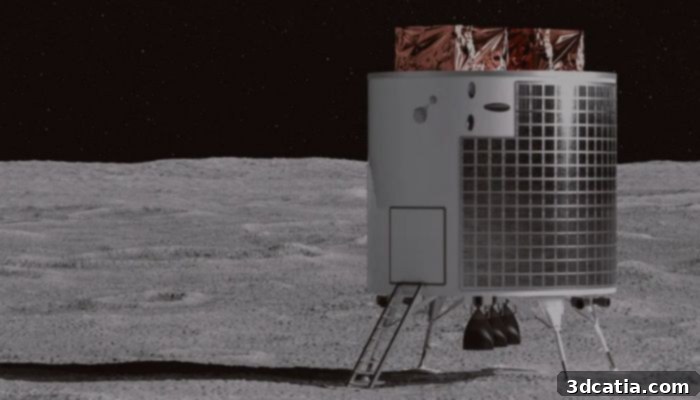
The Nyx Moon spacecraft will probably be inaugurated in 2030
Key Milestones and The Path Ahead
The coming months will mark significant milestones for The Exploration Company. As mentioned, mid-June will see the first launch of Nyx capsules into space as part of the pivotal “Mission Possible.” These capsules will be equipped with reusable, low-environmental-impact 3D-printed thrusters, showcasing the company’s innovative manufacturing approach and commitment to sustainable spaceflight. This event is not just a test; it is a key moment that will validate years of research, development, and groundbreaking engineering for The Exploration Company. It represents a tangible step forward in their quest to provide reliable and cost-effective space transport solutions.
Looking further ahead, the Nyx Moon spacecraft, critical for future lunar missions and supporting humanity’s return to the Moon, is tentatively scheduled for inauguration around 2030. These ambitious timelines underscore the company’s determination to quickly become a major player in the global space arena. As these exciting developments unfold, we will be closely monitoring The Exploration Company’s progress, ensuring our readers are kept informed of every advancement and achievement in this promising European venture. To delve deeper into the specifics of the Nyx program and its future applications, additional information can be found by clicking HERE.
The Future of Space Logistics: A European Perspective
The emergence of The Exploration Company signifies a crucial moment for European ambitions in space. By developing a comprehensive, cost-effective, and reusable cargo transportation system, Europe is taking a decisive step towards greater autonomy in space logistics. This initiative not only creates a competitive alternative to existing providers but also fosters technological innovation and job creation within the European Union. The ability to independently transport cargo to LEO, lunar orbit, and eventually the lunar surface will have profound implications for scientific research, commercial ventures, and strategic independence.
The company’s vision extends beyond mere cargo transport; it aims to be a cornerstone of a burgeoning European space ecosystem, capable of supporting a new generation of private space stations and facilitating international collaborations. The integration of cutting-edge technologies like advanced 3D printing into their core development process demonstrates a forward-thinking approach that prioritizes efficiency, performance, and environmental responsibility. As The Exploration Company moves from prototype testing to operational missions, its impact on global space logistics and Europe’s standing in the space race will undoubtedly be significant.
What are your thoughts on The Exploration Company’s innovative approach and its potential to reshape space logistics? We encourage you to share your perspective in a comment below or engage with us on our LinkedIn, Facebook, and Twitter pages! Don’t miss out on the latest advancements; sign up for our free weekly Newsletter here to receive the most current 3D printing news directly in your inbox! You can also explore all our videos and interviews on our dedicated YouTube channel. For more in-depth coverage of 3D printing news within the dynamic aerospace and defense sectors, please visit our specialized page HERE.
*All Photo Credits: The Exploration Company