
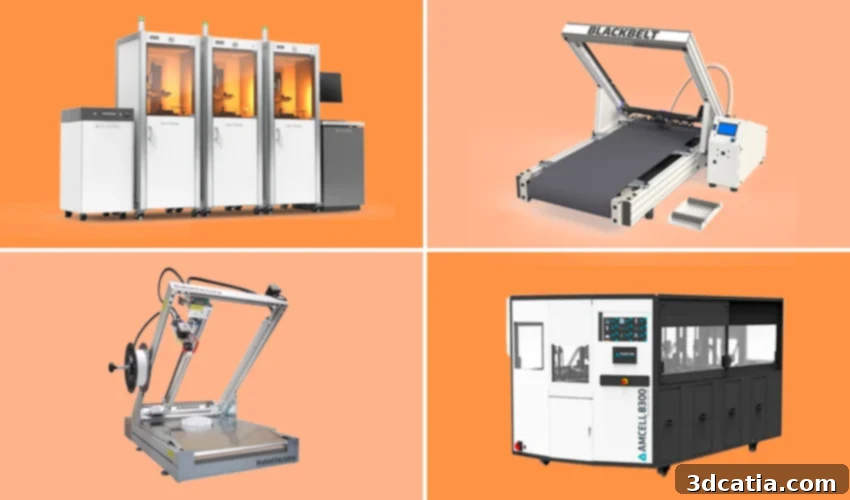
The Future of Production: Exploring Cutting-Edge Continuous 3D Printing Solutions
In the rapidly evolving landscape of additive manufacturing and the industrial sector, the demand for automation and uninterrupted production is more critical than ever. Forward-thinking companies are continuously innovating, developing sophisticated solutions to streamline workflows and integrate powerful 3D printers capable of operating continuously, often throughout multiple shifts. A core concept in achieving this efficiency is the incorporation of assembly line principles directly into the printing platform, enabling the production of exceptionally long components or high-volume series of smaller parts. Beyond this, a myriad of other inventive approaches exists to facilitate truly continuous 3D printing. These advanced automated manufacturing systems integrate printing, post-processing, and material handling, ensuring seamless production cycles without manual interruptions. This comprehensive guide provides an in-depth look at the leading technologies and systems currently available on the market that empower continuous 3D printing. Join us as we explore these innovations, presented alphabetically by manufacturer, to understand how they are revolutionizing industrial additive manufacturing.
Pioneering Continuous 3D Printing: A Manufacturer Showcase
3D Systems – DP Polar: Revolutionizing Production with Rotative AM
DP Polar, a German startup that previously featured on lists of continuous 3D printer innovators, was strategically acquired by industry leader 3D Systems in the fall of 2022. Far from being sidelined, DP Polar’s groundbreaking designs have been further developed, with their latest printer and technology currently in the early access stages under the 3D Systems umbrella. This acquisition has significantly advanced DP Polar’s remarkable High-Speed Rotative AM (HSR AM) technology. The fundamental principle behind HSR AM is a high-speed, continuously rotating build platform, ingeniously designed with separable, interchangeable segments. This innovative architecture ensures a constant output, eliminating the traditional pauses associated with build plate changes. Furthermore, the system boasts integrated technologies that allow for seamless interaction with Enterprise Resource Planning (ERP) systems, significantly enhancing quality assurance and operational transparency. Both pre- and post-processing elements are fully automated within the DP Polar system, minimizing human intervention. From material acquisition and precise part orientation to slicing and final part removal, the DP Polar is engineered for autonomous operation, requiring minimal manual interaction. Utilizing an inkjet-based 3D printing system, its exceptional build speed facilitates genuine mass production of intricate or specialized components. This versatility extends to a wide array of materials and colors, offering unparalleled flexibility. Interested parties can find further information, including details on requesting early access, directly on 3D Systems’ official website.
3D Systems – Figure 4: The Modular Production Platform
The Figure 4, another offering from additive manufacturing giant 3D Systems, distinguishes itself not merely as a standalone 3D printer but as a comprehensive production platform. This highly modular solution allows users to combine multiple machines, referred to by the manufacturer as “configurable units.” These units can include various 3D printers or post-processing solutions, providing immense flexibility. Operated from a dedicated control cell, a user can integrate up to 16 resin printers, forming a semi-automated system designed to dramatically increase the volume of parts produced. The Figure 4’s modularization concept is central to its appeal, offering greater customization and cost-effectiveness. Users can scale up their printing capabilities precisely as needed, by simply adding more printer modules. This adaptability makes it an ideal solution for businesses looking to grow their additive manufacturing capacity incrementally. The printers are compatible with an extensive range of resin materials, including those mimicking thermoplastic and rubber-like properties, and even biocompatible materials, broadening its application across diverse industries from healthcare to consumer goods prototyping.
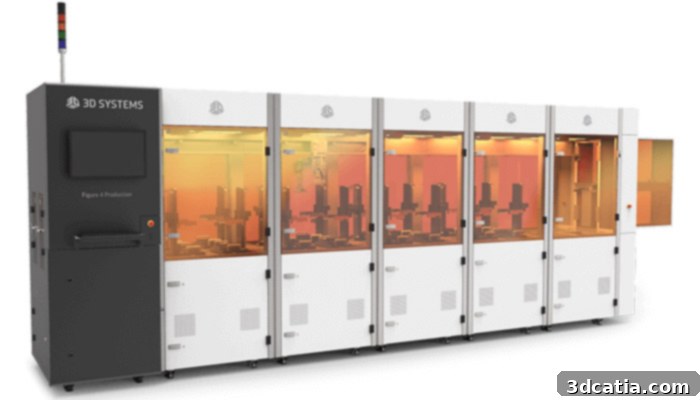
Photo credits: 3D Systems
BlackBelt3D – BlackBelt: Pioneering Infinite-Length Printing
The BlackBelt 3D printer project originated as a highly successful crowdfunding campaign, quickly surpassing its goals. While the concept of integrating a conveyor belt into a 3D printer had been discussed, the BlackBelt3D team was the first to effectively implement this innovative idea. The BlackBelt printer stands out for its unique ability to print under various angles, produce exceptionally long parts, create designs without the need for supports, and facilitate serial production. Technically, this FDM 3D printer offers a maximum print height of 340mm and a maximum print width of 340mm, coupled with an unprecedented infinite print length, making it ideal for continuous manufacturing of extended objects. Users can choose between two main configurations: the Standalone version, which provides an ergonomic printing height complete with a controller and support structure, or the Roller Table version. The latter is specifically designed for printing incredibly long parts without practical limits, featuring an integrated roller table to securely hold and guide extended prints as they emerge from the printer. Although the BlackBelt primarily works with rigid materials, an optional extension can be incorporated to enable the printing of flexible materials, further expanding its versatility and application range.
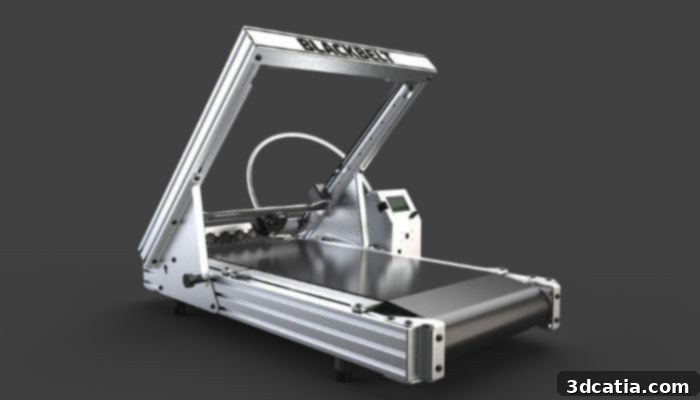
Photo credits: BlackBelt3D
Cosmyx – MIRA: The Connected Microfactory for Industrial AM
The French manufacturer Cosmyx has introduced MIRA, an innovative solution conceptualized as a fully connected microfactory dedicated to advanced industrial additive manufacturing. MIRA is an integrated system comprising multiple FDM 3D printers, all orchestrated and controlled by a sophisticated, fully automated robot. To ensure optimal production quality and consistency, MIRA is equipped with a comprehensive array of sensors. These sensors meticulously monitor critical parameters such as the quality and humidity levels within both the production and material storage areas in real time, allowing for immediate adjustments and maintaining ideal conditions. The central robotic arm is responsible for automating several key stages of the manufacturing process, including the meticulous inspection of 3D printed parts, their preparation for subsequent assembly, and efficient packaging. This holistic solution is designed to deliver round-the-clock production capabilities, effectively optimizing repetitive industrial processes and significantly accelerating production timelines. By minimizing or even eliminating the need for human intervention in these stages, MIRA not only boosts efficiency but also enhances consistency and reduces operational costs, making it a powerful tool for modern manufacturing.
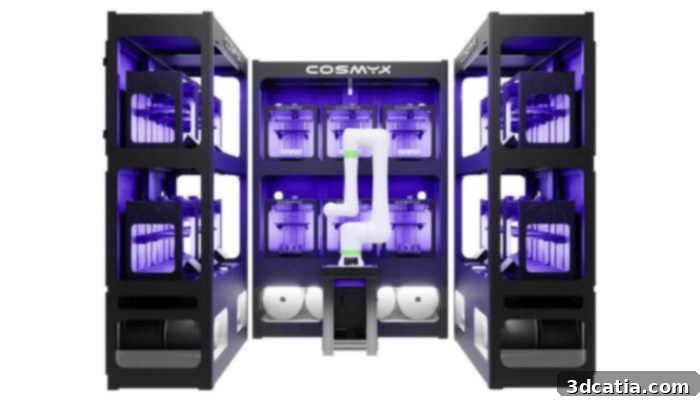
Photo credits: Cosmyx
Creality – 3DPrintMill: Accessible Infinite-Length Printing
The Shenzhen-based manufacturer Creality, renowned for making 3D printing more accessible, successfully launched a Kickstarter campaign for its innovative 3DPrintMill project some time ago and has since maintained continuous production. The device, aptly named the 3DPrintMill, is a FDM machine that brilliantly integrates a conveyor belt crafted from durable nylon. This feature is the cornerstone of its capability to manufacture pieces of virtually infinite length, with recorded prints extending up to an impressive 6 meters. Beyond its core continuous printing functionality, the 3DPrintMill incorporates several practical features for enhanced reliability and user convenience. It is capable of resuming the printing process seamlessly in the event of a power failure, preventing material waste and project delays. Furthermore, it includes end-of-filament detection, alerting users when material runs low to ensure uninterrupted operation. The printer offers a maximum printing volume of 200 x 170 x ∞ mm, providing ample space for diverse projects, though its width is slightly less than that of the BlackBelt. This 3D printer is also exceptionally well-suited for mass production scenarios that demand minimal supervision. As the nylon conveyor belt advances, finished parts automatically detach and fall into a designated container, automating the collection process and enabling true “print farm” capabilities.
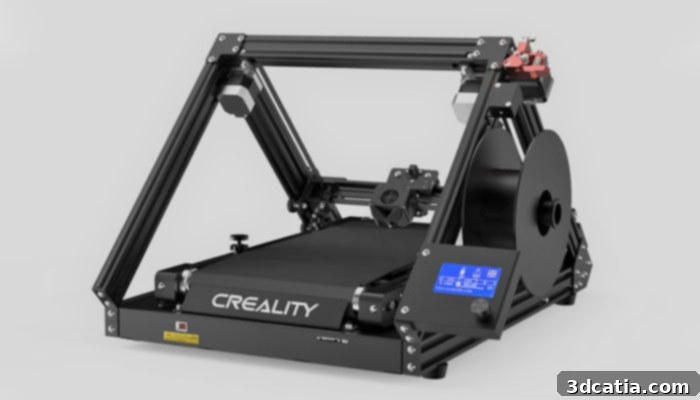
Photo credits: Creality
Formlabs – Form Auto: Automating Resin Printing Workflows
The Form Auto solution, meticulously developed by Formlabs, is not a 3D printer itself, but rather a powerful automation extension designed to streamline the resin 3D printing process. This innovative accessory significantly automates the workflow by automatically detaching finished parts from the build platform and initiating the next print job without manual intervention. Form Auto is specifically engineered for compatibility with Formlabs’ popular Form 3 and Form 3+ machines, seamlessly integrating into existing setups. After parts are removed, they are collected in a robust, UV-resistant tray, which can then be directly transferred to a Form Wash unit to commence the post-processing phase. This automated workflow dramatically reduces idle time for the 3D printers, thereby ensuring a continuous production flow. By handling the repetitive tasks of part removal and print initiation, Form Auto grants operators greater freedom, allowing them to focus on other critical aspects of the production process or manage multiple machines more efficiently. This enhancement is vital for scaling up production and maximizing the throughput of Formlabs’ resin printers.
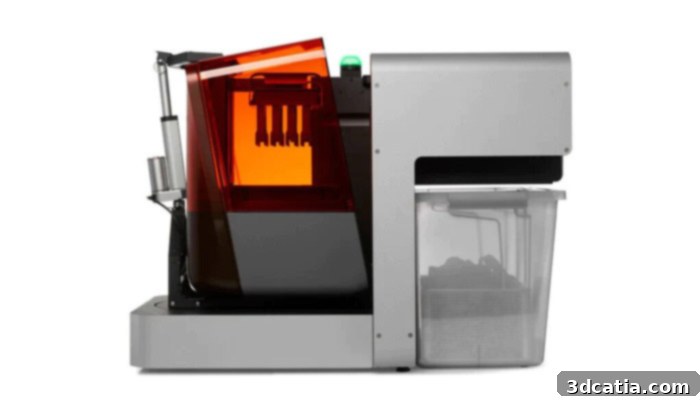
Photo credits: Formlabs
iFactory – iFactory One: Desktop Continuous FDM
The German startup iFactory has made a name for itself as a manufacturer of innovative desktop 3D printers leveraging FDM technology. In 2020, they introduced the iFactory One, a notable conveyor belt 3D printer designed for continuous operation. This machine offers the distinct advantage of 3D printing parts of virtually any length, making it perfect for high-volume production without interruptions. It stands as one of the few desktop 3D printers on the market to feature a conveyor belt build plate, a key attribute that enables its continuous production capabilities. Consequently, its effective build volume is described as 180 mm x 290 mm x infinity (in length). In terms of technical specifications, the iFactory One is equipped with a 0.4 mm exchangeable nozzle capable of reaching temperatures up to 260 degrees Celsius, allowing for a wide range of materials. It can print at an impressive speed of 200 mm/s, ensuring efficient production. The printer is compatible with a comprehensive selection of popular FDM filaments, including PLA, PETG, PC, TPU, NYLON, and ABS, offering versatility for various applications and material properties.
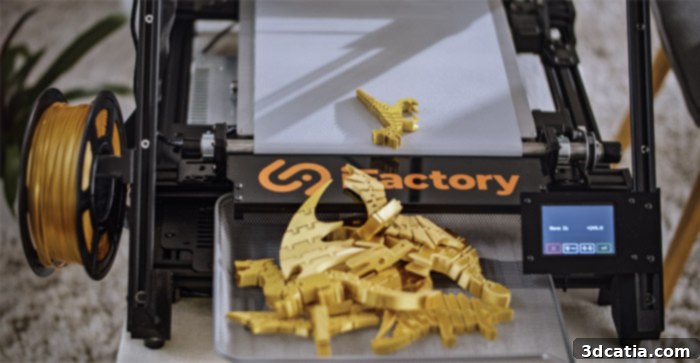
Photo credits: iFactory
HP – HP Jet Fusion 4200: Industrial Multi Jet Fusion for Batch Production
The HP Jet Fusion 4200 is a powerful industrial 3D printer, particularly well-suited for functional prototyping and small-to-medium series production. Its versatility is highlighted by customizable printing modes, allowing users to prioritize specific properties such as mechanical strength, functional performance, aesthetic qualities, precision, or overall speed, depending on the application’s requirements. The HP Jet Fusion 4200 incorporates an advanced, integrated quality control system, with real-time results conveniently displayed on the printer’s intuitive touch screen. Its robust connectivity options enable comprehensive remote control and monitoring, crucial for efficient industrial environments. A standout feature is its layer-by-layer thermal control system, which allows for predictive voxel-by-voxel corrections during the print process, ensuring exceptional accuracy and part consistency. The machine also includes automated systems for unpacking and material collection, as well as mechanisms that automatically mix and load materials, significantly reducing manual labor. Furthermore, a rapid cooling module is integrated to accelerate the post-processing phase. For truly continuous 3D printing with the HP Jet Fusion 4200, a configuration of two HP Jet Fusion 3D manufacturing units is typically recommended. This setup allows one unit to be automatically evacuated for cooling immediately after a print job is complete, while the other begins a new print, ensuring an uninterrupted workflow and maximizing throughput.
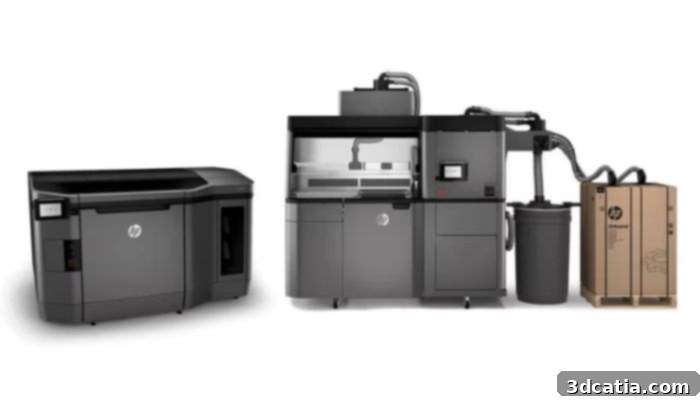
Photo credits: HP
Mosaic Manufacturing – Array: The Automated Print Farm for High-Performance Polymers
From Toronto-based 3D printing innovator Mosaic Manufacturing, the Array stands as a testament to automated production, built upon three core pillars of functionality: high throughput, significantly reduced cost, and minimal downtime. This sophisticated cabinet system houses four Element / HT 3D printers, each meticulously designed to support up to eight different materials. This translates to a remarkable total of 32 material options across the entire system, including advanced, high-performance polymers such as PEEK or PEKK, expanding its capabilities for demanding industrial applications. Complementing the printing units is an integrated storage cart specifically designed for the organized placement of finished prints. The automation process within the Array is engineered to continuously print across up to 40 separate print beds, ensuring sustained productivity. A highly intelligent robotic arm operates discreetly behind the scenes, performing critical tasks automatically: it replaces finished print beds with fresh ones, efficiently shuttles completed products to the storage cart, and even manages material replacement when spools run out. Mosaic claims that the overall level of automation provided by this robotic setup can increase throughput tenfold and reduce the cost per part by up to 95%, depending on the specific material type and application. To facilitate seamless operation and workflow management, Mosaic provides its intuitive Canvas management software. Furthermore, underscoring their commitment to quality and customer success, Mosaic dispatches specialists to clients for comprehensive setup and user training, ensuring a smooth transition up to and including the first mass-scale production runs. Pricing information for the Array is available upon request from Mosaic Manufacturing’s website, reflecting its tailored industrial solutions.
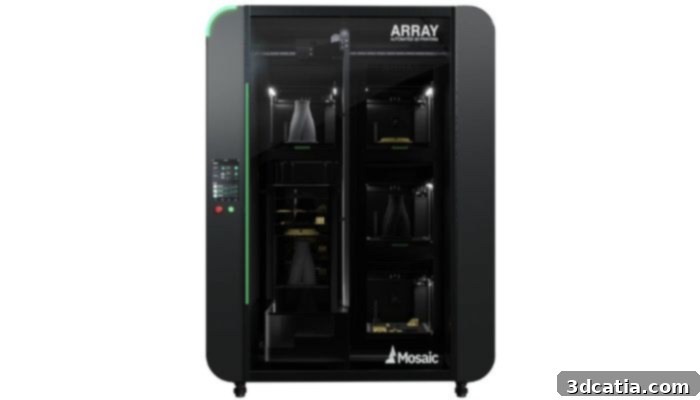
Photo credits: Mosaic
PowerBelt3D – Ender EZ Belt: DIY Continuous Printing for Makers
The Ender EZ Belt represents an innovative and accessible DIY FDM 3D printer solution from the American manufacturer PowerBelt3D, specifically designed to enable continuous printing for makers and hobbyists. The core concept behind the Ender EZ Belt project was to significantly upgrade the popular Ender-3 printer, transforming it into a fully automated continuous production machine through the integration of a specialized sliding print bed. The development of the Formula32 sliding print bed was a meticulous process, involving 28 months of rigorous trial and error to create an inexpensive yet remarkably durable solution. This open-source project is ideal for the maker community, providing a pathway to build a complete continuous 3D printer at a highly affordable cost, typically ranging from $250 to $450, depending on the sourcing of individual components. This accessibility allows a broader range of users to experiment with and benefit from the efficiencies of continuous 3D printing, fostering innovation at a grassroots level. The Ender EZ Belt empowers users to move beyond single-print limitations, opening up new possibilities for batch production and automated part generation in their workshops.
Prusa – Prusa Pro AFS: The Automated Farm System for Prototyping and Small Batches
Prusa Research, founded by Josef Průša as a modest one-man venture, has burgeoned into one of the most recognized and respected names in the global 3D printing industry. Established in 2009 in Prague, Czech Republic, the company swiftly ascended to become a leading force in 3D printing technology. The Prusa Pro AFS (Automated Farm System) is their cutting-edge solution, offering a stand-alone farm system specifically engineered for the rapid creation of prototypes and efficient production of small batches. It features an exceptionally user-friendly interface and an intuitive touch screen, making it accessible and effective for users of all experience levels, from beginners to seasoned professionals. The Prusa Pro AFS boasts several significant advantages over conventional FDM machines. Notably, it offers the ability to commence production almost immediately upon loading a file, drastically reducing setup times. It supports a wide and diverse range of compatible materials, providing flexibility for various applications. Furthermore, its design prioritizes easy maintenance, ensuring long-term reliability and minimizing operational downtime. This system embodies Prusa’s commitment to delivering robust, user-centric, and highly efficient 3D printing solutions for demanding professional environments.
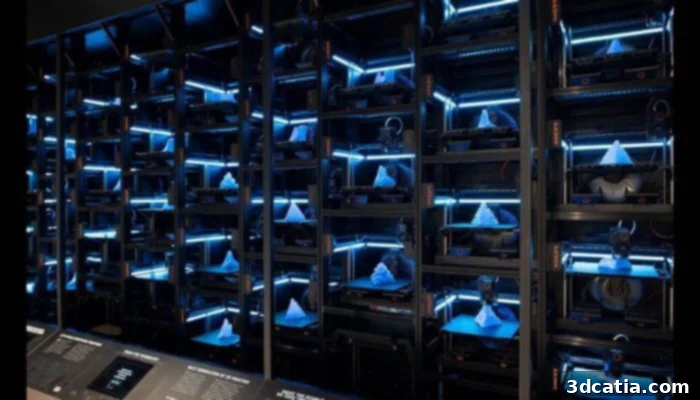
Photo credits: Prusa
RobotFactory – Silver Belt / Sliding-3D: Inclined Extrusion for Continuous Parts
The Italian company Robot Factory, a respected manufacturer of 3D printers since 2011, offers innovative solutions for continuous printing. One of their flagship models is the Silver Belt, an FDM kit machine that ingeniously features a 45° inclined extruder. This specific angle is a crucial design element, enabling continuous, support-free printing by allowing parts to gradually detach from the print bed as they are completed. Regarding the 3D printer’s capabilities, it boasts a generous printing volume of 270 x 300 mm on the XY axis, and critically, there is no inherent length limit on the Z-axis due to the inclined conveyor belt design. According to the manufacturer, assembling the Silver Belt kit is designed to be quick and straightforward, empowering users to easily design and produce multiple serial parts or exceptionally large objects with great efficiency. For those who prefer a ready-to-use solution, Robot Factory also provides the equivalent version, the Sliding-3D, which comes pre-assembled, offering convenience without compromising on the continuous printing capabilities.
Stratasys – Continuous Build: Scalable FDM Production with Reliability
Stratasys, a recognized global leader in 3D printing and additive solutions, materials, and services, offers a highly sophisticated Continuous Build 3D printer. This system is designed with a scalable print capacity, capable of producing parts continuously across a grid of modular build units. This innovative architecture ensures uninterrupted production without sacrificing FDM technology’s renowned reputation for repeatability and reliability. Stratasys asserts that their Continuous Build 3D printer can effortlessly print anywhere from a single part to thousands of parts, all without interruption. The system is equipped with automatic print preparation and setup, managed efficiently through its proprietary SKYLAB Software, streamlining the workflow and minimizing manual intervention. The 3D printer is compatible with robust ABS materials and offers a build size of 12 cm³. In addition to their FDM solutions, Stratasys has also developed the J55, a state-of-the-art PolyJet 3D printing solution. The J55 features a unique rotating platform paired with a stationary printhead, which optimizes print efficiency and quality. Its distinctive printing tray is intelligently divided into an active printing area and a separate transfer zone, further enhancing its continuous operation capabilities for highly detailed, multi-material prints.
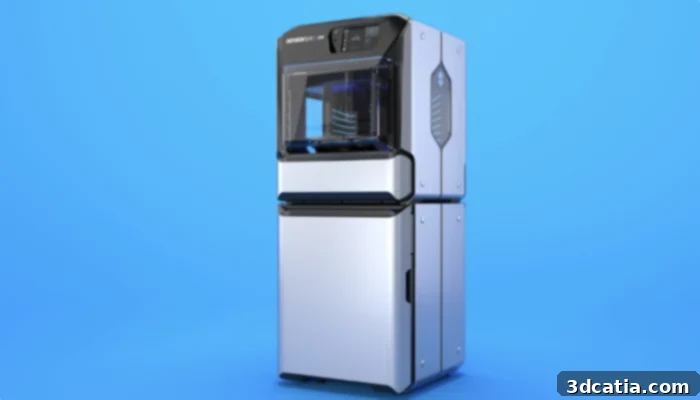
Photo credits: Stratasys
Tiertime – X5: Automated Small Batch Production with Multiple Build Beds
Tiertime, a prominent Chinese company, gained early recognition for its production of reliable 3D printers and solutions primarily geared towards prototype manufacturing. Their X5 model is a distinctive printer that comes equipped with a total of twelve individual print beds. This clever design allows the X5 to automatically position up to eight print beds onto its build platform, and crucially, to reload them dynamically during the printing process. As a result, the X5 excels at enabling continuous 3D printing of small batches, minimizing downtime between jobs. Furthermore, the print jobs can be entirely independent of each other, allowing for concurrent commissions from different users or departments to be processed sequentially. The X5 intelligently manages and continuously processes these jobs in a queue, ensuring maximum efficiency. Operating at an impressive maximum speed of 200 mm/sec, the X5 is capable of printing small parts with precise dimensions of 180 x 230 x 200 mm. The underlying process is based on extrusion, specifically Melted Extrusion Modeling (MEM), a robust FDM-like technology. For enhanced safety and to mitigate the release of toxic emissions, the Tiertime X5 is thoughtfully equipped with a dual Hepa and activated carbon filter system, making it suitable for various working environments.
Triditive – AMCELL 8300: Robotic Cell for Mass Production of Complex Parts
The AMCELL 8300 3D printer from the innovative Spanish startup Triditive represents a state-of-the-art robotic cell specifically engineered for industrial additive manufacturing. It is meticulously designed for the mass production of highly complex, precise finished parts, fulfilling the stringent demands of advanced manufacturing. When integrated with Triditive’s proprietary EVAM software, the AMCELL 8300 transforms into a comprehensive platform dedicated to mass production. This powerful combination allows for sophisticated management of manufacturing orders, real-time monitoring of processes, and precise control over raw materials, ensuring a fully optimized workflow. Automation is a core principle of the AMCELL 8300; calibration of each print head is entirely automated, as is the crucial ejection of printed parts and their subsequent transfer to the manufacturer’s automatic storage module, TRACED. Part traceability is also rigorously ensured through these integrated features, guaranteeing the success of continuous 3D printing operations. Measuring an imposing 3.4 x 2 x 2 meters, the AMCELL 8300 boasts an impressive annual capacity of printing 8 tons of metal. It can manufacture parts over an area extending up to 300 mm, with a maximum height of 350 mm. With a versatile nozzle diameter range from 0.4 to 0.8 mm, the AMCELL 8300 is capable of printing layers with a minimum height of just 30 micrometers, enabling exceptional detail and surface finish. The system features 8 robots working in unison to manage the printing process. Its heated enclosure incorporates an advanced temperature control system and a sophisticated filter mechanism, while the printing plate can reach temperatures up to 150°C to accommodate a variety of demanding materials. The 3D printer is compatible with a wide range of polymer materials and advanced composites, making it an incredibly versatile solution for industrial-scale additive manufacturing.
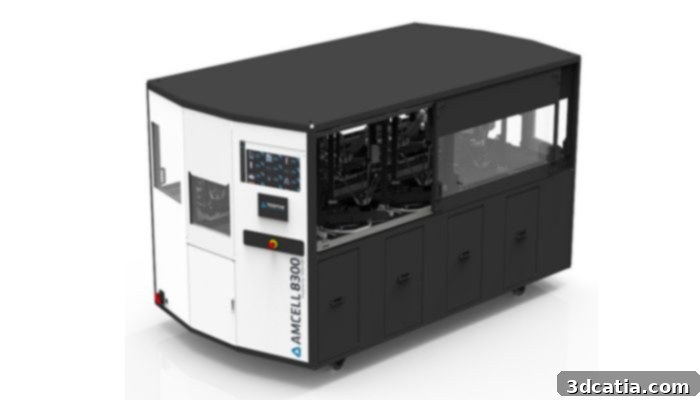
Photo credits: Triditive
Voxeljet – VX1000 HSS: Economical Polymer Production with High-Speed Sintering
The VX1000 HSS from Voxeljet is a high-performance industrial polymer printer engineered to serve as an economical and powerful additive alternative to traditional injection molding. It has been meticulously designed for continuous operation in industrial production environments, making it particularly suitable for mass production in multi-shift operations. A key advantage of the VX1000 HSS is its ability to eliminate unnecessary downtimes associated with mold changes, a common bottleneck in conventional manufacturing. It offers a substantial 215-liter build volume and utilizes advanced polymer High-Speed Sintering (HSS) technology to produce high-quality components measuring up to 100 x 540 x 400 mm. While the VX1000 HSS is configured to process PA12 as its standard material, its material portfolio is expandable, allowing for other specialized materials to be added after rigorous qualification, offering future flexibility for diverse applications. The VX1000 HSS is an ideal solution for the production of sophisticated polymer components on an industrial scale, efficiently handling small and medium batch sizes, and is also perfectly suited for rapid prototyping. Its automated system facilitates continuous printing, ensuring consistent output and significant operational efficiencies for demanding industrial workflows.
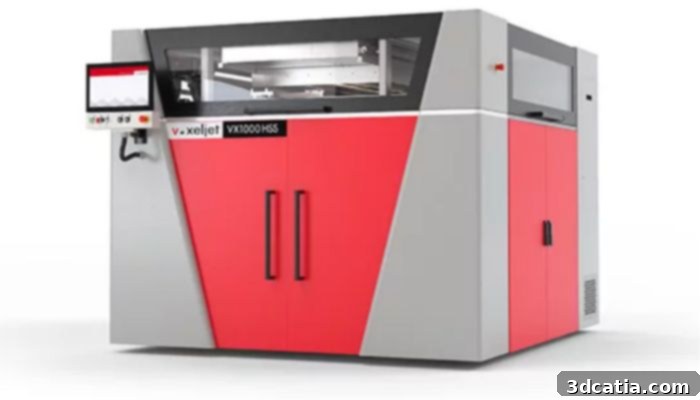
Photo credits: Voxeljet
Conclusion: The Future is Automated and Continuous
The innovations showcased above clearly demonstrate the profound shift occurring within additive manufacturing. Continuous 3D printing solutions are no longer a futuristic concept but a tangible reality, driving industrial automation and efficiency to unprecedented levels. These technologies offer numerous advantages, including significantly increased throughput, reduced labor costs, enhanced consistency in part quality, and the unparalleled ability to produce complex geometries or exceptionally long parts without interruption. From conveyor belt systems and modular production platforms to fully robotic microfactories and intelligent print farm solutions, manufacturers are pushing the boundaries of what’s possible. As these systems continue to evolve, they promise to further revolutionize prototyping, small-batch production, and ultimately, true mass customization in industrial settings, making “lights-out” manufacturing a more achievable goal. The future of manufacturing is undeniably intertwined with the continuous and automated capabilities of advanced 3D printing.
What are your thoughts on these groundbreaking continuous 3D printing solutions and their potential impact on manufacturing? We invite you to share your insights in a comment below or join the conversation on our LinkedIn, Facebook, and Twitter pages! Don’t forget to sign up for our free weekly Newsletter here to receive the latest 3D printing news directly in your inbox. You can also find all our engaging videos on our YouTube channel for more in-depth content.