
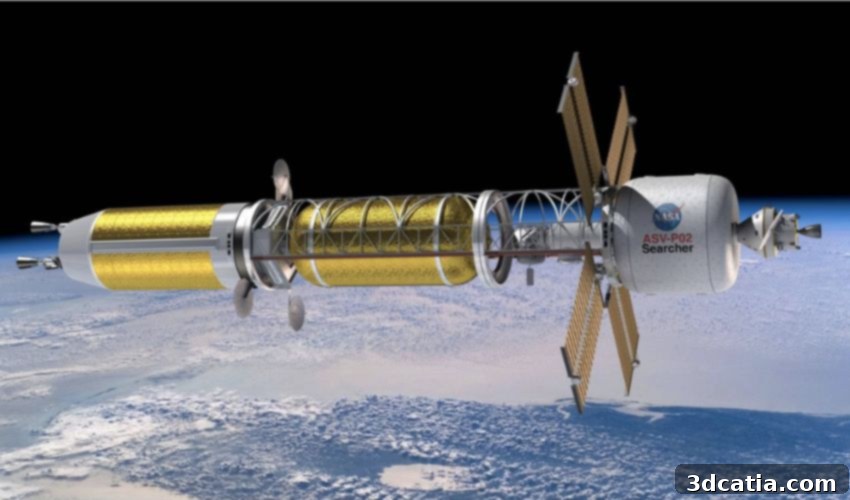
Advancing Deep Space Travel: UK Space Agency Invests in 3D Printed Nuclear Propulsion
The future of deep space exploration is increasingly reliant on innovative technologies that promise faster, more efficient, and more sustainable journeys. In a significant move highlighting this commitment, the UK Space Agency is making strategic investments in several pioneering projects designed to push the boundaries of space travel. Among these ambitious initiatives, the application of advanced 3D printing technologies stands out as a critical enabler. Researchers at the esteemed University of Bangor in Wales have been awarded a substantial £200,000 (approximately $240,000 USD) from the UK Space Agency’s Space Exploration Fund. This vital funding is earmarked for the development of a cutting-edge nuclear thermal fuel system and its associated thermal-based characterisation. This specific grant forms part of a larger £1.6 million funding package, meticulously distributed across various high-impact space projects, underscoring the UK’s strategic vision for its role in the global space sector.
At the heart of the University of Bangor’s project is a crucial objective: to rigorously test the performance and durability of novel metallic and ceramic zirconium-containing nuclear fuels. These advanced materials hold immense potential for use in nuclear thermal propulsion (NTP) systems – a revolutionary method designed to accelerate spacecraft and artificial satellites with unparalleled efficiency. Unlike conventional chemical rockets that rely on the combustion of propellants, NTP systems leverage the immense energy released from nuclear fission to heat a propellant (typically hydrogen) to incredibly high temperatures. This superheated gas is then expelled through a nozzle, generating thrust. The primary advantage of NTP lies in its significantly higher specific impulse, meaning it can generate more thrust per unit of propellant mass, leading to shorter transit times for missions to distant destinations like Mars and beyond.
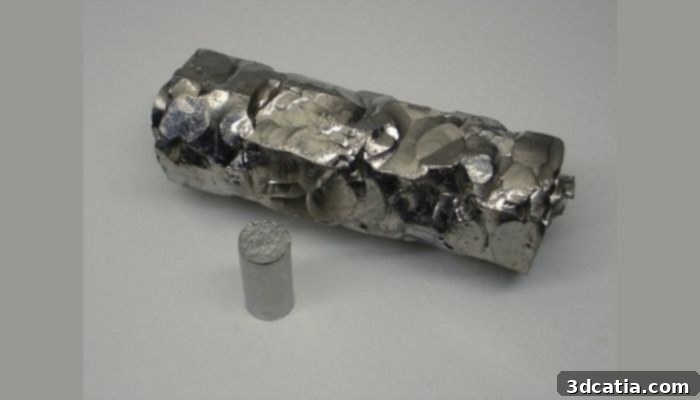
Zirconium, tested in the project, is a common component of nuclear fuels. (Photo credit: Refractory Metal org)
The integration of Additive Manufacturing (AM), commonly known as 3D printing, is a game-changer for this project. As highlighted in the official press release, the unparalleled benefit of AM lies in its ability to manufacture highly intricate configurations and complex designs that would be either impossible or prohibitively difficult to achieve using traditional manufacturing methods. For nuclear thermal propulsion systems, this capability is particularly critical. Fuel elements and reactor components often require highly precise geometries, internal cooling channels, and optimized structures to maximize heat transfer efficiency and ensure structural integrity under extreme conditions. 3D printing allows engineers to design and produce these components with unprecedented freedom, enabling rapid prototyping, iterative design improvements, and the creation of parts tailored for optimal performance in the demanding environment of space. Zirconium, a material known for its high melting point and neutron transparency, is ideally suited for nuclear fuel applications, and its ability to be precisely shaped via AM opens new avenues for enhancing propulsion system performance.
George Freeman, the Minister of State with responsibility for Space at the new Department of Science, Innovation and Technology, expressed his enthusiasm for the project’s potential impact on UK innovation and aerospace research. “Space is the ultimate frontier, laboratory, and technology testbed. The UK’s long history of leadership in deep space science and exploration is key to both understanding our solar system and the origins of life, and creating opportunities for our high-growth SpaceTech sector,” he stated. His remarks underscore the strategic importance of investing in cutting-edge research and development, not only for scientific advancement but also for bolstering the UK’s position as a global leader in the rapidly expanding space economy. Such investments are vital for fostering a vibrant ecosystem of innovation, attracting talent, and generating high-value jobs within the UK’s burgeoning space industry, driving economic growth and technological sovereignty.
This visionary project at Bangor University is by no means an isolated application of 3D printing in the aerospace and space sectors. Additive manufacturing has already carved a significant niche in these demanding fields, demonstrating its transformative potential across various applications. As of writing, one of the most prominent examples is Relativity Space, a company that has pushed the boundaries of what’s possible with 3D printing. They were preparing for the historic lift-off of their entirely 3D-printed rocket, the Terran 1, from Cape Canaveral in Florida. This test mission, aptly named GLHF (Good Luck, Have Fun), aimed to validate their innovative manufacturing approach. A staggering 90% (by mass) of the Terran 1 rocket was created using advanced 3D printing techniques, showcasing the technology’s capacity for producing large, complex structures with remarkable speed and reduced part count. This pioneering effort by Relativity Space serves as a powerful testament to the reliability and effectiveness of additive manufacturing for critical, flight-ready components, inspiring a new generation of aerospace engineers and manufacturers.
Beyond rockets, 3D printing plays an increasingly vital role in various facets of space exploration. It enables the creation of lightweight and optimized satellite components, enhances propulsion system efficiency through intricately designed engine parts, and even holds the promise of on-demand manufacturing and repair capabilities for future lunar or Martian bases. The ability to print tools, spare parts, or even entire habitats from local resources could revolutionize the logistics and sustainability of long-duration space missions. This shift towards in-situ resource utilization (ISRU) powered by additive manufacturing is seen as a key step towards humanity’s permanent presence beyond Earth.
Furthermore, the application of 3D printing extends significantly into the broader nuclear sector, which directly aligns with the focus of the UK Space Agency’s investment. Across the USA, Europe, and indeed the world, additive manufacturing has found numerous applications in the creation of durable, precision-engineered end parts for critical nuclear infrastructure. This includes components for advanced nuclear reactors, complex steel fuel assembly components, and parts for safety systems. The nuclear industry demands materials with exceptional integrity, high temperature resistance, and resistance to radiation, making AM an ideal candidate for producing components that meet these stringent requirements. 3D printing allows for the manufacture of complex internal geometries that can improve cooling efficiency in reactors, reduce material waste in production, and potentially shorten the manufacturing lead times for vital parts, ultimately enhancing the safety, efficiency, and cost-effectiveness of nuclear power generation. The research into zirconium fuels for space propulsion could, therefore, yield valuable insights and technological advancements with dual-use applications, benefiting both space exploration and terrestrial nuclear energy solutions.

The CEO of the UK Space Agency, Dr Paul Bate, on a visit to the Space Park Leicester (second left)
The investment by the UK Space Agency into these groundbreaking projects, particularly those leveraging additive manufacturing for nuclear thermal propulsion, marks a significant step forward in the quest for advanced space exploration. By fostering research into next-generation propulsion systems, the UK is not only contributing to global scientific knowledge but also positioning itself at the forefront of technological innovation. Such advancements are crucial for enabling faster, safer, and more ambitious missions to the Moon, Mars, and beyond, opening new frontiers for human discovery and scientific endeavor. The potential for nuclear thermal propulsion to drastically reduce travel times to Mars, for instance, could mitigate risks associated with long-duration spaceflight, such as radiation exposure for astronauts, and simplify logistical challenges for crewed missions. This strategic focus on high-impact technologies ensures that the UK remains a key player in shaping the future of humanity’s ventures into the cosmos.
You can find more detailed information about the UK Space Agency’s wider funding initiatives and press releases by following this link: HERE. This further illustrates the comprehensive nature of the UK’s commitment to exploring innovative solutions for space travel, including the potential utilization of lunar resources, which aligns perfectly with the long-term vision of sustainable space exploration.
What are your thoughts on the UK government’s substantial investment in space exploration, particularly its focus on cutting-edge additive manufacturing technologies for advanced propulsion systems? We invite you to share your insights and comments below, or engage with us on our social media platforms. Join the conversation on our LinkedIn, Facebook, and Twitter pages! For the very latest news and updates from the world of 3D printing, don’t forget to sign up for our free weekly Newsletter here, delivered straight to your inbox. You can also discover all our informative and engaging videos by visiting our YouTube channel.
*Cover photo: This conceptual spacecraft is powered by a nuclear thermal propulsion system (Photo credit: NASA)