

Revolutionizing Space Exploration: UW-Madison Pioneers Zero-Gravity 3D Printing of Functional RAM
Student engineers at the University of Wisconsin-Madison have achieved a monumental breakthrough, making a giant leap toward enabling truly self-sustaining space exploration. In a feat that promises to redefine the future of off-world missions, the team successfully 3D printed functional Random Access Memory (RAM) devices directly in a zero-gravity environment. This pioneering accomplishment, realized in March 2024, represents a significant advancement for long-duration space missions, addressing critical challenges related to in-space manufacturing and component repair. The ability to produce essential electronics on demand, far from Earth’s protective embrace, is a cornerstone for humanity’s sustained presence in the cosmos, paving the way for more ambitious and autonomous deep-space endeavors.
The inherent challenges of manufacturing in space have long posed a formidable barrier to extended human presence beyond Earth. Traditional 3D printing techniques, which form the backbone of modern additive manufacturing, fundamentally rely on gravity for their operation. These methods typically function by extruding material through a nozzle, a process where gravity plays a crucial role in directing the flow and ensuring precise deposition. This reliance renders them incompatible with the microgravity conditions prevalent in space environments, such as aboard the International Space Station or during deep-space transits. To surmount this fundamental hurdle, the visionary UW-Madison team, under the expert leadership of Assistant Professor Hantang Qin from the Department of Industrial and Systems Engineering, meticulously developed a groundbreaking approach known as electrohydrodynamic (EHD) printing. This innovative method completely re-imagines the mechanics of additive manufacturing, eliminating the need for gravity and opening up unprecedented possibilities for in-space production.
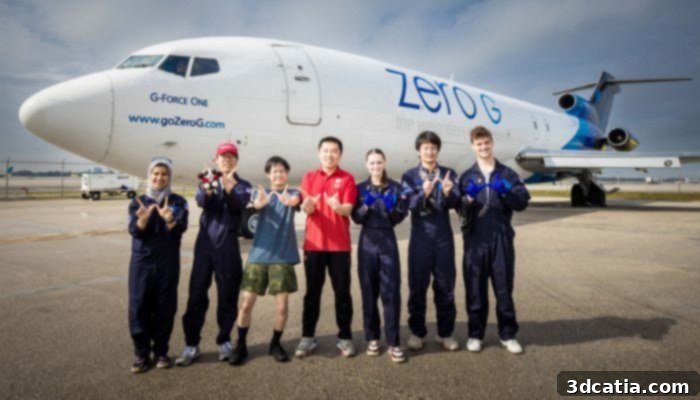
(Photo Credits: UW-Madison)
The sophistication of EHD printing lies in its ingenious utilization of electrical forces to manipulate liquid materials with extreme precision. Unlike conventional extrusion, this technique employs a powerful electrical field to propel minuscule droplets of liquid ink through an ultra-fine nozzle, measuring an astonishingly small 30 micrometers in diameter. This microscopic aperture is key to the system’s success in a weightless environment. Professor Qin elaborated on this critical mechanism, stating, “Under this small scale, the surface tension will prevent the liquid from flowing out from this nozzle. And then we apply this electrical force to break out of this surface tension force.” Essentially, the natural cohesive forces (surface tension) within the liquid at such a tiny scale are strong enough to hold the material within the nozzle, preventing unwanted leakage in zero gravity. The carefully calibrated electrical force then precisely overcomes this surface tension, allowing for controlled and accurate deposition only when printing is required. This innovative control over material flow ensures unparalleled precision and functionality, even in the most challenging microgravity conditions, making it an ideal candidate for future in-space electronics manufacturing.
This pioneering research, significantly funded by NASA, is driven by the imperative need to develop a robust and reliable in-space manufacturing method for critical electronic components. The focus extends beyond simple parts to sophisticated elements such as semiconductors, actuators, and sensors – components that are absolutely vital for the operation of modern spacecraft, scientific instruments, and habitats. The overarching goal is to enable true on-demand repair and fabrication capabilities, which would revolutionize mission logistics. Currently, any equipment malfunction or component failure necessitates either a costly and time-consuming return to Earth or a prohibitively expensive resupply mission. The ability to 3D print replacement parts, or even entirely new devices, in situ would eliminate the need to pre-launch every conceivable spare part, dramatically streamlining space missions. This not only reduces launch mass and costs but also introduces unprecedented flexibility and resilience, allowing missions to adapt to unforeseen circumstances and extend their operational lifetimes far beyond current limitations. Such capabilities are essential for human expansion into deep space, enabling long-duration stays on the Moon, Mars, and beyond.
To rigorously test and validate their groundbreaking EHD printing technology in a simulated space environment, the research team undertook a series of specialized parabolic flights. These unique flights, often referred to as “vomit comets,” create brief but effective periods of weightlessness by executing rapid ascents and descents, replicating the microgravity conditions of space for approximately 20-30 seconds per parabola. During their climactic final test flight, the dedicated UW-Madison engineers achieved a resounding success: they successfully 3D printed over a dozen fully functional RAM units. These initial units were created using zinc oxide, a specialized semiconducting ink, which forms the active layers of the memory device. Furthermore, the team also printed several more units with polydimethylsiloxane, a highly effective insulating polymer ink, critical for separating and protecting the electronic pathways. The entire printing process, which required meticulous manual control by skilled team members Rayne Wolf and Jacob Kocemba, showcased the remarkable precision of the EHD system. Post-flight, the printed RAM devices underwent rigorous validation in a makeshift laboratory, utilizing advanced microscopes to confirm the successful production of high-quality micro- and nanoscale structures, demonstrating the viability of zero-gravity 3D printing for complex electronics.
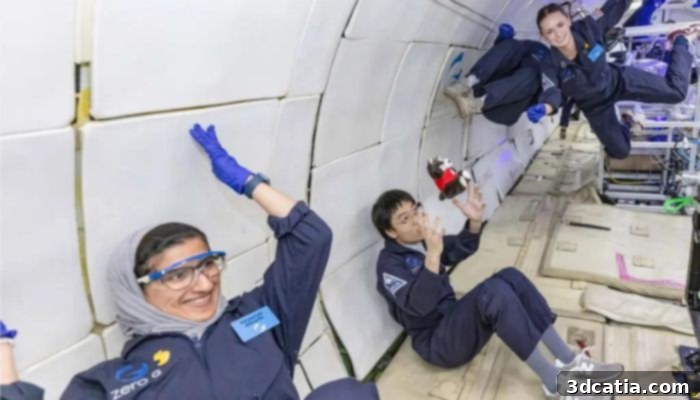
UW-Madison student engineers in zero-gravity conditions before testing. (Photo Credits: UW-Madison)
This successful demonstration of zero-gravity 3D printing of functional RAM units marks an incredibly crucial milestone in the burgeoning field of in-space manufacturing technologies. The UW-Madison team’s pioneering achievement with EHD printing paves an entirely new path for the on-demand production of essential electronic components during critical space missions. This capability is paramount for significantly enhancing the sustainability and autonomy of long-duration space explorations, making future missions to the Moon, Mars, and beyond not just possible, but more practical and safer. Moreover, this innovation directly addresses one of the most persistent practical challenges faced by astronauts: the inevitable wear and tear of sensitive equipment. By enabling immediate fabrication of replacement parts or upgrades, it ensures continuous operation of vital systems, thereby dramatically reducing mission costs and mitigating the substantial risks associated with returning to Earth for repairs or relying on costly and hazardous Earth-to-space shipments of new hardware components. This breakthrough is a foundational step towards establishing truly independent outposts in space, where humans can live, work, and explore with unprecedented freedom and self-sufficiency, truly embodying the spirit of exploration and innovation.
What are your thoughts on this groundbreaking achievement made by the dedicated engineers at UW-Madison and its implications for future space exploration? We’d love to hear from you! Let us know in a comment below or join the conversation on our LinkedIn, Facebook, and Twitter pages! Don’t forget to sign up for our free weekly newsletter here for the latest 3D printing news delivered straight to your inbox! You can also find all our compelling videos and interviews on our YouTube channel.
*Cover Photo Credits: University of Wisconsin-Madison