
Revolutionary 3D Printing Method Seamlessly Integrates Hard and Soft Materials for Next-Gen Medical Devices and Flexible Electronics
This summer marked a pivotal moment in the realm of additive manufacturing, as the University of Texas at Austin unveiled a groundbreaking innovation in 3D printing. This pioneering development holds immense potential to fundamentally transform the landscape of next-generation medical devices, sophisticated biomedical implants, and advanced flexible electronics. Researchers at UT Austin, bolstered by significant funding from key institutions including the US Department of Defense, the National Science Foundation, and the prestigious Robert A. Welch Foundation, have engineered an ingenious method. Drawing inspiration from the complex, seamlessly integrated structures found in natural materials like bone and cartilage, this technique facilitates the unprecedented integration of both hard and soft materials into a single, cohesive 3D-printed object. This remarkable capability was vividly demonstrated through the successful creation of a fully functional mini-model of a human knee joint, produced entirely with a 3D printer, showcasing the profound implications for future prosthetics and wearable technologies.
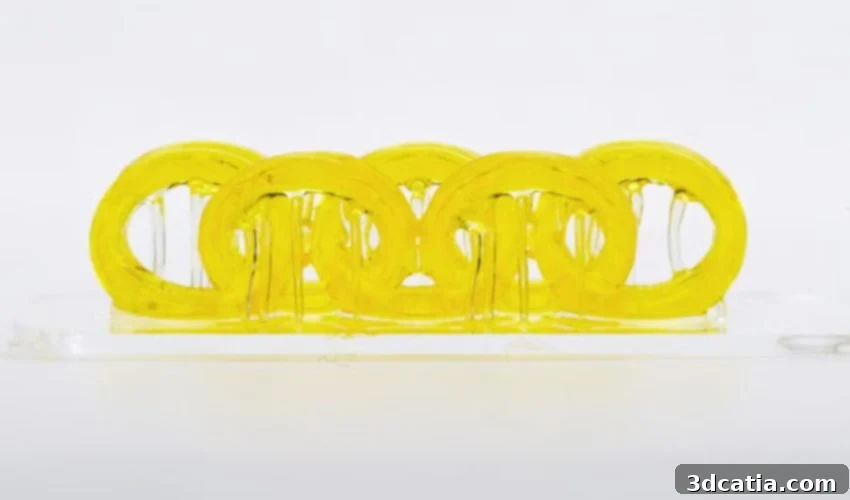
Unlike conventional 3D printing technologies that typically rely on traditional filaments, this novel method employs a highly specialized liquid resin as its primary material. The true innovation lies in how this resin is manipulated: it reacts selectively to two distinct light pulses. The process leverages ultraviolet (UV) light to induce the hardening of specific sections, creating rigid, plastic-like structures with precise mechanical properties. Simultaneously, violet light is utilized to solidify other areas into elastic, rubber-like zones, offering flexibility and resilience. This sophisticated dual-light approach allows for an incredibly controlled and gradual transition from hard to soft material within a single, continuous component, addressing a long-standing challenge in multi-material 3D printing and opening up vast possibilities for designing objects with previously unattainable functional gradients. The ability to dictate material properties at such a fine resolution is what sets this UT Austin breakthrough apart from existing techniques.
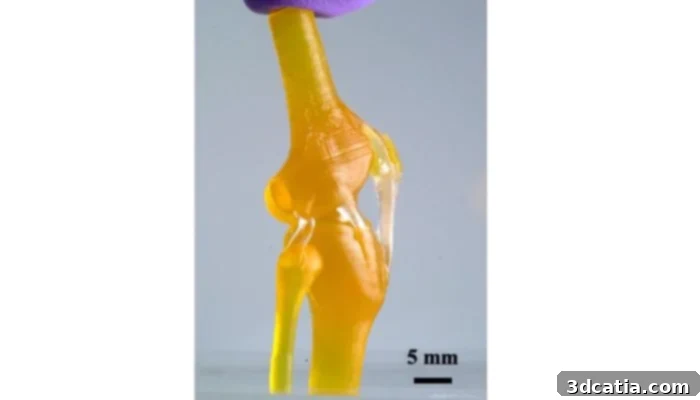
The artificial knee joint model served as the research team’s initial successful attempt to apply this innovative 3D printing method in a practical, biomechanical context.
A critical aspect of this groundbreaking process is the intelligent use of chemically cross-linked molecules. These specialized molecules are meticulously incorporated into the resin formulation to prevent common failure points, ensuring that the interfaces between dissimilar materials do not break or become structurally weak. This robust chemical bonding is fundamental to creating durable and reliable integrated structures. As Zak Page, an assistant professor at UT Austin and a lead researcher on the project, eloquently explains, “We built in a molecule with both reactive groups so our two solidification reactions could ‘talk to each other’ at the interface. That gives us a much stronger connection between the soft and hard parts, and there can be a gradual transition if we want.” This meticulous molecular engineering allows for an unprecedented level of control over the mechanical properties across the entire printed object, from rigid supports to flexible joints. The ability to achieve a truly seamless, strong, and gradual transition between hard and soft regions is what empowers the creation of highly functional and durable complex structures, mimicking the resilience and adaptability found in biological systems.
Transformative Applications and Future Prospects from UT Austin’s Innovation
The practical utility of this advanced 3D printing method has already been rigorously tested through several compelling demonstrations. One of the most significant applications involved the successful creation of a fully functional knee joint model. In this intricate structure, the artificial bones of the joint were designed to maintain crucial stability and load-bearing capacity, while the ligaments, which provide flexibility and allow for movement, were engineered to act with elastic compliance. The successful functionality of this complex model represents a monumental stride forward for biomechanical implants, offering a pathway to design and produce custom prosthetics and orthotics that more closely mimic natural body parts, improving patient comfort, mobility, and long-term durability. This proof-of-concept for the knee joint opens doors to custom-made surgical guides, organ models for pre-surgical planning, and even potentially patient-specific implantable devices.
Beyond biomechanics, the UT Austin team also ventured into the realm of flexible electronics, developing a stretchable electronic strip. This demonstration highlighted the method’s capacity to embed delicate electronic components within robust, multi-material structures. The challenge lay in ensuring that a fine gold conductor, essential for electrical conductivity, remained reliably stretchable and functional, even when integrated within harder, ligament-like sections designed for structural integrity and protection. The ability to seamlessly integrate such disparate material properties—rigid protective elements alongside highly flexible conductive pathways—is critical for the advancement of next-generation wearable technologies, smart sensors, and soft robotics where components must adapt to movement without compromising performance. This breakthrough paves the way for truly integrated electronic devices that can conform to irregular shapes and withstand repeated deformation, vastly expanding the possibilities for health monitoring, human-machine interfaces, and robotic systems.
According to the authors of the research, the UT Austin team’s novel 3D printing method offers significant advantages over previous approaches, delivering superior results with enhanced speed and efficiency. Crucially, the process is designed for ease of use and accessibility: the printer settings are remarkably simple to reproduce, and the overall implementation is inexpensive. These factors make the innovative technique readily available to a broad spectrum of users, including academic researchers, clinical hospitals, and educational institutions, fostering wider adoption and accelerating further development. Keldy Mason, a PhD student in Professor Page’s lab, emphasizes the broader economic and design implications: “This approach could make additive manufacturing more competitive for higher-volume production compared with traditional processes like injection molding. Just as important, it opens up new design possibilities.” This statement underscores the potential for this technology to not only compete with established mass-production techniques but also to unlock entirely new product designs that were previously unachievable due to material integration limitations.
The revolutionary capability to integrate both intricate biological functionality and robust mechanical properties into a single, cohesive 3D-printed object opens up a vast array of possibilities across numerous industries. From life-changing medical implants and custom prosthetics that perfectly match patient anatomy, to advanced wearable electronics that offer unprecedented comfort and functionality, and sophisticated components for soft robotics that can interact safely with delicate environments – the applications are truly enormous. This pioneering approach, characterized by its high precision, inherent scalability, and cost-effectiveness, positions the technology on the cusp of widespread practical applications. This means that these cutting-edge innovations are not just theoretical concepts but are rapidly moving towards real-world implementation, promising to redefine how we design, manufacture, and interact with complex devices. For those eager to delve deeper into the technical specifics and broader implications of this remarkable research, further detailed information is available by clicking HERE.
We invite you to share your thoughts on this groundbreaking new 3D printing method developed by the University of Texas. How do you foresee this innovation impacting the future of medicine and technology? Let us know your perspective in a comment below or join the discussion on our LinkedIn or Facebook pages! Furthermore, to stay informed about the very latest advancements in additive manufacturing, don’t forget to sign up for our free weekly Newsletter, delivering all the essential 3D printing news directly to your inbox. You can also discover a wealth of insightful videos and demonstrations on our YouTube channel. For those particularly interested in more news and developments within the medical and dental 3D printing sectors, please visit our dedicated page HERE to explore specialized content and updates.
*Photo Credits: UT Austin