
Revolutionary 3D Printed Electric Motor: Chemnitz University Pioneers Multi-Material Additive Manufacturing
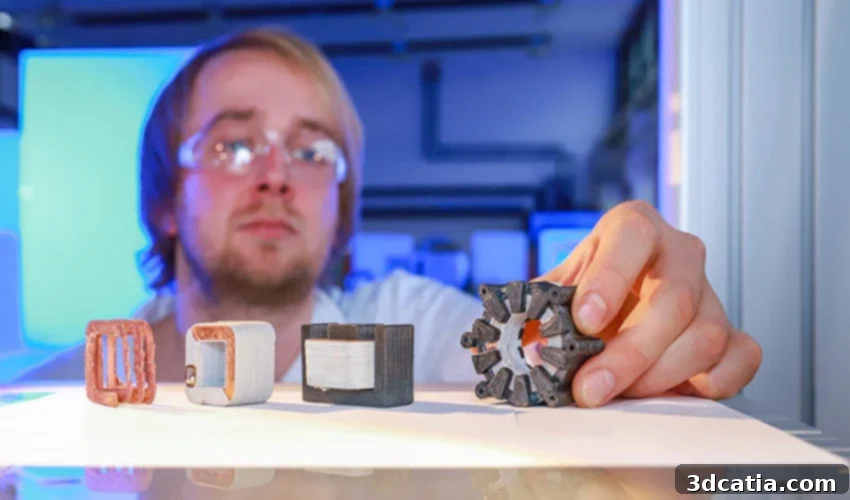
In a significant leap forward for additive manufacturing and electrical engineering, researchers at the Chemnitz University of Technology have unveiled a fully functional electric motor, meticulously crafted using advanced 3D printing techniques. This groundbreaking achievement, the culmination of two and a half years of intensive research by a dedicated team of electrical engineers, showcases the immense potential of multi-material 3D printing by combining iron, copper, and ceramics into a single, cohesive, and highly efficient electric motor. This innovative approach not only demonstrates the feasibility of creating complex electrical components additively but also pushes the boundaries of performance, especially concerning operating temperatures and power density.
The advent of additive manufacturing, commonly known as 3D printing, has already revolutionized various sectors, paving the way for novel engine concepts across diverse applications. From creating components for advanced rocket engines that propel us into space to optimizing power units for heavy-duty trucks and even developing prototypes for sophisticated jet reactors, 3D technologies consistently offer unparalleled advantages. These benefits span improved performance metrics, enhanced customization capabilities, drastically reduced manufacturing times, and often, significant cost efficiencies. The German engineers from Chemnitz University now add another remarkable milestone to this list by successfully 3D printing an electric motor composed of three distinct material types, each serving a crucial functional role.
Engineering a Multi-Material 3D Printed Electric Motor
The engineering team at Chemnitz University embarked on this ambitious project with a clear vision: to overcome the limitations of conventional electric motor manufacturing, particularly concerning thermal management and material integration. Over the last few years, their dedicated efforts have not only resulted in the creation of this functional multi-material engine but also led to the parallel development of a specialized printing filament. This proprietary filament is engineered to withstand extreme temperatures exceeding 300°C, a critical factor for high-performance electrical machines. Leveraging this advanced material, the team utilized selective laser sintering (SLS) – an additive manufacturing technique that uses a laser to selectively fuse powdered material – to precisely build the functional engine, layer by layer.
The intricate design of the 3D printed motor integrates three distinct materials, each chosen for its specific properties and contribution to the motor’s overall functionality. Copper forms the electrical conductors, responsible for generating precise magnetic fields crucial for motor operation. These conductors are strategically placed within an iron structure, which serves as the magnetic core, efficiently channeling the magnetic flux. What truly sets this innovation apart is the integration of electrical ceramic insulation. This ceramic material is meticulously incorporated to insulate the copper conductors from each other and from the iron components, preventing short circuits and ensuring efficient electrical flow. The ability to print these disparate materials concurrently and with such precision represents a major hurdle overcome in additive manufacturing, opening new avenues for complex electromechanical system design.
Enhanced Thermal Resistance and Power Density Through Ceramic Insulation
The primary objective driving this research, as articulated by Professor Ralf Werner, who spearheaded the study, was “to dramatically increase the temperature that electrical machines are capable of withstanding.” This goal directly addresses one of the most significant limitations in conventional electric motor design: the thermal breakdown of polymer-based insulation materials. Traditional insulating polymers typically degrade at elevated temperatures, thereby limiting the maximum operating temperature and, consequently, the power output of electric motors. The Chemnitz team successfully circumvented this challenge by replacing these conventional polymer-based insulations with a specially formulated ceramic material.
This innovative ceramic not only boasts superior heat resistance, allowing the motor to operate effectively in environments exceeding 300°C, but also possesses a significantly higher degree of thermal conductivity compared to its polymer counterparts. This dual advantage is transformative. The enhanced thermal conductivity means that any heat losses generated within the copper conductors can be dissipated much more quickly and efficiently. Rapid heat dissipation is crucial because it prevents overheating, a common cause of motor failure and reduced lifespan. By effectively managing thermal loads, the researchers are able to push the boundaries of current motor technology, enabling them to significantly increase the output density of electrical machines. This translates into more powerful motors in smaller packages, offering immense potential for applications where space and weight are at a premium, such as in aerospace, automotive, and high-performance industrial equipment.
Photo credits: TU Chemnitz / Jacob Müller
The Advanced Extrusion Printing Process
The sophisticated printing process developed by the Chemnitz University researchers is founded on the principle of extrusion printing. This method involves the precise, layer-by-layer deposition of highly viscous pastes. These specialized pastes are meticulously formulated and consist of fine particles of the desired materials – be it iron, copper, or ceramics – combined with appropriate binders. The binders play a crucial role in maintaining the paste’s consistency during printing and ensuring that the deposited layers adhere correctly before subsequent processing, such as sintering.
Achieving the required level of precision during the extrusion of these multi-material pastes presented a significant technical challenge. To overcome this, the research team collaborated closely with ViscoTec, a renowned specialist in high-precision dosing and dispensing technology. This partnership was instrumental in refining the extrusion process, allowing for the accurate and consistent deposition of each material layer. The ability to precisely control the flow and placement of these highly viscous, multi-component pastes is fundamental to creating the intricate internal structures of the electric motor, ensuring optimal magnetic and electrical properties. This method, combining material science with advanced dispensing technology, paves the way for the fabrication of complex devices with integrated functionalities that were previously impossible to achieve with traditional manufacturing techniques.
Future Implications and Broader Impact of Multi-Material 3D Printing
The development of this 3D printed electric motor by Chemnitz University of Technology marks a pivotal moment for advanced manufacturing. It underscores the immense potential of additive manufacturing to move beyond prototyping and into the realm of functional, high-performance end-use components, especially in complex electromechanical systems. The ability to combine conductive, magnetic, and insulating materials in a single, integrated manufacturing process opens up a plethora of design possibilities. Engineers can now envision motors with optimized geometries that are impossible to achieve through conventional winding and assembly processes, leading to greater efficiency, reduced size, and lighter weight.
The successful implementation of ceramic insulation to drastically increase temperature resistance is particularly significant. This innovation is not confined to electric motors; it could be applied to various other high-temperature electrical components, enabling new designs for power electronics, sensors, and actuators that operate in harsh environments. Such advancements are critical for emerging technologies in electric vehicles, aerospace, industrial automation, and renewable energy systems, where operating temperatures are often extreme and reliability is paramount. This research provides a tangible pathway towards creating more robust, efficient, and compact electrical machines, contributing significantly to sustainable engineering and the future of electrification.
For those interested in delving deeper into the technical specifications and detailed findings of this groundbreaking research, comprehensive information about the 3D printed engine is available on the University’s website. The publication offers further insights into the material science, printing processes, and performance metrics of this innovative motor.
What are your thoughts on this revolutionary 3D printed electric motor and its potential to reshape the landscape of electrical engineering? We invite you to share your insights and comments below, or engage with us on our Facebook and Twitter pages! For all the latest news, breakthroughs, and developments in the world of 3D printing, don’t forget to sign up for our free weekly Newsletter, delivered directly to your inbox!