
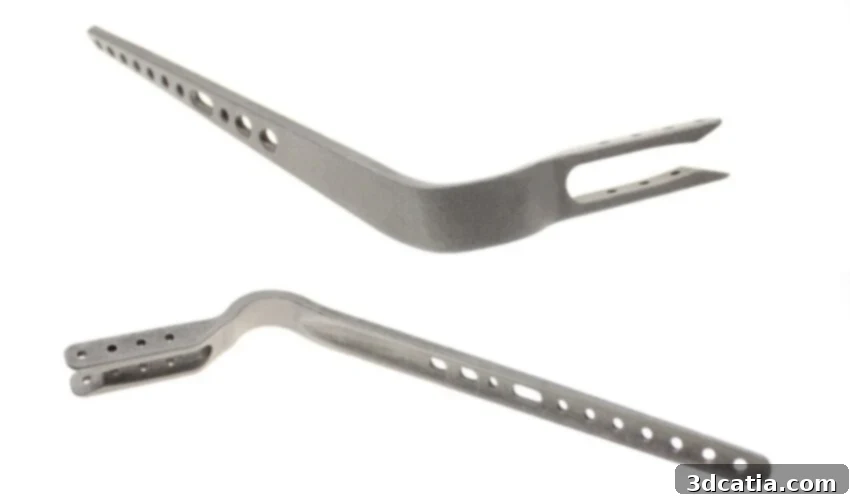
Metal 3D Printing Revolutionizes Medical Implants: A Deep Dive into Custom Shoulder Arthrodesis Plates
The rapid evolution of additive manufacturing technology has dramatically reshaped the healthcare sector in recent years. This transformative shift spans various domains, from innovative research and advanced drug development to the precise production of prostheses, implants, and sophisticated medical devices. Within this landscape, metal 3D printing stands out as a particularly disruptive force, fundamentally changing the medical industry by enabling the creation of highly customized and rapidly produced medical solutions. The inherent advantages of this technology, coupled with the strategic use of biocompatible materials such as titanium and cobalt alloys, guarantee the safety and durability critical for medical applications. Beyond patient benefits, metal additive manufacturing fosters more sustainable production practices, significantly reducing material waste, lowering manufacturing costs, and boosting efficiency through accelerated production speeds.
One of the most profound impacts of additive manufacturing in medicine is its capability to produce patient-specific components. This includes tailor-made plates, screws, and even complete prostheses and implants, each meticulously crafted to perfectly match the unique anatomical characteristics of individual patients. This level of personalization is achieved by seamlessly integrating cutting-edge technologies like 3D scanning, Computed Tomography (CT), and other advanced imaging techniques with sophisticated 3D software and high-precision 3D printers. The resulting medical products have not only demonstrated exceptional safety records but, in many instances, have proven to be more effective than traditionally manufactured alternatives, significantly accelerating the patient’s healing and recovery process. To illustrate these remarkable benefits, we delve into a recent case study focusing on the application of metal additive manufacturing for producing titanium shoulder arthrodesis plates, exploring the advantages and technical considerations involved.
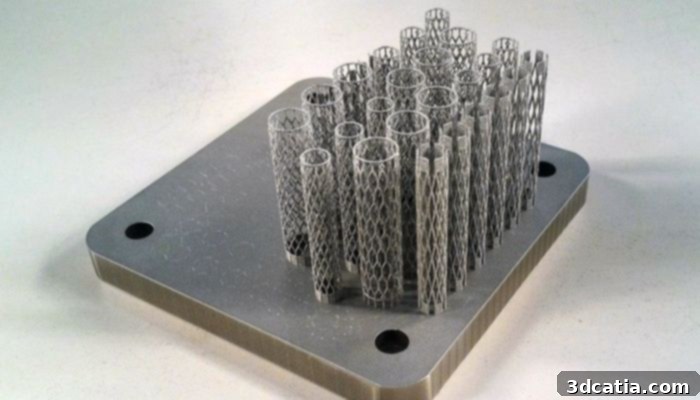
3D printing is changing the way medical implants and prostheses are produced, offering new possibilities for customization and precision.
Overcoming Challenges: Traditional vs. Additive Manufacturing for Shoulder Arthrodesis Plates
Manufacturers specializing in implants for spinal surgery, neurosurgery, and osteosynthesis frequently encounter considerable challenges when producing complex devices such as shoulder arthrodesis plates. These specialized plates are crucial for procedures involving the resection of the humeral head, often necessitated by severe shoulder ligament injuries. Traditionally, the fabrication of such intricate products presents numerous hurdles. The design and manufacturing of specialized tooling required for conventional methods are notoriously time-consuming and resource-intensive, demanding significant investment in both capital and skilled labor. Furthermore, the inherent complexity of these parts’ geometries often poses significant manufacturing difficulties. Beyond standard machining operations, traditional production frequently requires bending, a technology that often lacks the necessary precision and struggles to guarantee the high degree of repeatability essential for medical-grade implants. This can lead to inconsistencies in plate dimensions and mechanical properties, potentially impacting patient outcomes.
In a compelling demonstration of its problem-solving capabilities, Eplus3D recently showcased a case where an industrial company successfully utilized L-PBF (Laser Powder Bed Fusion) metal 3D printing technology to directly address and overcome these aforementioned manufacturing obstacles. The adoption of additive manufacturing enabled the rapid production of a fully functional prototype for a shoulder prosthesis, drastically shortening development cycles and significantly reducing the costs associated with prototyping. This method inherently bypasses many of the limitations of traditional manufacturing by building parts layer-by-layer directly from a digital design, eliminating the need for complex tooling and allowing for geometric freedom previously unattainable. This transition to additive manufacturing not only streamlines the production process but also opens new avenues for personalized medicine, where implants can be precisely tailored to each patient’s unique anatomy, leading to better fit, function, and potentially superior clinical outcomes.
Precision Manufacturing: 3D Printing Titanium Shoulder Arthrodesis Plates
For the production of these advanced shoulder arthrodesis plates, Eplus3D employed their state-of-the-art EP-M260 3D printer. This sophisticated L-PBF metal additive manufacturing machine is engineered for high performance and precision, boasting a generous print volume of 260 mm × 260 mm × 390 mm. Its versatile design supports configurations with either single or dual lasers, enhancing productivity and enabling complex builds. The EP-M260 is also capable of processing a diverse range of high-performance materials critical for various industries, including titanium alloys, stainless steel, and aluminum alloys. For this specific medical application, the material of choice was VT6 titanium alloy, a material widely recognized and certified by medical authorities for its superior biocompatibility, excellent mechanical properties, and high corrosion resistance, making it ideal for permanent implants. The intricate 3D printing process for these plates, which measured approximately 25 cm in length and featured a fine layer height of 30 μm, was completed in approximately 12 hours, showcasing the efficiency of modern additive manufacturing systems.
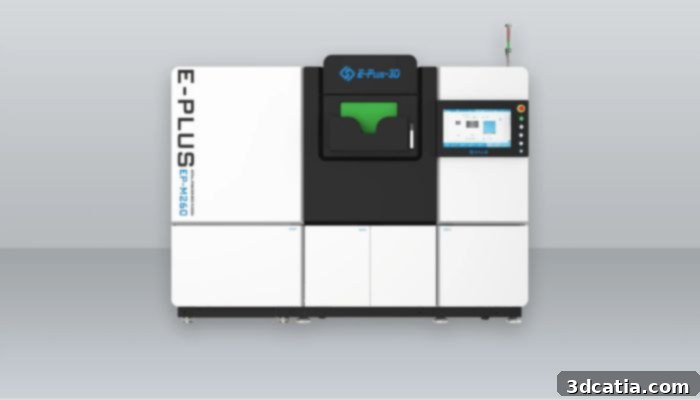
The EP-M260 3D printer from Eplus3D, a powerful tool for high-precision metal additive manufacturing.
Post-Processing for Optimal Performance
Once the 3D printing phase was complete, each titanium plate underwent a critical post-processing regimen designed to optimize its structural integrity and surface finish. The first essential step involved heat treatment, where the products were subjected to temperatures of approximately 700°C for a duration of two hours. This annealing process is crucial for relieving any residual stresses that might have accumulated within the material during the rapid heating and cooling cycles inherent to the L-PBF process. Residual stresses, if not addressed, can lead to part distortion or even premature failure in service. Following heat treatment, the necessary support structures, which are integral for preventing warping and ensuring geometric accuracy during printing, were carefully removed using specialized hand tools. The final stage of post-processing involved sandblasting the parts. This abrasive blasting technique refines the surface finish, removing any lingering impurities, smoothing rough areas, and preparing the plate for further treatments or direct medical application, ensuring it meets stringent medical device standards for surface quality and cleanliness.
Hybrid Manufacturing for Precision Threads
A particular challenge arose concerning the tapered threads initially envisioned for the shoulder arthrodesis plates. While L-PBF technology excels at creating complex geometries, the process involves repeated cycles of localized thermal expansion and contraction. This phenomenon can lead to minute deformations and shrinkage, which, although often negligible for larger features, can critically compromise the delicate geometry and precise regularity required for functional threads. To circumvent this technical hurdle and ensure the highest level of accuracy for the screw-receiving elements, the tapered threads were deliberately omitted from the initial 3D print model. Instead, simple, precisely dimensioned holes were incorporated into the cast model during the additive manufacturing phase.
The threads were then meticulously executed in a subsequent step using traditional precision machining methods, either via Computer Numerical Control (CNC) or manual machining. This innovative hybrid manufacturing approach proved highly effective. It allowed for the production of threads with exceptionally smooth surfaces and dimensional tolerances that precisely conformed to the rigorous standards demanded for medical implants. By combining the geometric freedom and material efficiency of metal 3D printing with the unparalleled precision of traditional machining for critical features like threads, manufacturers can achieve optimized results that meet the exacting requirements of medical applications while leveraging the strengths of each technology. This strategic integration ensures that the final product not only benefits from customization but also from superior functional performance where it matters most.
Transformative Impact and Future Outlook of Metal 3D Printing in Medicine
The successful implementation of this case study unequivocally demonstrates the profound advantages of metal 3D printing for producing custom medical devices. The company involved reported a significantly shorter manufacturing process compared to traditional technologies, leading to faster turnaround times for critical implants. This efficiency gain was coupled with a notable reduction in resource consumption and material waste, underscoring the sustainability benefits of additive manufacturing. Crucially, the process yielded more accurate and precisely tailored results, leading to improved fit and functionality for the patient. Ultimately, these advancements directly contribute to speeding up patient recovery, minimizing surgical complications, and enhancing overall quality of life. The ability to create implants that perfectly match a patient’s unique anatomy ensures optimal integration and long-term success.
The success highlighted in this application serves as a compelling testament to how metal 3D printing is revolutionizing the world of medicine. This paradigm shift extends beyond individual cases, promising a future where personalized medicine is not just an aspiration but a standard practice. As additive manufacturing technologies continue to advance at an astonishing pace, we anticipate the introduction of even more powerful biocompatible materials with enhanced properties, alongside cutting-edge techniques that push the boundaries of what is possible. These innovations are poised to not only simplify existing medical processes but fundamentally redefine the way we diagnose, treat, and care for patients. From increasingly complex implant designs to potential functional integration with biological systems, the progress we are witnessing in this field has only just begun. The horizon for medical 3D printing is vast, promising a future of unprecedented precision, customization, and improved patient outcomes worldwide.
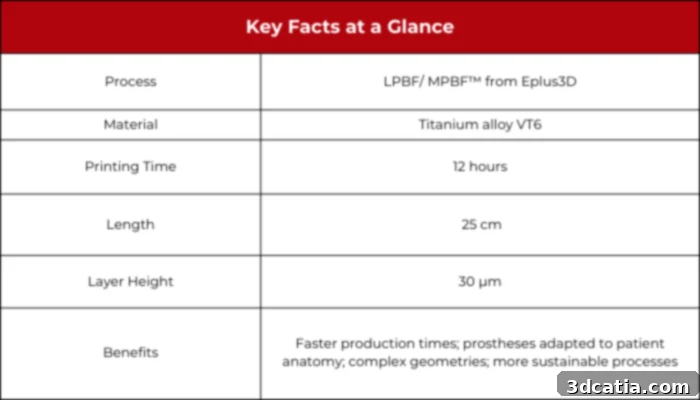
Image Credits: 3Dnatives
What are your thoughts on the groundbreaking use of metal 3D printing to create highly specialized titanium shoulder arthrodesis plates? We invite you to share your perspectives in a comment below or join the discussion on our LinkedIn, Facebook, and Twitter pages! Don’t miss out on the latest advancements and news in additive manufacturing by signing up for our free weekly Newsletter here, delivered straight to your inbox! Additionally, you can explore all our insightful videos on our YouTube channel. If you are particularly interested in discovering more 3D printing news within the dynamic medical and dental sector, click HERE for more dedicated content.
*Cover Photo: Close-up of 3D-printed titanium shoulder arthrodesis plates, demonstrating intricate details and custom design capabilities (all photo credits: Eplus3D)