
Revolutionizing Microfluidics: MIT’s Breakthrough in 3D-Printed Self-Heating Devices
Microfluidics, the science of controlling and manipulating tiny volumes of fluids within miniature channels, plays an increasingly vital role in countless scientific and technological applications. From groundbreaking medical diagnostics to sophisticated biotechnology, process engineering, and even everyday consumer products, microfluidic systems are ubiquitous. You don’t need to be an engineer with deep technical expertise to encounter their impact. Perhaps one of the most relatable examples from recent times is the widespread use of do-it-yourself COVID-19 antigen tests, which effectively leverage microfluidic principles to detect diseases in biological samples like blood or saliva. These miniature laboratories on a chip are designed to handle precise quantities of liquids, enabling rapid analysis and identification of various substances and pathogens.
However, the development and manufacturing of advanced microfluidic devices present significant challenges. Many critical chemical reactions, essential for accurate diagnostics and research, demand specific temperature conditions. This often necessitates the incorporation of complex heating elements, traditionally crafted from expensive materials like gold and platinum, within the microfluidic architecture. The conventional production methods for such devices are typically carried out in highly controlled and costly cleanroom environments. This intricate manufacturing process is not only expensive but also time-consuming and difficult to scale, limiting broader accessibility and innovation in the field. These limitations have long been a barrier to making advanced microfluidic technology more widely available, particularly in regions with limited resources.
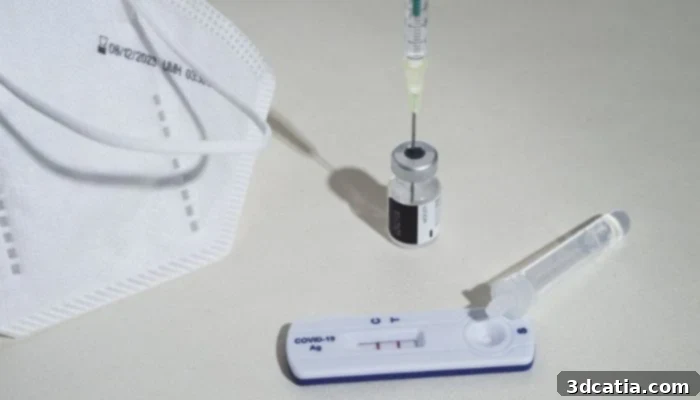
COVID-19 self-tests are a prominent example of microfluidic applications, demonstrating their widespread impact (photo credits: Pixabay).
Addressing these long-standing obstacles, a pioneering research project at the Massachusetts Institute of Technology (MIT) has made a significant leap forward. Scientists at MIT have successfully developed a groundbreaking 3D-printed, self-heating microfluidic device, as recently announced in a press release. This innovative approach promises to revolutionize the fabrication of microfluidic systems, making them more affordable, accessible, and scalable. The research team, spearheaded by Luis Fernando Velásquez-García, a principal scientist in MIT’s Microsystems Technology Laboratories (MTL), harnessed the power of additive manufacturing to create a miniature reactor capable of both transporting liquids and precisely triggering chemical reactions through integrated heating. This remarkable advancement paves the way for the cost-effective production of highly accurate measuring instruments, critical for the early and rapid detection of diseases. The implications are particularly profound for developing countries, where establishing and maintaining optimal, high-tech laboratory environments can be incredibly challenging and often unfeasible.
Velásquez-García underscored the transformative potential of their work, stating, “Clean rooms in particular, where you would usually make these devices, are incredibly expensive to build and to run. But we can make very capable self-heating microfluidic devices using additive manufacturing, and they can be made a lot faster and cheaper than with these traditional methods. This is really a way to democratize this technology.” This emphasis on democratization highlights the project’s core objective: to make sophisticated diagnostic tools available to a much wider global population. Thanks to the efficiency and reduced material waste inherent in 3D printing technology, each microfluidic mini-device produced by the MIT team costs an astonishingly low approximately $2 USD. This drastic reduction in cost, coupled with simplified manufacturing, represents a paradigm shift in the accessibility of advanced diagnostic capabilities.
Making Microfluidic Devices With Multi-Material 3D Printing: A Monolithic Approach
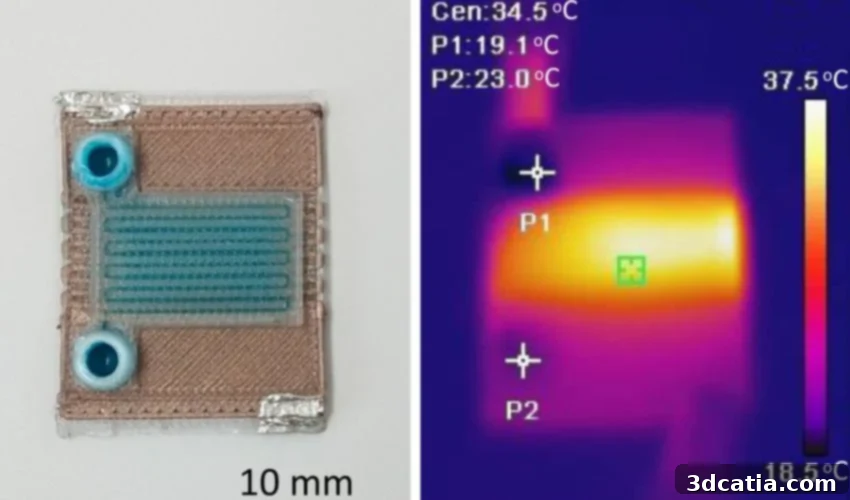
A key innovation in the MIT project lies in its manufacturing process, which the research team refers to as a “monolithic process.” This means the entire microfluidic device, including its intricate channels and integrated heating elements, is produced in a single, continuous print run on the 3D printer, eliminating the need for any post-assembly. This streamlined approach significantly reduces manufacturing time and complexity. Utilizing advanced multi-material 3D printing techniques, the researchers extruded different materials through separate nozzles, building the complete mini-reactor layer by layer. This capability allows for the precise placement of various components within the device’s architecture. The integrated heating elements are strategically designed to heat the liquid flowing through the channels to a specific, controlled temperature, or even to restrict heating to a particular area of the device. This remarkable flexibility in customization enables the implementation of preset heating profiles, tailoring the device to the specific requirements of different chemical reactions or biological assays.
In a proof-of-concept demonstration, the first prototype successfully heated a liquid by 4°C as it traversed the microfluidic channels from inlet to outlet. This initial application test vividly illustrates the immense possibilities for designing devices where liquids flow in predefined patterns or along specific lines, enabling and controlling a wide array of chemical reactions. The precision of the additive manufacturing process is evident in the dimensions of the channels within the researchers’ initial device, which are incredibly small—approximately 500 micrometers wide and 400 micrometers high. Such fine resolution is critical for achieving efficient fluid control and reaction kinetics in microfluidic applications.
The integration of heating elements necessitated the use of electrically conductive materials within the device. This is precisely where the power of multi-material 3D printing for microfluidics became indispensable. The MIT team ingeniously combined two variants of polylactic acid (PLA): standard biodegradable PLA, known for its insulating properties, and a modified version of PLA enriched with copper nanoparticles. By incorporating copper nanoparticles, the otherwise insulating PLA was transformed into an electrical conductor, allowing it to function as a heating resistor. Velásquez-García explained the utility of these PLA variants: “You can use these two materials to create chemical reactors that do exactly what you want. We can set up a particular heating profile while still having all the capabilities of the microfluidic.” This innovative material combination is central to the device’s self-heating functionality.
The principle behind the self-heating mechanism is straightforward yet effective: by applying an electrical current to the copper-nanoparticle-enriched PLA heating resistor, electrical energy is efficiently converted into thermal energy. This heat then warms the liquid flowing through the microfluidic channels, which are also simultaneously formed during the same single 3D printing process. For optimal heat transfer from the resistor to the liquid, the researchers meticulously designed and printed a thin wall of standard PLA. This wall had to strike a delicate balance: thin enough to allow for efficient heat conduction to the fluid, yet thick enough to reliably contain and repel the liquid within the channels. Furthermore, to enable observation of chemical reactions and facilitate analysis of the processes occurring within the device, the researchers utilized transparent PLA for certain sections, allowing for direct visual monitoring of the fluids in real-time. This thoughtful material selection and design ensure both functionality and observability, crucial for research and diagnostic applications.

PLA, derived from corn starch, is typically insulating. By enriching it with copper nanoparticles, it gains electrical conductivity, essential for integrated heating (photo credits: MIT).
Addressing Future Challenges in Additive Microfluidics
While the use of similar PLA-based materials offered a distinct advantage by allowing for nearly uniform printing temperatures during the 3D printing process, streamlining manufacturing, some inherent limitations of PLA remain. Specifically, PLA’s thermal stability is a significant consideration. Although it can withstand temperatures up to approximately 50°C without issue, it begins to gradually decompose at higher temperatures. This presents a challenge because many critical chemical reactions, such as those involved in polymerase chain reaction (PCR) tests, require temperatures upwards of 90°C. To precisely control temperatures within the microfluidic device and enable accurate measurements for such high-temperature applications, an additional material would be necessary to overcome PLA’s current thermal limits. This highlights an area for future research and material development in additive manufacturing for advanced microfluidics.
Velázquez-García’s research group is already exploring promising avenues to address this challenge. One potential solution involves incorporating magnets, which could not only facilitate specific chemical reactions but also enable the sorting and precise arrangement of particles within the fluidic channels. The researchers are also intensely focused on further understanding and optimizing the electrical conductivity of nanoparticle-enriched PLA. This deeper material analysis is crucial for unlocking the full potential of these devices. Velázquez-García expressed his fascination with this aspect: “It is amazing when you think about it because the PLA material is a dielectric, but when you put in these nanoparticle impurities, it completely changes the physical properties. This is something we don’t fully understand yet, but it happens and it is repeatable.” He further emphasized the importance of this foundational research, adding, “If we can understand the mechanism that is related to the electrical conductivity of PLA, that would greatly enhance the capability of these devices, but it is going to be a lot harder to solve than some other engineering problems.” This pursuit of fundamental understanding is critical for pushing the boundaries of what’s possible with 3D printed microfluidic devices.
Despite these ongoing challenges, the initial results of the MIT study are exceptionally promising. The technology holds exciting potential for a wide array of applications, including the advanced analysis of biological samples, precise mixing of various liquids, and the creation of innovative implants such as dissolvable chips for targeted drug delivery or biosensing. As previously highlighted, the development of low-cost chips featuring microfluidic channels and integrated electrical functionalities will be particularly beneficial for developing countries. The single-step 3D printing process drastically reduces manufacturing costs and the reliance on expensive, specialized laboratory equipment, thus democratizing access to sophisticated diagnostic and analytical tools on a global scale.
The pioneering MIT project has already garnered significant international recognition, receiving positive feedback from prestigious institutions such as the Royal Institute of Technology in Sweden and Keio University in Tokyo. Both institutions have emphasized the immense future potential of 3D printed microfluidic devices and are actively discussing possible new applications and collaborative research opportunities. This broad enthusiasm underscores the transformative impact this technology is expected to have across various scientific and medical fields. For more detailed information on this breakthrough research, you can find further resources HERE.
What are your thoughts on this innovative 3D-printed, self-heating microfluidic device from MIT? We invite you to share your insights in a comment below or connect with us on our LinkedIn, Facebook, and Twitter pages! Don’t forget to sign up for our free weekly Newsletter here to receive the latest 3D printing news directly to your inbox! You can also find all our videos on our YouTube channel.
*Cover Photo Credits: MIT