

Empowering Women in 3D Printing: Key Insights from the 2020 Industry Report
The landscape of additive manufacturing is continuously evolving, with 3D printing transitioning from a niche prototyping tool to a pivotal technology for mass production across various industries. A few days ago, we explored The State of 3D Printing 2020, Sculpteo’s comprehensive annual report that highlighted this significant industry shift. Beyond the technological advancements and market growth, it’s crucial to understand the human element driving this innovation, particularly the diverse talent contributing to its success. In a pioneering effort, Sculpteo, in collaboration with Women in 3D Printing, embarked on a deeper dive into the industry’s workforce, culminating in a new report focused specifically on the role and experiences of women. This critical study provides invaluable insights into the current state of gender diversity within the sector. Our previous coverage has often highlighted the contributions of influential women, featuring interviews with leaders like Marie Langer, CEO of the EOS Group; Monica Smith from EOS; Nina Hoff from byFlow; and Sylvia Heisel from Heisel, among others. Such narratives underscore the vital contributions women make to the 3D printing world. So, as we progressed into 2020, what did this new report reveal about the general situation for women in this rapidly expanding industry? We have meticulously compiled and expanded upon the most significant findings from this eye-opening report, offering a detailed perspective on the opportunities and challenges faced by women in 3D printing.
High Educational Attainment and Professional Entry Points
The joint study by Sculpteo and Women in 3D Printing offers a compelling picture of the educational background and professional pathways of women in the sector. A remarkable finding was that over half of the female participants surveyed—specifically 51%—possess a master’s degree or higher education. This statistic immediately highlights a highly qualified and academically accomplished female workforce, suggesting that women entering or already within the 3D printing industry are often equipped with advanced knowledge and specialized skills. This level of educational attainment is a strong indicator of dedication and intellectual prowess, positioning these women to contribute significantly to research, development, and strategic leadership roles.
Furthermore, the report sheds light on how women predominantly enter the field. A significant majority, 64% of the women surveyed, found their access to 3D printing through their jobs. This suggests that employment opportunities, rather than initial personal ventures or academic specializations, serve as the primary gateway for many women into additive manufacturing. This trend could imply that companies are actively recruiting and training women for roles involving 3D printing, or that women are discovering the technology’s relevance once they are already within a professional setting. Understanding this entry point is crucial for industry stakeholders looking to enhance female participation, as it emphasizes the importance of company-led initiatives, training programs, and inclusive hiring practices.
Delving deeper into their professional contributions, the study identified that most women involved in 3D printing are concentrated in key functional areas such as sales, marketing, and research and development (R&D). These roles are integral to the industry’s growth, covering everything from promoting innovative products and solutions to pushing the boundaries of material science and process optimization. Within these broad categories, the report further specified research, CAD design, and prototyping as the most common activities. This distribution of roles underscores the diverse talents women bring to the table, from conceptualizing and designing complex models using advanced CAD software to conducting critical research that drives future innovations, and rapidly developing functional prototypes that accelerate product cycles. Their presence in R&D and design roles is particularly important, as these are the areas where foundational decisions are made and new directions are forged, ensuring that women’s perspectives are integrated into the very fabric of technological advancement.
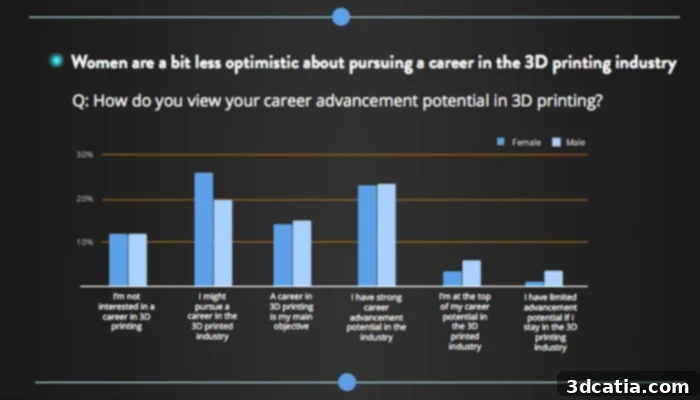
Image via The State of Women in 3D Printing
Navigating Career Prospects: A Gendered Perspective
A particularly illuminating aspect of the study involved a direct comparison of how men and women perceive their career prospects within the 3D printing industry. While the overall optimism levels were high, the findings revealed subtle yet significant differences. It became apparent that women tended to be slightly less optimistic about their career trajectories than men, though this margin was not excessively wide. This nuanced difference suggests that while women recognize the potential of the industry, there might be underlying factors contributing to a more cautious outlook on their personal career progression.
Digging deeper into career interest and commitment, the report indicated that approximately 12 percent of all respondents, irrespective of gender, expressed a lack of interest in pursuing a career in 3D printing. This figure might reflect individuals whose current roles intersect with 3D printing but do not align with their long-term career aspirations. More critically, the survey highlighted a notable disparity in uncertainty regarding career pursuit: nearly 26 percent of women, compared to 20 percent of men, were unsure whether they wanted to pursue a dedicated career in the additive manufacturing industry. This higher percentage of undecided women could point to several factors, including a lack of clear career pathways, insufficient mentorship, perceived barriers to advancement, or concerns about work-life balance within a demanding tech sector.
Furthermore, the survey results consistently showed that fewer women than men expressed confidence about the sheer breadth of career opportunities available in 3D printing. This confidence gap is a crucial finding, as it directly impacts an individual’s willingness to invest in skills development, seek promotions, and take on leadership roles. Coupled with this, fewer female respondents than male respondents reported feeling that they had already realized their full career potential within the industry. This suggests that many women might perceive their growth within 3D printing as curtailed or that they face unique challenges in reaching their ultimate professional goals.
The report unequivocally highlights a “stark difference” in how men and women perceive and approach career pursuit in the 3D printing industry. While the exact interpretation of “women leading in this department” in the original context might require further nuance, it likely refers to the distinct challenges and proactive navigation women undertake in charting their career paths. Despite potential lower optimism or confidence in certain areas, women are actively present and seeking advancement, often navigating a different set of expectations, biases, or systemic hurdles than their male counterparts. This underlines the importance of creating equitable environments that actively support women in identifying opportunities, building confidence, and fully realizing their extensive potential in a rapidly growing and innovation-driven sector. Addressing these gender-specific perceptions and fostering an inclusive culture are paramount for ensuring that the industry benefits from the full spectrum of talent available.
Pathways to Knowledge: How Professionals Learn About 3D Printing
Another fascinating dimension explored by the study concerns the various ways in which participants acquire knowledge about 3D printing technology. Understanding these learning pathways is essential for educators, employers, and industry advocates aiming to broaden engagement and facilitate skill development. The report revealed some distinct gender-based patterns in how individuals familiarize themselves with additive manufacturing.
For both men and women, a job served as the primary starting point for learning about 3D printing. This finding reinforces the idea that professional environments are critical hubs for practical skill acquisition and exposure to new technologies. Interestingly, women cited their job as the initial learning point 4 percent more often than men. This subtle difference might suggest that for many women, formal entry into a workplace that utilizes 3D printing is a more common introduction to the technology compared to self-initiated exploration. It underscores the importance of company training programs, on-the-job learning opportunities, and internal mentorship as key mechanisms for women to develop expertise in this field.
In contrast, personal interests or hobbies played a more significant role for men in their initial engagement with 3D printing. While nearly 29 percent of men stated they learned about 3D printing through their hobbies, only 18 percent of the women surveyed reported the same. This disparity highlights a potential gender gap in early exposure to and recreational engagement with advanced technologies. It suggests that while men might more frequently gravitate towards 3D printing as a personal hobby, perhaps through DIY projects, maker communities, or home-based experimentation, women may not have the same level of early, informal access or encouragement. Addressing this gap could involve promoting STEM activities and maker culture among young girls and women, fostering an environment where technological curiosity is nurtured outside of formal professional settings.
A particularly striking difference emerged in the area of institutional learning. The study found that more than twice as many female participants as male participants cited institutional learning—such as university courses, vocational training, or certification programs—as their primary motive for gaining knowledge in 3D printing. This significant finding indicates that formal educational frameworks and structured learning environments are especially important for women entering and advancing in the additive manufacturing space. It suggests a preference or necessity for certified, recognized pathways to skill development, potentially due to a desire for formal qualifications, structured curriculum, or access to specialized equipment and expert instruction that might not be readily available through informal channels. This insight is invaluable for educational institutions, signaling a strong demand from women for robust, accessible 3D printing programs that can serve as direct conduits into the industry.
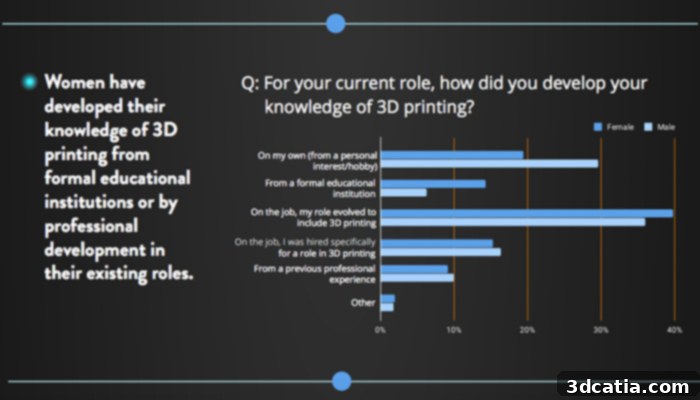
Image via The State of Women in 3D Printing
The Importance of Diversity in Additive Manufacturing
The findings from “The State of Women in 3D Printing 2020” are more than just statistics; they are a call to action for greater inclusivity and equitable opportunities within a rapidly innovating sector. The additive manufacturing industry, characterized by its dynamism and potential for disruption, thrives on diverse perspectives and creative problem-solving. A workforce that reflects a wide range of backgrounds, experiences, and thought processes is inherently more innovative, resilient, and better equipped to address complex challenges. Gender diversity, in particular, has been repeatedly shown to correlate with improved financial performance, enhanced employee satisfaction, and a richer organizational culture.
When women are underrepresented or face unique barriers, the industry risks missing out on a significant pool of talent and innovative ideas. The high educational attainment among women in 3D printing, as highlighted by the report, underscores that the talent is certainly present. The key lies in effectively harnessing and nurturing this talent. Addressing the disparities in career confidence, reducing uncertainty about career paths, and providing robust mentorship and sponsorship programs are vital steps. Furthermore, promoting early engagement through STEM initiatives and hobbyist communities, while also supporting institutional learning pathways, can create a more balanced and accessible entry point for future generations of female innovators.
Recommendations and Future Outlook
To build on the insights from this important report and foster a truly inclusive 3D printing industry, several strategic approaches can be considered. Companies should prioritize inclusive hiring practices, develop clear career progression frameworks, and implement flexible work policies that support a diverse workforce. Mentorship and sponsorship programs, both formal and informal, can play a pivotal role in guiding women through their careers, building confidence, and expanding their professional networks. Educational institutions must continue to offer and promote high-quality 3D printing programs, making them accessible and attractive to women, while also collaborating with industry to ensure curriculum relevance. Industry organizations and media platforms have a crucial role in championing female role models, sharing success stories, and advocating for policies that promote gender equality. By actively working towards these goals, the 3D printing industry can not only address the findings of the 2020 report but also pave the way for a more diverse, equitable, and ultimately more innovative future.
For those interested in delving deeper into these figures and the comprehensive analysis, you can find more information about the full study HERE. What are your thoughts on these important findings and the direction the 3D printing industry is heading regarding gender diversity? We encourage you to share your insights and comments below, or join the conversation on our Facebook and Twitter pages! Don’t miss out on the latest advancements and discussions in additive manufacturing—sign up for our free weekly Newsletter to receive all the crucial news straight to your inbox!