
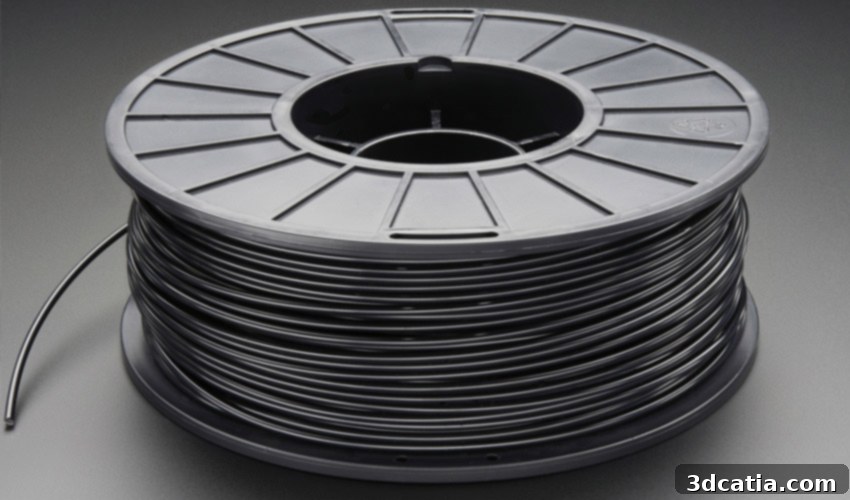
Recreus Unveils Reciflex: The Future of Sustainable 3D Printing with 100% Recycled TPU Filament
In an era increasingly defined by environmental consciousness, the timeless mantra of “Reduce, reuse, recycle” has transcended mere awareness to become a critical imperative for industries worldwide. Among them, the additive manufacturing sector, while inherently efficient, faces its own sustainability challenges. Stepping up to meet this challenge head-on is the innovative Spanish company, Recreus, with the groundbreaking introduction of Reciflex. This pioneering TPU filament for 3D printing stands out remarkably as it is crafted entirely from 100% recycled materials.
Reciflex is not just another filament; it’s a testament to sustainable innovation. This ingenious thermoplastic is meticulously produced from industrial waste, specifically sourcing materials from the footwear industry and integrating Recreus’ own in-house production scraps. Recreus has long been recognized for its diverse range of high-quality filaments, particularly for its celebrated flexible FilaFlex material. With Reciflex, the company propels its commitment to the next level, presenting a solution that rivals the reliability and performance of its existing products, yet is conceived entirely from reclaimed resources. This strategic move emphatically showcases Recreus’ profound dedication to environmental stewardship and its proactive stance in addressing the pressing global climate crisis.
The launch of Reciflex significantly broadens Recreus’ product portfolio, driven by a clear strategic objective: to vigorously promote the circular economy within the 3D printing landscape. This initiative represents a substantial stride forward in terms of sustainability, directly responding to and fulfilling the evolving demands of its growing customer base. Ignacio García, the visionary CEO of Recreus, articulates the company’s motivation, stating, “This is a project that was very much on our minds at Recreus, and we were eager to tackle it. The community, customers, and the industry were also demanding it, and thanks to the extensive research and testing work we have conducted in recent months within the company, we have achieved a truly exceptional material as a result.” His words underscore the blend of internal drive and external market necessity that fueled the development of Reciflex, highlighting a collaborative effort toward a greener future in additive manufacturing.
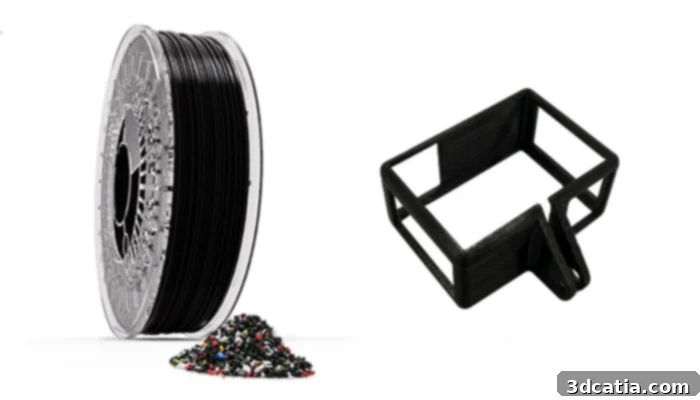
Photo Credits: Recreus
Reciflex: Uncompromising Quality from Recycled Materials
Despite its origin from recycled products, Recreus steadfastly upholds its commitment to producing filaments of uncompromising quality. The manufacturing process for Reciflex filament is a testament to this dedication, involving meticulous selection and a rigorous magnetic screening procedure. This critical step is implemented to effectively prevent any metallic residue from entering the filament, thereby guaranteeing that the material will perform flawlessly and reliably throughout the 3D printing process. Such attention to detail ensures that users experience consistent results, free from potential issues that recycled materials might otherwise present.
Reciflex boasts a hardness range between 96A and 98A SHORE “A”. While minor variations in hardness can occasionally be attributed to its recycled origins, these are engineered to be practically imperceptible in the final 3D printed parts, ensuring that functional integrity is never compromised. This specific hardness range positions Reciflex as an outstanding choice for manufacturing parts that demand robust mechanical requirements, excellent flexibility, and high durability. Typical applications include protective phone cases that absorb impact, robust drone protections designed to withstand harsh landings, resilient wheels for radio control cars and robots that endure constant motion, or any part requiring contact with aggressive solvents. Its properties make it suitable for custom gaskets, flexible tooling, protective gears, and components in footwear or sporting goods, where both elasticity and resistance are paramount. The versatility of Reciflex extends to various industrial and consumer applications where sustainable yet high-performance flexible materials are essential, bridging the gap between ecological responsibility and engineering excellence.
For optimal results when working with Reciflex, Recreus provides specific printing recommendations. The manufacturer advises a printing temperature between 220 and 235ºC, which is ideal for achieving proper layer adhesion and flow consistency characteristic of TPU materials. A printing speed ranging from 20 to 60 mm/s is recommended, balancing detail preservation with efficient production, crucial for flexible filaments. Furthermore, a printing plate temperature set between 50 and 60ºC is suggested to ensure excellent first-layer adhesion and minimize warping, a common challenge with many thermoplastic filaments. Users are encouraged to conduct calibration prints to fine-tune these settings for their specific 3D printer and printing environment, thus maximizing the potential of Reciflex.
Interestingly, Reciflex is currently available exclusively in a solid and bright black color. This deliberate choice is a direct consequence of its recycled nature. When various recycled plastic colors are mixed during the production process, the black pigment is strategically added. This addition serves to homogenize the diverse color palette of the incoming recycled materials, resulting in a consistently vibrant and uniform black finish. Far from being a limitation, this black color symbolizes the fusion of disparate waste streams into a single, high-quality, and environmentally responsible product. The filament reels are offered in two convenient weights: 750g for smaller projects or initial testing, and 3kg for larger-scale production or frequent use. Users also have the flexibility to choose between two standard diameters: 1.75 mm and 2.85 mm, ensuring compatibility with a wide range of FDM 3D printers on the market.
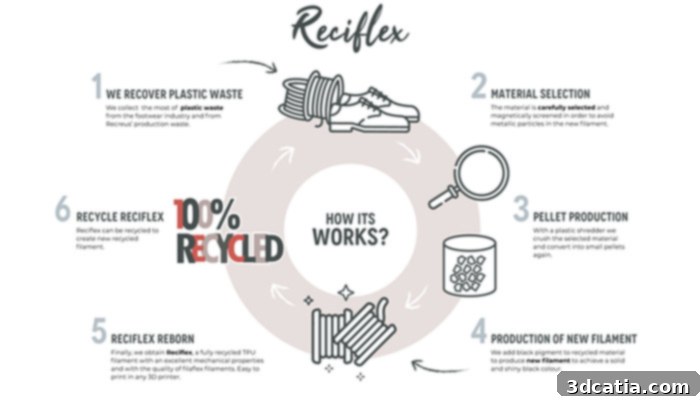
The Reciflex creation process (photo credits: Recreus)
Recreus and the Broader Push for Sustainability in Additive Manufacturing
From its inception, additive manufacturing was heralded as a transformative solution for more sustainable production. Its core principle of building parts layer by layer, rather than cutting away material, inherently generates significantly less waste compared to traditional subtractive manufacturing methods. This promise of efficiency and resource conservation was a key selling point for 3D printing technology. However, as the industry matured and its applications expanded, it became increasingly apparent that there were significant roadblocks to truly deeming it eco-friendly. The pervasive reliance on plastic as one of the most widely used materials in 3D printing has emerged as a primary concern, contributing to the global plastic waste crisis.
In response to this growing challenge, a robust and expanding movement has emerged within the 3D printing community, passionately dedicated to finding viable solutions. Extensive research and development efforts are underway, exploring innovative more sustainable materials. These investigations span various avenues, from bio-based polymers derived from renewable resources to composites incorporating natural fibers, and even the exploration of unconventional materials like mycelium. In this dynamic landscape, Recreus’ Reciflex filament represents a pivotal step in the right direction. By offering a high-performance plastic filament manufactured entirely from recycled materials, Reciflex clearly demonstrates another impactful way that 3D printing can dramatically reduce its environmental footprint, transforming waste into valuable resources and moving closer to a truly circular economy. This not only mitigates plastic pollution but also conserves virgin resources, embodying a more responsible approach to technological advancement.
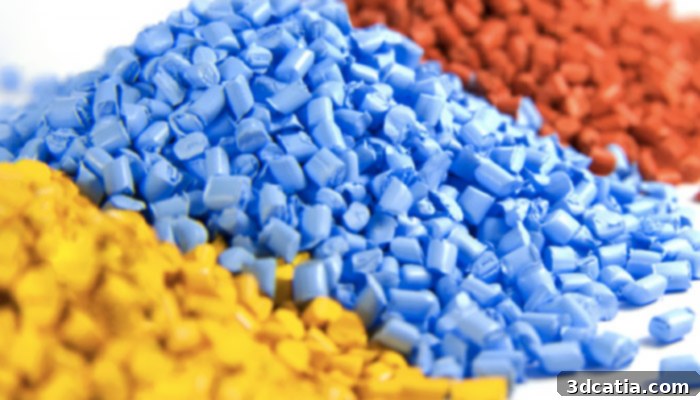
Recreus says companies must commit to great sustainability. (photo credits: Aimplas)
The team at Recreus is acutely aware of the inherent paradox in being a leading producer of plastic filaments while championing environmental causes. However, this awareness does not deter them; instead, it fuels their unwavering commitment to safeguarding the environment and fostering the principles of a circular economy. Ignacio García reinforces this philosophy, stating, “All companies have to go in this direction, there is no other way! In our production processes, we consistently integrate sustainable actions, such as reusing the water collected by our dehumidification rooms for the filament production process. These gestures, however small they may seem, are actions that collectively contribute significantly in the end. We are deeply conscious of our role in the industry, and our ultimate goal is to provide, in addition to high-quality 3D printing filaments, comprehensive integral solutions that genuinely respect the environment, as exemplified by Reciflex.” This statement highlights Recreus’ holistic approach to sustainability, integrating eco-friendly practices throughout their operations, from raw material sourcing to manufacturing processes.
Looking ahead, Recreus is not resting on its laurels with Reciflex. Later this year, the company is set to unveil a new line of products designed to establish yet another significant milestone in the realm of sustainability. These upcoming innovations are part of a broader, ambitious strategy to maximize efforts and steer towards a more “self-sustaining” world, where industrial production harmonizes with ecological balance. This continuous pursuit of greener alternatives solidifies Recreus’ position as a frontrunner in sustainable additive manufacturing. In the meantime, for those eager to learn more about Reciflex and Recreus’ other environmentally conscious initiatives, additional information can be found on the official Recreus website HERE. Explore how their commitment to innovation and sustainability is shaping the future of 3D printing.
What are your thoughts on the innovative Reciflex filament and Recreus’ dedication to sustainable 3D printing? We’d love to hear from you! Let us know in a comment below or join the conversation on our Linkedin, Facebook, and Twitter pages! Don’t miss out on the latest advancements and news in additive manufacturing; sign up for our free weekly Newsletter here and get the freshest 3D printing updates delivered straight to your inbox!