
UCLA Engineers Pioneer Sustainable Construction with Carbon-Captured 3D Printed Concrete
In a groundbreaking move towards a more sustainable future, a team of visionary engineers at UCLA recently secured a substantial $1.5 million grant. This significant funding is earmarked for the development of an innovative, environmentally friendly concrete that promises to redefine the construction industry. At the heart of this pioneering effort is the novel idea of incorporating carbon dioxide (CO2), a potent greenhouse gas, directly into the concrete’s binder. This ingenious approach not only sequesters atmospheric carbon but also aims to drastically reduce the carbon footprint associated with concrete production, with projections indicating a potential reduction of up to 60% compared to conventional concrete formulations. This initiative perfectly aligns with the growing trend of additive manufacturing technologies, particularly 3D printing in construction, which are rapidly gaining traction and are poised to revolutionize how buildings are designed and erected. However, for these advanced construction methods to reach their full potential, the materials themselves, especially sustainable concrete formulations, must continue to evolve and adapt to new technological demands.
The prestigious grant was awarded by the National Science Foundation (NSF), recognizing the profound potential of this research. Leading this transformative project is Mathieu Blanchy, a distinguished computational materials scientist and an assistant professor of civil and environmental engineering at the UCLA Samueli School of Engineering. Professor Blanchy articulates the urgency of their mission, stating, “Concrete is by far the most manufactured material in the world, however its large carbon footprint is a major detriment toward its continued use in its current form”. His statement underscores a critical environmental challenge: the traditional process of cement production, a key binding agent in concrete, is an enormous contributor to global climate change. Estimates suggest that cement manufacturing alone accounts for approximately 8% of all man-made carbon emissions worldwide. This staggering figure highlights the imperative for innovative solutions that can mitigate the environmental impact of this essential building material.
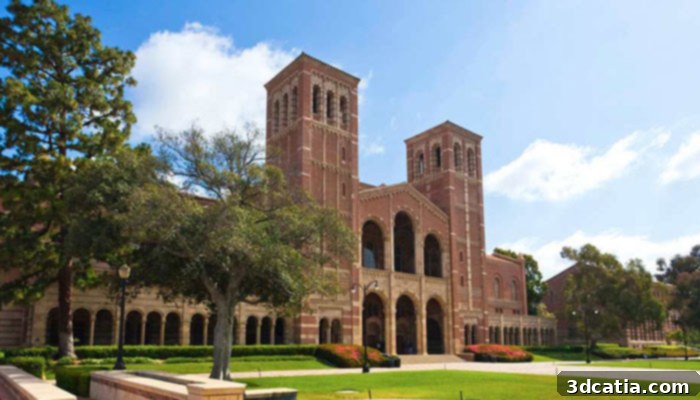
UCLA Campus
The substantial funding provided by this NSF grant is set to empower Professor Blanchy’s team with the necessary resources to thoroughly investigate and develop viable, environmentally conscious solutions for concrete production. Their research aims to move beyond incremental improvements, striving for a paradigm shift in how building materials are conceived and manufactured. “This grant allows us to leverage recent developments in artificial intelligence and machine learning to design a more sustainable product. We aim to help construction—a conservative, empiricism-based industry— evolve into a knowledge- and data-intensive industry of the 21st century” adds Mathieu Blanchy. This vision emphasizes the integration of cutting-edge computational tools, like AI and machine learning, to accelerate discovery and optimization. By embracing data-driven methodologies, the project seeks to transform the historically traditional construction sector into an innovative, high-tech domain capable of addressing pressing global environmental challenges with unprecedented efficiency and precision.
The initial phase of the project will largely concentrate on rigorous simulations and extensive experimental work. A primary objective is the creation of truly sustainable concrete specifically optimized for 3D printing applications. This involves a deep understanding and precise control over the rheological properties of cement slurries – how they flow, their viscosity, and their setting times – to ensure their suitability for intricate additive manufacturing processes. Achieving consistent and printable material properties is a formidable challenge, as the mixture must be fluid enough to extrude but stiff enough to hold its shape immediately after deposition, layer by layer. Furthermore, a crucial technical hurdle involves determining the optimal methods to maximize the amount of carbon dioxide that can be stably and effectively incorporated into the binding matrix without compromising the material’s structural integrity or durability. This requires innovative chemical engineering approaches and meticulous testing. Lastly, the team will harness the power of machine learning algorithms to explore and discover entirely new 3D printed structural designs. These advanced algorithms will be employed to identify geometries and material distributions that offer superior load-bearing capabilities while simultaneously maintaining a remarkably lightweight profile, pushing the boundaries of what is conventionally possible in structural engineering. This multi-faceted approach aims to address both the material science and structural design aspects of sustainable 3D printed construction.
The implications of this research extend far beyond the laboratory. Successfully developing carbon-negative concrete has the potential to dramatically alter the environmental landscape of the global construction industry. It offers a tangible pathway to reducing industrial greenhouse gas emissions on a massive scale, helping countries meet their climate change targets and fostering a truly circular economy where waste CO2 is transformed into a valuable resource. The widespread adoption of such materials could lead to significantly lower embodied carbon in buildings, transforming them from carbon emitters into carbon sinks over their lifetime. This shift is not merely an environmental benefit but also holds immense economic promise, potentially creating new markets for carbon capture and utilization technologies, driving innovation, and fostering a new generation of green jobs. The integration of 3D printing further amplifies these benefits, allowing for on-demand production, reduced material waste at construction sites, and the creation of highly optimized, less material-intensive structures. This convergence of sustainable materials and advanced manufacturing promises a future where infrastructure development is inherently compatible with ecological preservation.
Beyond the immediate research outcomes, the grant is designed to cultivate the next generation of scientific leaders and innovators. It will provide critical financial and research support for graduate students and postdoctoral scholars, allowing them to delve deep into cutting-edge materials science and engineering. This hands-on experience in a high-impact research area is invaluable for their professional development. Moreover, the project will actively involve and train undergraduate students, offering them early exposure to advanced research methodologies, interdisciplinary collaboration, and the profound societal impact of their work. This commitment to education and mentorship ensures that the knowledge and expertise generated through this grant will continue to propagate, fostering a pipeline of talented individuals dedicated to solving complex environmental challenges. The grant thus serves as an investment not just in a specific technology, but in the human capital essential for driving future innovations in sustainable civil engineering and construction. Further detailed information on this exciting initiative can be found by following the link HERE.
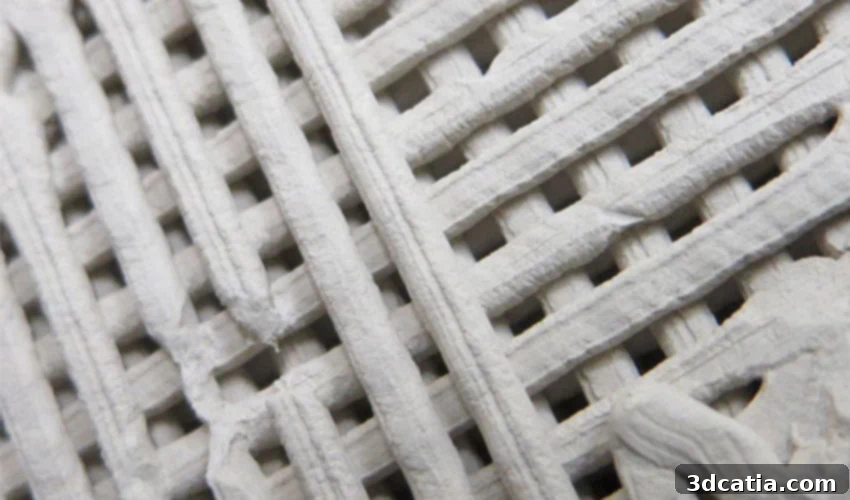
*Cover Image: Prototype samples of 3D-printed concrete. The cube is about 1 square inch in volume | Credits: UCLA Samueli Newsroom
What are your thoughts on this pioneering research project by UCLA engineers to create environmentally friendly and potentially carbon-negative concrete? Do you believe this will be a game-changer for the construction industry and our efforts against climate change? We invite you to share your perspectives and engage with us in the comments section below. You can also connect with our community and join the discussion on our Facebook and Twitter pages! For the latest updates, breakthroughs, and news from the world of 3D printing and sustainable construction, don’t forget to sign up for our free weekly Newsletter, delivered directly to your inbox!