
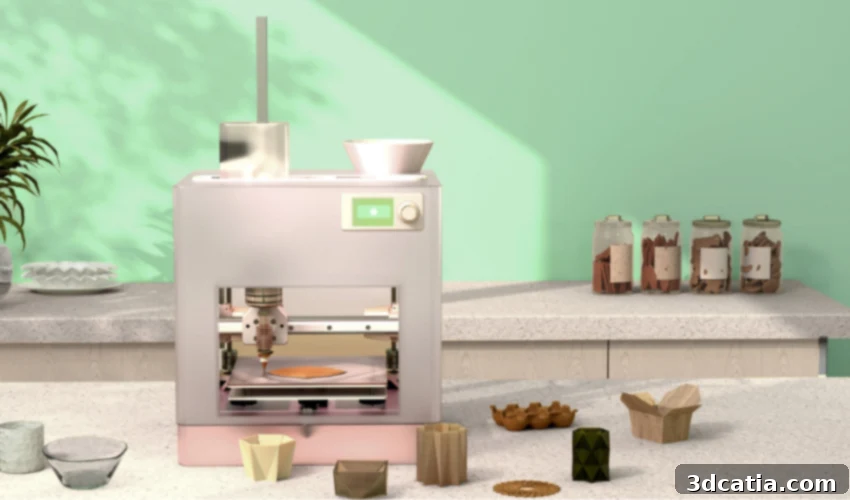
Revolutionizing Sustainability: How FOODres.AI Transforms Food Waste into 3D Printed Treasures
In a groundbreaking stride towards sustainable living and innovative manufacturing, two brilliant graduates from MIT, Biru Cao and Yiqing Wang, have unveiled a revolutionary desktop 3D printer named FOODres.AI. This cutting-edge system seamlessly integrates artificial intelligence, sophisticated object recognition capabilities, and advanced additive manufacturing techniques to tackle the escalating global problem of household food waste. Imagine a world where your daily fruit peels, used coffee grounds, or last night’s leftover rice don’t end up in a landfill but are instead transformed into beautiful and functional objects like sturdy coasters, practical containers, or charming decorative pieces right in your own home. FOODres.AI makes this vision a tangible reality.
What sets FOODres.AI apart from the vast majority of consumer-grade 3D printers is its pioneering approach to materials. While conventional at-home 3D printing typically relies on plastics or resins derived from fossil fuels, FOODres.AI champions the use of unconventional organic materials. By demonstrating how everyday kitchen scraps can be adapted for 3D printing by consumers at home, this invention opens up an entirely new paradigm for domestic recycling and creative reuse. It challenges our perception of waste, revealing its hidden potential as a valuable resource for creating new products.
The technological heart of FOODres.AI lies in its meticulously engineered custom three-axis extrusion system. This sophisticated mechanism works in conjunction with a specialized heating and mixing module, which is the key to converting diverse food waste — from fibrous fruit skins to granular coffee grounds — into a printable bioplastic paste. This paste serves as the eco-friendly “ink” for the 3D printer, allowing users to build objects layer by layer with materials that would otherwise contribute to environmental pollution. The process is designed to be user-friendly, ensuring that transforming waste into resources is accessible to everyone, regardless of their technical expertise.
User interaction with the FOODres.AI system is primarily facilitated through an intuitive mobile application. This app is equipped with a self-trained object detection model, an impressive feat of artificial intelligence. Users simply point their phone’s camera at their food waste, and the AI instantly identifies the type of material. Based on this identification, the app suggests suitable ‘recipes’ – specific combinations and preparation methods – tailored to the unique material properties of the waste. For instance, the optimal processing for coffee grounds might differ significantly from that for potato peels, and the app intelligently guides the user through each step. Beyond material identification, the app also provides a versatile design template library, enabling users to either choose from pre-existing models or upload their own custom designs. This thoughtful integration of AI and user-friendly design makes the FOODres.AI system remarkably accessible, even for individuals with minimal prior experience in 3D printing or complex design software.

The genesis of FOODres.AI can be traced back in part to the prestigious MIT IDEAS Social Innovation Program, a testament to its profound potential for societal benefit. Since its inception, the project has garnered significant recognition, receiving the highly coveted Platinum A’ Design Award 2024–2025 and the prestigious iF Design Award 2025. These accolades underscore the system’s innovative design, technological prowess, and immense impact on sustainability. At its core, FOODres.AI is a powerful advocate for small-scale circular design. By empowering individuals to reuse organized waste at home, it diverts valuable organic matter from landfills, where it would otherwise decompose and release harmful methane gas. This direct intervention in waste management transforms a linear “take-make-dispose” economy into a more sustainable, circular model.
Biru Cao eloquently summarized the project’s philosophy, explaining, “We can turn food waste into something more meaningful.” This statement perfectly encapsulates the system’s dual role: not only does it offer a tangible solution for environmental sustainability by reducing waste, but it also serves as a potent educational tool. By actively participating in the transformation process, users gain a deeper understanding of resourcefulness and the value of materials often discarded without a second thought. This hands-on experience fosters a greater appreciation for the principles of recycling, upcycling, and sustainable consumption, reinforcing positive behavioral changes that extend beyond the mere act of printing.
The thoughtful and compact design of the FOODres.AI printer ensures its versatility across various environments. Its small footprint allows for seamless integration into domestic settings, making it an ideal appliance for eco-conscious households. Furthermore, its educational potential makes it perfect for classrooms, where it can provide students with invaluable practical experience in sustainable design, engineering, and circular economy principles. Small workshops and creative studios can also leverage its capabilities to produce unique, environmentally friendly prototypes and products. By masterfully combining automation, modularity, and intelligent AI guidance, the system achieves more than just producing durable objects from food scraps; it actively reinforces behavioral change. Users witness firsthand how their discarded waste can be transformed in real time into functional items, creating a powerful and immediate connection between consumption, waste, and creation.
FOODres.AI stands as a shining example of how the future of 3D printing can extend far beyond the confines of conventional materials. It envisions a future where waste is not an end but a beginning, giving household refuse a new, functional, and aesthetically pleasing life while vigorously promoting sustainability on a personal and community level. This innovation paves the way for a more resourceful and environmentally responsible approach to consumption, encouraging individuals to see their kitchen waste not as garbage, but as a raw material for endless possibilities. The ability to create personalized items from one’s own organic waste fosters a deeper sense of ownership and responsibility towards the environment, making sustainability an engaging and rewarding endeavor.
With its intelligent AI integration and seamless incorporation of additive manufacturing, FOODres.AI brilliantly demonstrates how emerging technologies can converge to effectively tackle pressing everyday sustainability challenges. It’s a powerful statement that innovation in 3D printing is by no means limited to large-scale industrial applications or specialized commercial uses. Instead, it proves that this transformative technology can, and should, reshape the way ordinary people interact with and repurpose materials within the comfort and convenience of their own homes. This shift democratizes manufacturing and empowers individuals to contribute directly to a circular economy, fostering a new era of personal responsibility and creative eco-conscious living. FOODres.AI is not just a printer; it’s a blueprint for a more sustainable, innovative future where waste becomes a resource, and every household can be a hub of eco-friendly creation.
What are your thoughts on the groundbreaking FOODres.AI system and its potential to revolutionize sustainable living? We’d love to hear your insights! Share your comments below or connect with us on our LinkedIn or Facebook pages. Additionally, don’t miss out on the latest advancements in 3D printing technology and news by signing up for our free weekly Newsletter, delivered straight to your inbox. For a visual deep dive into the world of 3D printing and beyond, you can also find all our compelling videos on our YouTube channel.
*All Image Credits: FOODres.AI