
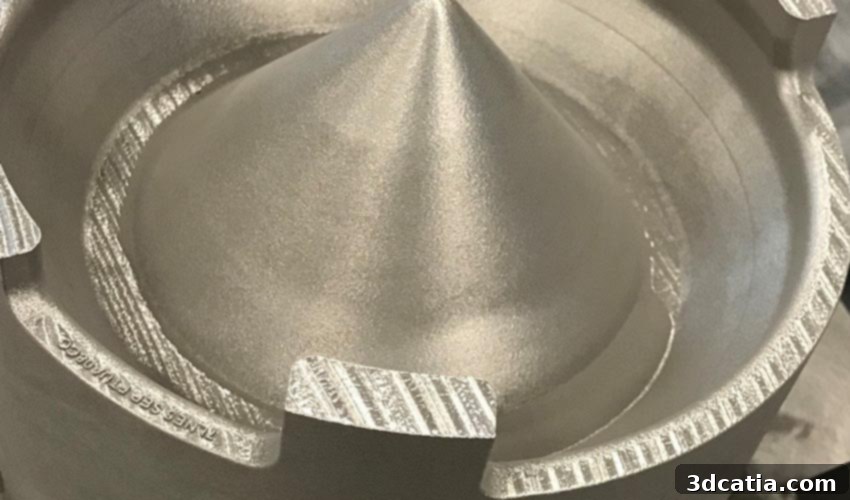
US Air Force & GE Additive: Revolutionizing Aerospace Sustainment with Metal 3D Printing
The dynamic landscape of military aviation continually presents complex challenges, particularly concerning the sustainment of its extensive and aging aircraft fleets. Recognizing this critical imperative, in mid-2019, GE Additive and GE Aviation embarked on a pioneering collaboration with the US Air Force. This strategic partnership was meticulously designed to harness the transformative capabilities of metal additive manufacturing to directly address the Air Force’s pressing needs for improved sustainment, enhanced readiness, and greater affordability across its fleet. Central to this initiative is the US Air Force’s Rapid Sustainment Office (RSO), which bears the crucial responsibility for the operation and ongoing maintenance of these vital aerial assets. With a significant portion of the Air Force’s aircraft approaching, and in some cases surpassing, their sixth decade of service, the traditional supply chains for sourcing and producing spare parts have become increasingly strained. This scenario introduces considerable risks to operational availability and mission effectiveness. It is in this challenging environment that advanced 3D printing technologies emerge as a game-changing solution, enabling the rapid and precise production of unique, on-demand components that consistently meet the exceptionally rigorous performance and regulatory standards of the demanding aerospace industry.
GE’s profound and extensive experience in the realm of additive manufacturing serves as a robust foundation for this ambitious program. The company boasts a proven track record of successfully qualifying and rigorously certifying additively manufactured metal components, which consistently adhere to the incredibly stringent regulatory requirements prevalent within the commercial aviation sector. This deep-seated expertise in establishing and implementing robust certification processes, coupled with a history of relentless innovation, provides the US Air Force with significant confidence in adopting this cutting-edge technology. Colonel Benjamin Boehm, director of the AFLCMC/LP Propulsion Directorate, eloquently articulated the profound strategic significance of this collaborative endeavor, stating, “The collaborative effort between the US Air Force and GE shows great promise toward the adoption of metal 3D printed parts as an option to solve the US Air Force’s current and future sustainment challenges. This capability provides an alternate method to source parts for legacy propulsion systems throughout their life cycle.” His insightful remarks highlight the critical necessity of discovering and implementing novel, reliable, and highly efficient methodologies for maintaining vital propulsion systems, thereby ensuring the uninterrupted operational readiness of aircraft that are absolutely integral to national security and defense.
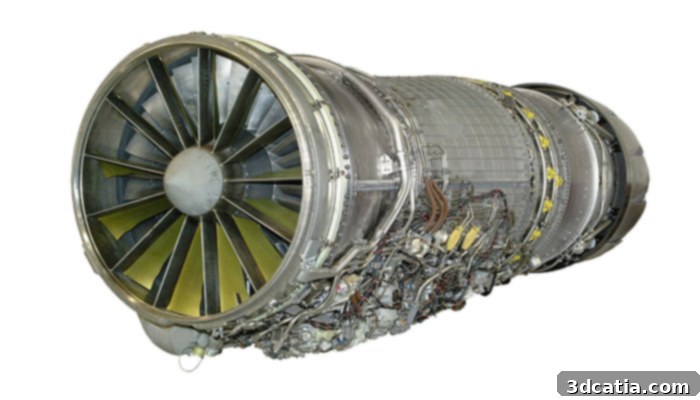
GE Aviation F110 engine | Credits: GE Additive
Unlocking the Multifaceted Benefits of Metal Additive Manufacturing for Aerospace Sustainment
The partnership between the US Air Force and GE is meticulously structured around an innovative “spiral development” model. This progressive approach is engineered to systematically increase in both complexity and scale with each successive phase, guaranteeing a controlled yet significantly accelerated pathway for technology integration and adoption. Initially, the program judiciously focuses on the identification and production of simpler, less functionally complex parts. As experience and confidence grow, it gradually progresses towards more intricate challenges, such as the strategic consolidation of multiple individual parts into a single, optimized component or entire families of parts. Ultimately, the long-term objective is to confidently tackle highly complex and critical components and integrated systems, including sophisticated common core heat exchangers. The overarching and compelling benefit of employing additive manufacturing technologies in this critical aerospace context is its inherent and unparalleled speed and agility in both developing and validating these essential solutions. This rapid iteration capability profoundly reduces the extensive lead times typically associated with conventional manufacturing processes, a factor that is absolutely paramount for maintaining military readiness and operational agility.
Lisa Coroa-Bockley, general manager for advanced materials solutions at GE Aviation, perfectly encapsulated a core advantage of this revolutionary technology: “Speed is additive’s currency, and by applying our additive experiences with the LEAP fuel nozzle and other parts additively printed for the GE9X, being able to offer an end-to-end solution and also applying lessons learned of a robust certification processes, we’ve been able to accelerate the pace for the US Air Force.” This profound emphasis on speed directly translates into significantly enhanced operational readiness across the Air Force fleet. Additive manufacturing empowers parts to be produced precisely when and where they are needed, operating on an on-demand basis. This drastically minimizes the necessity for extensive physical inventories and alleviates the logistical burdens and protracted timelines inherently associated with conventional global supply chains. Furthermore, the unparalleled design freedom intrinsic to 3D printing technology enables engineers to achieve remarkable feats, such as consolidating numerous discrete components into a single, intricately optimized part. This innovative approach leads to substantial reductions in overall weight, measurable improvements in component performance, and significantly simplified assembly procedures. For legacy aircraft, where original equipment manufacturers may have long ceased the production of specific, essential components, additive manufacturing provides a vital lifeline, effectively extending the operational life of these critical assets and ensuring their continued mission capability for decades to come.
The crucial aspect of affordability stands as another compelling driver behind the widespread adoption of additive manufacturing within military aerospace. By intelligently streamlining both design and production workflows, minimizing material waste through optimized geometries, and significantly reducing the substantial costs typically associated with tooling fabrication and extensive inventory management, additive manufacturing offers a clear and sustainable pathway towards more cost-effective sustainment strategies. This financial advantage is particularly pertinent for the production of low-volume, yet exceptionally high-value components that are characteristic of the specialized aerospace defense sector. Beyond the immediate benefits of reduced cost and accelerated production speed, additive manufacturing plays a pivotal role in fostering a more robust and resilient supply chain. The inherent ability to produce critical parts closer to their ultimate point of need, whether that be at a forward operating base in a remote location or a domestic maintenance depot, dramatically enhances logistical flexibility and significantly mitigates vulnerabilities that are often associated with complex and geographically dispersed global supply chains. This localized production capability represents a profound strategic advantage for military operations, ensuring continuity and reliability even in challenging geopolitical landscapes.
Phase 1 Success: Demonstrating Airworthiness with the F110 Sump Cover
GE has officially announced the successful and pivotal completion of Phase 1 of this groundbreaking program, marking a significant milestone in the collaborative journey with the US Air Force. This initial, foundational phase was strategically concentrated on two vital propulsion systems: the formidable GE Aviation F110 and TF34 engines. The primary and overarching objective was twofold: first, the meticulous identification of specific spare parts that were highly suitable for production via additive manufacturing, and second, and perhaps most critically, the undeniable demonstration of their airworthiness capability through an exhaustive series of rigorous testing and validation protocols. Extensive preliminary research and development work had already been diligently conducted on a particular component: the sump cover for the General Electric F110 engine. This engine is a true workhorse of military aviation, providing the thrust for both the iconic F-15 Eagle and the agile F-16 Fighting Falcon aircraft, both of which are foundational cornerstones of the US Air Force’s combat fleet. Consequently, the F110 sump cover was strategically chosen as the focal point part for this critical first phase of the program, serving as a robust proof-of-concept.
While the sump cover, in terms of sheer functional complexity, might appear to be less intricate when compared to other highly sophisticated components nestled deep within the F110 engine, its role is unequivocally critical to the engine’s holistic integrity, reliability, and safe operation. It is an unassuming yet essential part that must exhibit exceptional structural durability, unfailingly form a perfect and hermetic seal to prevent any leakage of fluids, and operate flawlessly and dependably throughout the engine’s demanding operational cycles for the entire propulsion system to function safely, efficiently, and effectively. The successful additive manufacturing of this specific part demanded an extraordinary level of meticulous attention to advanced material science, precision design optimization, and stringent process control throughout every stage of its creation. For the initial builds of these additively manufactured sump covers, GE Additive leveraged its state-of-the-art Concept Laser M2 machines. These highly sophisticated industrial systems, precisely operating with high-performance cobalt-chrome alloys at GE’s renowned Additive Technology Center (ATC), were absolutely instrumental in producing components that not only met but exceeded the exceptionally stringent quality, performance, and certification specifications required for any aerospace application. The strategic choice of cobalt-chrome alloy was deliberate, owing to its superior high strength-to-weight ratio, outstanding corrosion resistance, and remarkable ability to withstand the extreme temperatures and pressures characteristic of the harsh operating environment within a jet engine.
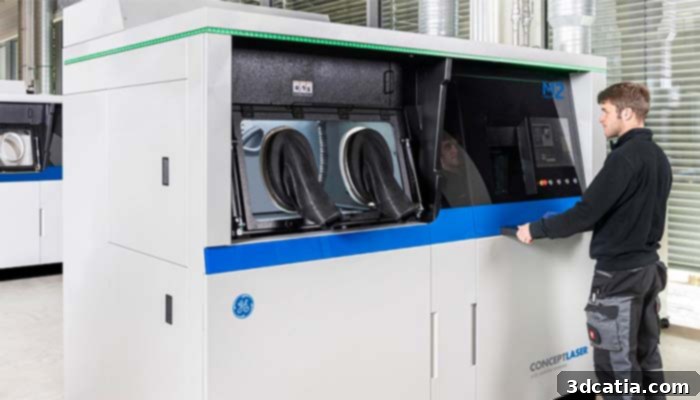
GE’s Concept Laser M2 machine
This foundational collaboration serves as a powerful and compelling demonstration of how metal additive manufacturing is fundamentally poised to profoundly advance, inform, and reshape the established paradigms of design, manufacturing methodologies, and rigorous certification processes across both the commercial and military aerospace sectors. It is actively paving the way for the realization of capabilities and the creation of parts that were previously considered unimaginable or simply unfeasible with traditional manufacturing techniques. Throughout every stage of this pioneering process, both GE and the US Air Force have been actively and diligently exploring, validating, and establishing protocols for how metal additive manufacturing can effectively replace conventional manufacturing methods. This application is particularly crucial for components that are either no longer in production by original equipment suppliers due to obsolescence, or for situations where smaller, highly specialized production runs are urgently needed without incurring the prohibitive costs and protracted lead times typically associated with retooling for conventional manufacturing. The implications of this collaborative effort extend far beyond mere part replacement; it actively opens expansive new avenues for radical design innovation, significant part lightweighting, and measurable performance enhancement that promise to profoundly impact future aircraft designs, improve operational efficiencies, and enhance the overall readiness of the fleet. Further detailed information on this significant partnership and its key technology milestones can be accessed directly HERE.
The strategic importance and far-reaching impact of this collaboration between the US Air Force and GE Additive cannot be overstated. By establishing robust and validated processes for certifying additively manufactured parts, the US Air Force is actively constructing a more resilient, significantly agile, and ultimately cost-effective supply chain for its critical aerial assets. This forward-thinking approach not only profoundly enhances the readiness and operational lifespan of its current fleet but also lays an indispensable groundwork for the next generation of advanced aircraft. In these future designs, additive manufacturing will undoubtedly play an even more integral and central role, influencing everything from initial conceptualization to final production and sustainment. This groundbreaking partnership perfectly exemplifies the transformative potential of advanced manufacturing technologies to effectively solve exceptionally complex logistical and operational challenges, thereby securing a more sustainable, capable, and technologically advanced future for military aviation.
What are your thoughts on this groundbreaking collaboration between the US Air Force and GE Additive? How do you foresee metal 3D printing continuing to impact and revolutionize the future of aerospace sustainment and military readiness? We invite you to share your valuable insights in the comment section below or engage with us on our Facebook and Twitter pages! Don’t miss out on the very latest advancements and breaking news in the exciting world of 3D printing; remember to sign up for our free weekly Newsletter, delivering all the essential updates straight to your inbox!