
USAF Accelerates Advanced Manufacturing Capabilities with Strategic Investments in Inkbit and BotFactory
The U.S. Air Force (USAF) has once again underscored its profound commitment to leveraging cutting-edge additive manufacturing technologies, announcing substantial contracts with two pioneering 3D printing companies: Inkbit and BotFactory. This latest development, while significant, aligns perfectly with the USAF’s established trajectory of integrating advanced manufacturing into its operational framework. Over recent years, the Air Force has consistently demonstrated its trust and investment in 3D printing, forging partnerships with industry leaders such as Optomec and Essentium. Its extensive portfolio of additive manufacturing investments spans a wide spectrum of materials and processes, from metal 3D printing to advanced ceramic 3D printing solutions developed in collaboration with General Electric (GE). These new contracts further solidify this strategic direction, with Inkbit securing $1.7 million for its advanced multi-material 3D printing platforms and BotFactory receiving $750,000 for its innovative electronics 3D printer. These investments signal a clear intent by the USAF to enhance its agility, reduce costs, and bolster national security through the transformative power of additive manufacturing.
Strategic Imperatives: Why Additive Manufacturing is Critical for the USAF
The U.S. Air Force’s consistent investment in additive manufacturing is driven by a confluence of strategic imperatives that are reshaping defense readiness and operational efficiency. In an era of complex global supply chains and rapidly evolving technological landscapes, 3D printing offers unparalleled advantages. Firstly, it provides robust supply chain resilience. The ability to produce critical parts on-demand and often on-site significantly reduces reliance on lengthy procurement cycles and vulnerable external manufacturing sources. This agility is vital for maintaining operational readiness, especially in austere or forward-deployed environments.
Secondly, additive manufacturing promises substantial cost reduction. By enabling the production of specialized components without expensive tooling or large minimum order quantities, it streamlines manufacturing processes and minimizes waste. This directly impacts the lifetime cost of military assets, from aircraft to ground support equipment. Furthermore, 3D printing facilitates rapid prototyping and iteration, allowing engineers to design, test, and refine components at an accelerated pace. This faster innovation cycle translates into quicker deployment of advanced capabilities and a sustained technological edge.
The technology also allows for unprecedented customization and geometric complexity, enabling the creation of lightweight parts with optimized performance characteristics. This can lead to improved fuel efficiency for aircraft or enhanced capabilities for various defense systems. For the USAF, these benefits collectively contribute to a more agile, cost-effective, and technologically superior force. The collaborations with Inkbit and BotFactory exemplify this forward-thinking approach, targeting specific challenges in multi-material fabrication and critical electronics production.
Inkbit’s Multi-Material Innovation: The Vista System for Enhanced Performance
As part of a Small Business Innovation Research (SBIR) contract, the USAF has commissioned three Inkbit Vista 3D printing systems. The SBIR program is crucial for fostering innovation within small businesses, enabling them to contribute groundbreaking technologies to federal agencies. Inkbit, a spin-out from MIT, brings a truly distinctive approach to additive manufacturing with its proprietary Vision-Controlled Jetting (VCJ) solution, integrated with multi-material design software. These Inkbit Vista machines represent some of the company’s inaugural commercial systems, marking a significant milestone in their journey.
The Inkbit Vista stands out for its exceptional reliability and precision, achieved through real-time, in-process voxel-level control. This innovative feature allows the system to monitor and adjust every microscopic detail of the printing process, ensuring unparalleled accuracy. Capable of depositing 2.75 liters of material per hour with precision down to tens of microns, the Vista system minimizes defects and ensures consistent quality. A key strength of the Inkbit Vista is its ability to simultaneously process up to four different materials. This multi-material capability is transformative for defense applications, allowing engineers to produce highly complex parts with varied mechanical properties, integrated functionalities, or even embedded sensors within a single print. For instance, a single component could feature rigid structural elements, flexible seals, and thermally conductive pathways, all precisely fabricated in one go, with the fourth material acting as an easily removable support structure during the printing process. This integration streamlines assembly, reduces part count, and enables designs previously impossible with traditional manufacturing methods.
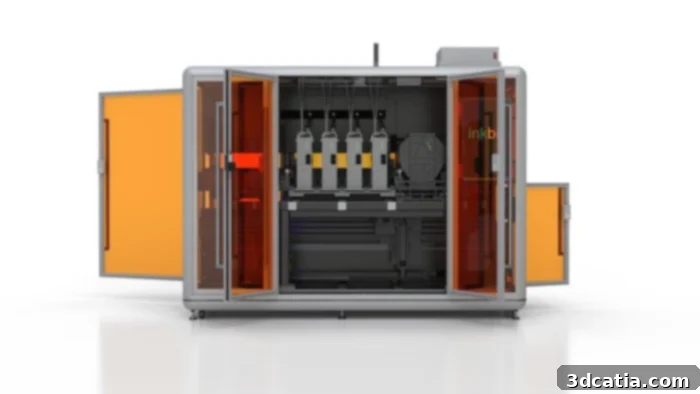
The Inkbit Vista. (Photo Credit: Inkbit)
Davide Marini, co-founder and CEO of Inkbit, expressed enthusiasm for this collaboration: “We are thrilled to be awarded this substantial contract from the United States Air Force. We are at an inflection point in our business where the technology is undoubtedly making a difference in how additive manufacturing is used to create materials that are appropriate for end-use, pass quality assurance standard, and reduce general production costs from legacy systems. We are looking forward to working with the USAF and are excited to make a difference with additive manufacturing.” This statement perfectly encapsulates the USAF’s goal: to move beyond mere prototyping and utilize 3D printing for certified, end-use parts that meet rigorous defense standards, all while achieving significant cost reductions compared to traditional manufacturing pipelines. The partnership with Inkbit is expected to empower the USAF to achieve manufacturing at a ‘greatly reduced’ cost, a critical factor for optimizing defense budgets. Further details on the Inkbit Vista contracts can be found HERE.
BotFactory: Revolutionizing On-Demand PCB Production for National Security
The contract awarded to BotFactory stems from another crucial USAF initiative, AFWERX. This program is dedicated to fostering a culture of innovation across the Air Force, connecting military challenges with commercial and academic solutions. AFWERX has tasked BotFactory with developing a fully automated desktop machine capable of on-site, on-demand 3D printing and assembly of printed circuit boards (PCBs). This focus on PCBs highlights their indispensable role across a vast array of USAF activities, serving as the neural network for critical equipment ranging from sophisticated aircraft avionics and navigation systems to advanced communication devices and even integrated components within warfighter uniforms.
Despite remarkable advancements in PCB technology itself over recent years, the methods for small-scale and prototyping production have conspicuously lagged. This disparity has resulted in significant financial drains for the USAF, amounting to millions of dollars annually, and has caused airmen and engineers to lose invaluable time waiting for custom or replacement PCBs. The conventional outsourcing and extended lead times for specialized PCBs pose not only logistical hurdles but also potential vulnerabilities in securing sensitive defense technologies. BotFactory’s solution directly addresses these critical pain points.
Carlos Ospina, Co-Founder and CTO of BotFactory, emphasized the uniqueness and importance of their approach: “Integrating Inkjet Printing and Pick-and-Place capabilities for PCB fabrication is something no-one is doing, and we’re excited to work with the USAF to fix a problem that is so critical to US National Security.” This innovative integration allows for the rapid, localized production of functional electronic prototypes and small batches of PCBs. By combining inkjet printing (for conductive traces) with automated pick-and-place technology (for component assembly) in a compact desktop unit, BotFactory empowers the USAF to fabricate complex electronics with unprecedented speed and security. This capability directly enhances national security by reducing reliance on external, potentially less secure, supply chains for vital electronic components. It means quicker repairs, faster upgrades, and the ability to rapidly develop and deploy bespoke electronic solutions for emerging threats, ensuring that military technology remains at the forefront.
Broader Implications and the Future of Defense Manufacturing
These latest contracts with Inkbit and BotFactory are more than just isolated transactions; they are indicative of a broader and accelerating trend: the growing importance of additive manufacturing across the entire defense sector. The U.S. military, including the Army, Navy, and newly formed Space Force, is increasingly recognizing 3D printing as a cornerstone technology for future readiness. The ability to produce parts, tools, and even complete systems closer to the point of need is revolutionizing logistics, maintenance, and innovation cycles. This shift supports the military’s strategic goals of maintaining technological superiority, reducing operational costs, and enhancing adaptability in an unpredictable world. From enabling rapid field repairs of critical equipment to fabricating custom tools on demand in remote locations, additive manufacturing offers an unparalleled degree of operational flexibility.
Looking ahead, the collaboration with companies like Inkbit and BotFactory promises to drive further advancements in material science and process automation, pushing the boundaries of what’s possible with 3D printing. We can expect to see integrated systems capable of producing increasingly complex and multi-functional components, further blurring the lines between design, manufacturing, and assembly. This relentless pursuit of innovation ensures that the U.S. military remains at the forefront of technological capability, capable of quickly adapting to new challenges and maintaining its strategic edge against global adversaries. The ongoing investments reinforce the strategic imperative for the United States to harness advanced manufacturing to secure its national interests and safeguard its personnel.
What are your thoughts on the U.S. Air Force’s expanding investments in advanced 3D printing technologies? We invite you to share your insights in the comments section below or join the conversation on our Linkedin, Facebook, and Twitter pages! For the latest updates and breaking news in the world of 3D printing, remember to sign up for our free weekly Newsletter here, delivered straight to your inbox.
*Cover photo courtesy of Lance Anderson on Unsplash