
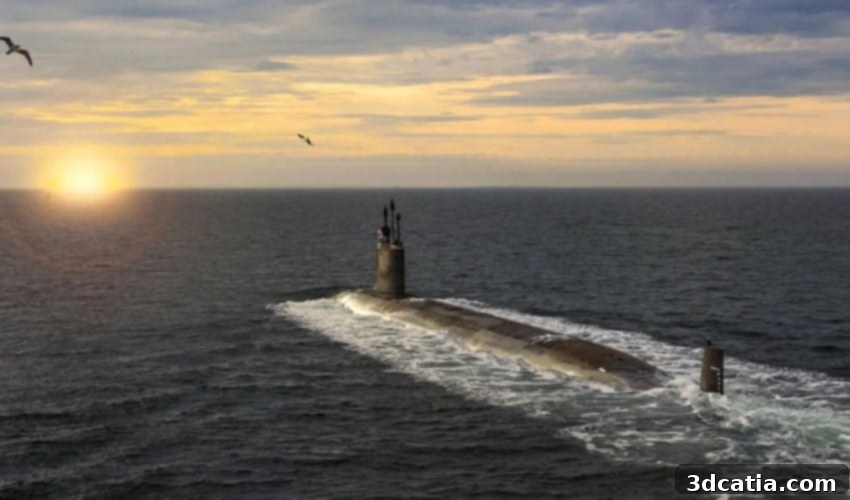
Revolutionizing Naval Power: 3D Printing Transforms Virginia-Class Submarine Manufacturing
The United States Navy operates as a formidable global force, projecting power and ensuring maritime security across every ocean. To maintain its unparalleled operational effectiveness and technological superiority, the Navy consistently seeks the most cutting-edge advancements. In recent years, additive manufacturing, commonly known as 3D printing, has emerged as a transformative solution, playing an increasingly vital role in modernizing naval submarine production and maintenance. This innovative approach is enabling the Navy to develop entirely new strategies for manufacturing, particularly for its advanced submarine fleet. A significant leap forward has been announced by leading defense contractors HII Newport News Shipbuilding and General Dynamics Electric Boat, who are now integrating additive manufacturing into the production of the next generation of Virginia-class nuclear submarines – iconic vessels renowned for their stealth and capability. This strategic adoption of 3D printing promises to significantly accelerate the construction of these sophisticated ships, drastically reduce reliance on traditional, often lengthy, supply chains, and ensure faster, more agile deliveries of critical components and entire vessels.
HII and General Dynamics Electric Boat have solidified their roles as integral members of the Virginia-class submarine production team, driving innovation at the forefront of naval engineering. The Virginia-class submarines represent the pinnacle of undersea warfare capabilities, featuring state-of-the-art intelligence equipment, robust battle group support functionalities, and advanced mine warfare capabilities. The overarching objective of this ambitious project is not merely to replace existing vessels, but to design and construct a submarine that surpasses its predecessors in every metric. Specifically, the program aims for significantly shorter production times and a marked improvement in both materials and operational capabilities compared to the contemporary Los Angeles-class submarines, which they are slated to replace. To achieve these ambitious goals, groundbreaking marine alloys, such as copper-nickel, are being strategically implemented as alternative building materials. These materials offer enhanced properties compared to the traditional metals that have dominated shipbuilding for decades. This particular copper-nickel alloy, for instance, has been identified for critical applications, specifically for the 3D printed manufacturing of deck drains, showcasing the precision and material diversity enabled by additive processes.
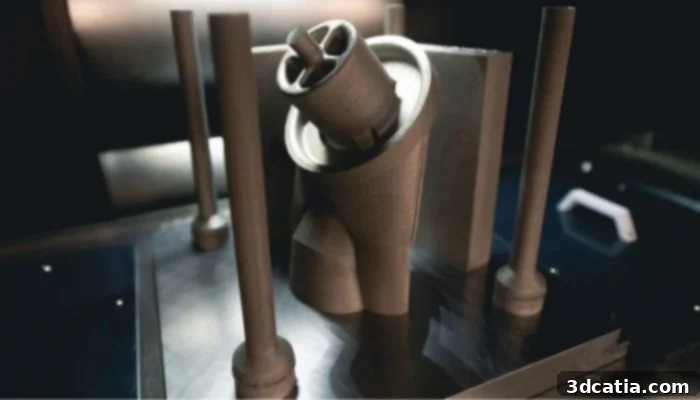
The 3D printed pieces for use in the subs (Photo credits: HII)
One of the initial and most significant components targeted for 3D printing on the advanced Virginia-class submarine is the deck drain system. These ducts perform a crucial function aboard any vessel, efficiently channeling water from specific locations to prevent accumulation and ensure structural integrity and crew safety. The collaborative efforts of AMMCON, a specialized manufacturing supplier, alongside naval specialists HII and General Dynamics Electric Boat, were instrumental in the rigorous testing of these 3D printed drains. The comprehensive evaluation yielded unequivocally positive results, robustly demonstrating the exceptional strength and durability of the 3D printed parts. Beyond their mechanical integrity, the testing also confirmed the remarkable cost-effectiveness achieved through the additive manufacturing process. This dual success—superior performance coupled with significant economic advantages—paved the way for their immediate implementation. These pioneering 3D printed deck drains have since been successfully installed on the Virginia-class USS Oklahoma (SSN-802), a vessel currently under active construction. The USS Oklahoma is not just another submarine; it is anticipated to serve as a pivotal model, establishing a new paradigm for the integration of 3D printing in the production of the entire Virginia-class fleet. The undeniable benefits of this system, including its rapid and straightforward fabrication process, coupled with its notably lower production cost, firmly position the 3D printed drainage system as the optimal and preferred choice for the U.S. Navy, underscoring a strategic shift towards more efficient and innovative shipbuilding practices.
The enthusiastic adoption of additive manufacturing within naval shipbuilding reflects a forward-thinking leadership vision. Dave Bolcar, Vice President of Engineering and Design at Newport News Shipbuilding, articulated this commitment, stating, “As a leader in additive manufacturing for shipbuilding, we are aggressively looking for opportunities to find ways to incorporate this technology into mainstream shipbuilding.” This statement underscores a proactive and determined effort to integrate 3D printing beyond experimental applications and into core production methodologies. To facilitate this ambitious transition, the U.S. Navy has actively approved a series of progressive proposals designed to streamline the stringent requirements necessary for validating and ultimately approving a wider array of ‘low-risk’ 3D-designed parts for direct use in their vessels. This strategic easing of approval pathways for non-critical components serves as an invaluable entry point, allowing the Navy to gain experience, refine processes, and build confidence in the technology before scaling up to more complex, mission-critical applications. The demonstrable efforts to successfully install parts created with additive manufacturing, such as the copper-nickel deck drains, on operational submarines profoundly illustrate the technology’s immense potential. Crucially, this integration dramatically reduces lead times for critical components, a factor that holds immense strategic value for military readiness, operational agility, and the overall resilience of the naval supply chain. In a dynamic global environment, the ability to rapidly produce and replace parts on demand is a distinct advantage, ensuring that the U.S. Navy’s fleet remains operational and technologically superior.
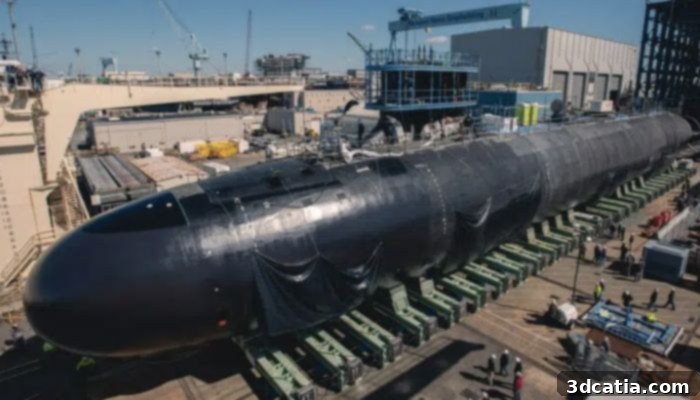
Construction underway on the USS New Jersey, a Virginia-class submarine (Photo credits: Huntington Ingalls)
The implementation of 3D printing in the construction of Virginia-class submarines marks a pivotal moment in the history of naval engineering and advanced manufacturing. This strategic embrace of additive manufacturing is not merely about producing parts; it represents a fundamental shift in how the U.S. Navy designs, builds, and maintains its most critical assets. By leveraging the capabilities of 3D printing, the Navy is not only optimizing its current shipbuilding processes but also laying the groundwork for future innovations that will define naval power for decades to come. The initial successes with components like the copper-nickel deck drains on the USS Oklahoma underscore the immense potential for efficiency, cost savings, and enhanced operational readiness. This commitment to integrating cutting-edge technology ensures that the U.S. Navy remains at the forefront of defense innovation, capable of rapidly adapting to evolving challenges and maintaining its global presence with unmatched strength and agility. This advancement promises a future where naval vessels are built faster, smarter, and with greater resilience, securing America’s maritime superiority in an increasingly complex world.
We’d love to hear your thoughts on the U.S. Navy’s latest advancements in shipbuilding through 3D printing. What do you think about the transformative potential of additive manufacturing for naval defense? Share your insights and join the conversation in the comments below, or connect with us on our LinkedIn, Facebook, and Twitter pages! Don’t miss out on the latest developments in the world of 3D printing – remember to sign up for our free weekly Newsletter here, delivering the most important news straight to your inbox! You can also explore all our in-depth videos and content on our dedicated YouTube channel.
*Cover Photo Credits: General Dynamics