
3D Printed Coral Reefs: Revolutionizing Marine Ecosystem Restoration and Ocean Conservation
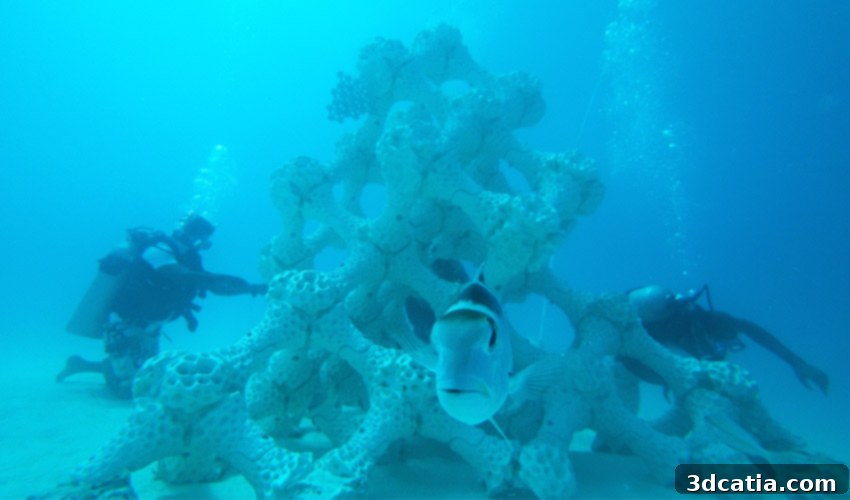
The world’s oceans are facing unprecedented challenges, with marine ecosystems under immense pressure from climate change, pollution, and human activities. Among the most vulnerable and vital of these ecosystems are coral reefs. These vibrant underwater cities, teeming with life, are critical habitats for a quarter of all marine species. Yet, they are disappearing at an alarming rate due to phenomena like coral bleaching. In response to this global crisis, innovative technologies are being harnessed, with 3D printing emerging as a powerful tool for large-scale marine restoration. One groundbreaking example, highlighted in our previous features, is the installation of the largest 3D printed coral reef in the Maldives, a visionary project spearheaded by industrial designer Alex Goad of the Reef Design Lab.
This ambitious initiative represents a significant leap forward in our efforts to combat the degradation of marine environments. Positioned at the bottom of the Indian Ocean, this artificial reef, constructed from hundreds of meticulously crafted 3D printed ceramic molds, aims to provide a new sanctuary for marine life and encourage natural coral growth. It’s more than just a structure; it’s a living laboratory, designed to mimic the intricate complexities of natural reefs, offering a sustainable solution to preserve biodiversity and restore the health of our planet’s most precious underwater habitats. The ability of 3D printing to create highly detailed, biomimetic structures offers an unparalleled advantage in these critical conservation efforts.
The Critical State of Coral Reefs: Understanding Coral Bleaching
Coral reefs, often referred to as the “rainforests of the sea,” are biodiversity hotspots, supporting an astonishing array of aquatic species, from microscopic algae to large fish and intricate invertebrates. Beyond their ecological importance, they provide essential services such as coastal protection, food security for millions of people, and significant economic value through tourism and fisheries. However, these vital ecosystems are currently under severe threat, primarily from a phenomenon known as coral bleaching. This alarming process is accelerating globally, pushing many reef systems to the brink of collapse.
Coral bleaching occurs when corals expel the symbiotic algae (zooxanthellae) living in their tissues, which provide them with essential nutrients and their vibrant colors. This expulsion primarily happens due to increases in ocean temperature, often linked to global warming and climate change, but can also be triggered by pollution or extreme changes in salinity. When corals bleach, they turn white and become highly susceptible to disease and death if environmental stressors persist. The gradual death of corals subsequently devastates the entire reef ecosystem, impacting all the species that depend on it for food, shelter, and reproduction. The urgency of finding effective preservation and restoration methods has never been greater, prompting scientists and innovators to explore novel approaches, including the transformative potential of 3D printing technologies.
3D Printing: A New Dawn for Reef Restoration
The unique capabilities of 3D printing, or additive manufacturing, make it an exceptionally suitable technology for addressing the complex challenges of coral reef restoration. Traditional methods often struggle to replicate the intricate and varied structures of natural reefs, which are crucial for attracting and supporting diverse marine life. 3D printing, however, allows for the creation of highly detailed, biomimetic substrates that can closely mirror the shapes, textures, and interstitial spaces found in natural coral formations. This precision is key to successful ecological integration.
This precision engineering capability is vital because the micro-environments within a reef are critical for the settlement of coral larvae and the establishment of other marine organisms. By designing artificial structures that precisely emulate these natural conditions, 3D printed reefs can more effectively attract coral polyps, providing ideal surfaces for their attachment, growth, and subsequent reproduction. Furthermore, the technology offers immense flexibility in material choice, enabling the use of biocompatible and environmentally friendly materials that can safely integrate into the marine environment and even promote calcification processes vital for coral health. This adaptability allows researchers to experiment with materials that best support specific coral species and local conditions.
Pioneering Projects: Beyond the Maldives
While the Maldives project stands out for its scale and innovation, it is part of a broader global movement utilizing 3D printing for marine conservation. Another notable example includes the collaboration between Emerging Objects, Boston Ceramics, and SECORE (Sexual Coral Restoration). This partnership focused on creating innovative 3D printed substrates specifically designed to attract coral larvae. By providing optimal surfaces and intricate micro-architectures, these substrates aim to encourage the natural settlement and reproduction of corals, thereby aiding in the replenishment of damaged reefs. Such projects highlight the versatility of 3D printing, from creating large structural elements to small, intricate pieces tailored for larval attachment, all contributing to the overarching goal of reef rehabilitation.
The Maldives’ Ambitious Venture: The Largest 3D Printed Barrier Reef
With an unwavering commitment to marine restoration, industrial designer Alex Goad of the Reef Design Lab embarked on developing what has officially become the largest 3D printed coral reef ever created. This monumental structure was successfully deployed in the Indian Ocean, specifically near the luxurious Summer Island Maldives resort, making it an accessible and visible beacon of hope for conservation. The project serves as a powerful demonstration of how advanced manufacturing can contribute to ecological recovery on a significant scale.
The design phase of this extraordinary reef involved cutting-edge computer modeling programs. These advanced tools allowed Goad and his team to meticulously design hundreds of individual modules, replicating the complex and varied textures found in natural coral formations. This sophisticated modeling ensures that the artificial reef provides the necessary nooks, crannies, and surfaces that are biologically advantageous for a wide variety of marine organisms, fostering a rich and diverse ecosystem. The goal was not merely to create a structure, but a vibrant, functional habitat that closely mimics nature’s own intricate designs, crucial for attracting and supporting life.
Once the digital modeling was perfected, the actual fabrication process began, leveraging the speed and efficiency of 3D printing. A large-scale 3D printer was utilized to rapidly produce 220 ceramic molds. Remarkably, this phase of printing the intricate molds took approximately 24 hours, showcasing the incredible speed advantage of additive manufacturing compared to traditional fabrication methods. Alex Goad elaborated on the material choice, explaining that these molds were then cast in ceramics – a material specifically chosen for its properties that are remarkably similar to calcium carbonate, the primary component of natural coral skeletons. This bio-mimetic approach is crucial for creating an environment conducive to coral growth and attachment, offering a chemically hospitable surface for colonisation.
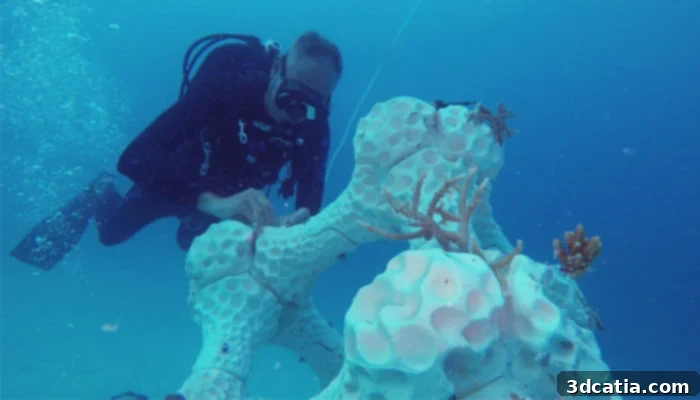
Following the casting, the ceramic molds were filled with marine-grade concrete to provide stability and durability for the underwater environment. The assembly of these robust modules took place directly in the Indian Ocean, at a depth of 7 meters, adjacent to an existing coral nursery. This strategic placement allows for the immediate integration of living corals into the new structure, drawing from a local, adapted population. Coral fragments, carefully harvested from the nearby nursery, were then painstakingly placed onto the textured surfaces of the 3D printed reef. The expert team behind the project harbors great optimism, hoping that within one to two years, these transplanted corals will successfully colonize the artificial reef, transforming it into a thriving, self-sustaining ecosystem that mimics a natural reef system.
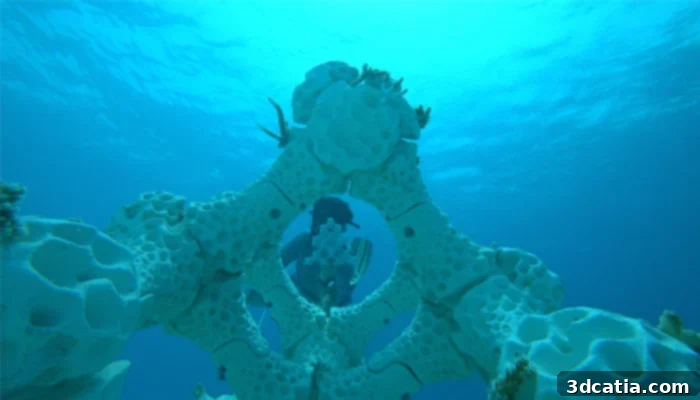
The modular design facilitated efficient underwater assembly of the 3D printed reef components by a team of divers.
The Vision and Future Impact of 3D Printed Reefs
Alex Goad articulates the profound scientific motivation behind the project: “This is fundamentally a scientific and research project. 3D printing technology empowers us to meticulously mimic the extraordinary complexity of natural reef structures. This capability allows us to design artificial reefs that are not only structurally sound but also remarkably similar to their natural counterparts in form and function. Our ultimate hope is that this method will prove to be a significantly more effective way to cultivate and restore coral populations, providing a robust defense against the escalating threats to marine life.” His words underscore the blend of art, science, and technology driving this innovative approach to conservation.
The stakeholders involved in this innovative endeavor are cautiously optimistic about its potential. They anticipate that if the project proves successful in fostering robust coral growth and attracting diverse marine species, the underwater landscape could see the emergence of a new, vibrant natural reef within a year or two. Such an outcome would not only validate the efficacy of 3D printing in large-scale marine conservation but also pave the way for similar projects worldwide, offering a tangible, scalable solution to the global challenge of coral reef degradation. The data collected from this project will be invaluable for future reef restoration efforts.
Beyond the immediate ecological benefits, successful 3D printed reefs can contribute significantly to local economies through eco-tourism and enhanced fisheries, creating new opportunities for communities reliant on healthy marine environments. They serve as tangible examples of how cutting-edge technology can be leveraged for environmental stewardship, inspiring further research and development in sustainable conservation practices. This project underscores a powerful message: with innovation, dedication, and collaborative effort, humanity can play an active and restorative role in healing the planet’s most precious ecosystems, ensuring their survival for future generations.
For those interested in delving deeper into the specifics of this pioneering work, more comprehensive information can be found on the Reef Design Lab website. You can also gain a visual understanding of the project by watching the insightful video below, which provides a firsthand look at the design, production, and installation process:
What are your thoughts on this incredible 3D printing coral reef project and its potential to safeguard our marine ecosystems? We invite you to share your comments and insights below or engage with us on our Facebook and Twitter pages! Don’t forget to sign up for our free weekly Newsletter to receive all the latest news, innovations, and developments in the world of 3D printing directly in your inbox.