
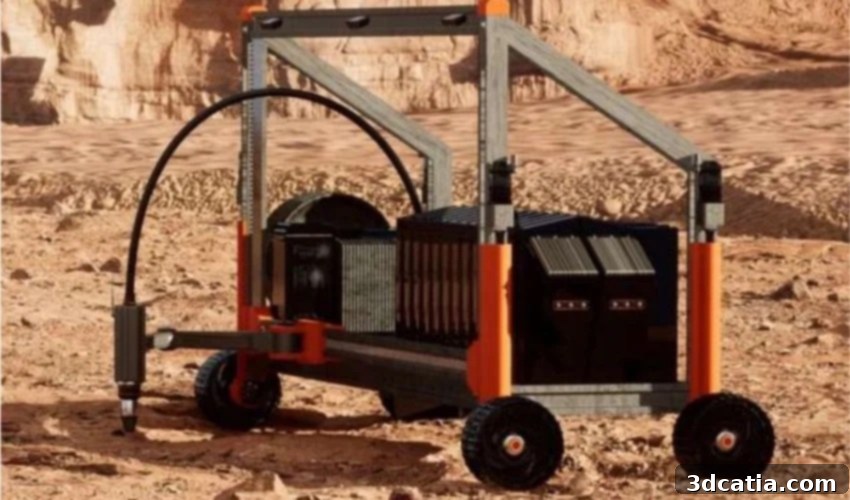
Pioneering Martian Habitats: Taylor University’s Mobile Gantry 3D Printer Revolutionizes Space Colonization
The dream of human presence beyond Earth is rapidly evolving from science fiction to tangible engineering challenges. As humanity sets its sights on establishing a lasting foothold on celestial bodies like Mars, the need for innovative, self-sufficient construction methods becomes paramount. We’ve previously explored the vast potential of 3D printing for life in space, envisioning everything from specialized spacesuits and vital equipment to entire extraterrestrial habitats and essential repair patches – all producible on-demand in the harsh vacuum or alien landscapes. Building upon this groundbreaking vision, a dedicated team of researchers from the Department of Physics and Engineering at Taylor University in the United States has engineered a remarkable solution: a unique mobile 3D printer designed specifically to tackle the monumental task of constructing infrastructure on distant planets. This innovative device, named the Mobile Gantry, represents a significant leap towards enabling sustainable human settlement on Mars, offering unprecedented flexibility and capability for developing vital living spaces.
The research team, comprised of Peter J. Staritz, Caleb S. Miller, and Josiah C. McClurg, recognized that the conventional approach of transporting all necessary building materials from Earth to Mars is not only prohibitively expensive but also logistically complex and unsustainable for long-term colonization efforts. Instead, they focused on harnessing the full power of additive manufacturing (3D printing) technologies to utilize local Martian resources, known as in-situ resource utilization (ISRU). Their vision centered on developing a robust robotic system capable of constructing larger, stronger, and more resilient structures directly on the Martian surface. To address the inherent challenges of extraterrestrial construction – such as uneven terrain, varying atmospheric conditions, and the need for precision – the team brilliantly combined the agility of a mobile robot with the structural stability and precision of gantry robots. This ingenious fusion has given birth to the Mobile Gantry 3D printer, a system that uniquely leverages the advantages of both technologies, enabling advanced functionalities like sequential assembly and parallel construction, which are critical for efficient and rapid habitat development on Mars. A prototype of their Mobile Gantry has already undergone successful initial test runs, paving the way for future advancements.
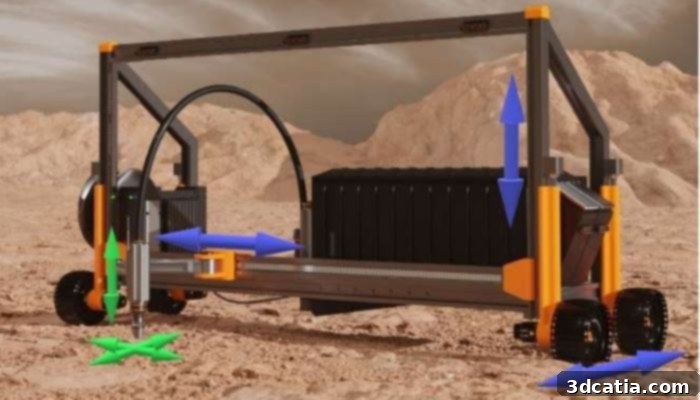
Could the Mobile Gantry soon make planning and building habitats on Mars a concrete reality?
The Ingenious Fusion: How the Mobile Gantry Combines Robotics for Martian Construction
The true innovation of the Mobile Gantry lies in its ability to transcend the traditional limitations of static 3D printers. By seamlessly integrating mobile robotics with gantry-based additive manufacturing, the Taylor University researchers have created a system that can efficiently 3D print structures on Mars that are significantly larger than the Mobile Gantry itself. This crucial capability means that future Martian habitats and infrastructure will not be constrained by the size of the printing apparatus, allowing for the construction of expansive and complex living spaces. The Mobile Gantry’s design enables it to traverse challenging, uneven, and unfamiliar planetary surfaces with remarkable ease. More astonishingly, it possesses the unique ability to travel *on surfaces that it has printed itself*. This is achieved through a sophisticated process where the robot prints foundational structures, including walls and inner partitions, specifically designed with integrated tracks or guides upon which its wheels or locomotion system can precisely align and move forward. This self-advancing capability is a game-changer for autonomous construction on Mars, as it eliminates the need for extensive pre-prepared terrain or external guidance systems.
To accelerate the realization of ambitious goals like Elon Musk’s vision for a multi-planetary civilization, the Mobile Gantry incorporates specialized functions designed to maximize efficiency. Foremost among these is its capacity for parallel construction. In practical terms, this means that multiple Mobile Gantry units can simultaneously work on different sections of the same structure or even collaborate on less complex but equally vital constructions. By enabling robots to operate in parallel on a single large-scale habitat, the overall time required to complete a concrete, 3D-printed Martian dwelling can be drastically reduced. This parallel processing capability is not just about speed; it also introduces a layer of redundancy and fault tolerance, essential for critical missions in remote and unforgiving environments like Mars. Imagine a future where a fleet of Mobile Gantries works in concert, rapidly erecting a complex of interconnected habitats, greenhouses, and scientific facilities, thereby significantly shortening the timeline for establishing a self-sufficient Martian outpost.
Advanced Capabilities and Testing: The “Mud Dauber” Prototype
The ongoing development and rigorous testing of the Mobile Gantry are currently taking place at Taylor University, with a specific prototype affectionately named “Mud Dauber.” This prototype is demonstrating the practical application of the system’s integrated mobility and precision printing capabilities. One of its most significant features is its ability to maintain high-fidelity printing even on surfaces that are inherently uneven or irregular, which is a critical requirement for Martian terrain. Thanks to its advanced positioning system, the Mud Dauber can accurately control and place the print head with remarkable precision, compensating for any surface inconsistencies. This meticulous control ensures that the printed structures meet the stringent requirements for integrity and stability necessary for extraterrestrial habitats.
The research teams are consistently impressed by the overall performance of the Mobile Gantry. A particularly noteworthy advantage is the significantly reduced control complexity of the system. This simplification translates into easier and lower-risk operation, a vital consideration for autonomous or remotely controlled systems operating millions of miles from Earth. Despite this simplified control, the Mobile Gantry delivers impressively high print speeds, without compromising on print quality. In fact, the quality of the structures produced by the Mud Dauber prototype has been consistently high, offering excellent structural integrity and aesthetic finish. These combined attributes—precision on uneven terrain, simplified control, high speed, and superior print quality—make the Mobile Gantry a formidable tool in the quest for establishing off-world human settlements. The success of the Mud Dauber prototype provides crucial validation for the Mobile Gantry’s design philosophy and brings us one step closer to practical Martian colonization.
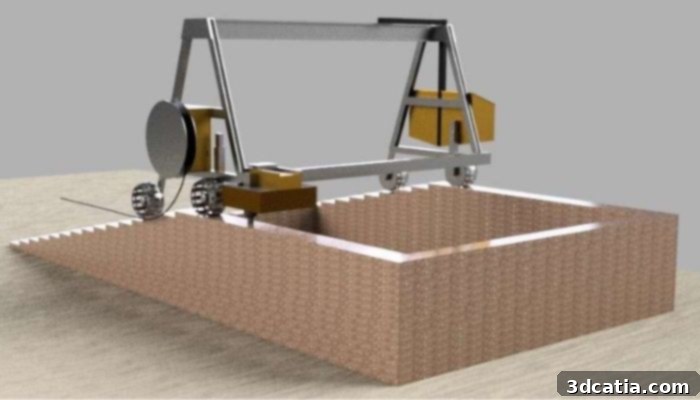
An image depicting the Mobile Gantry as it autonomously moves along a surface it has just printed.
The Broader Vision: 3D Printing’s Role in a Multi-Planetary Future
The Mobile Gantry project at Taylor University is more than just an engineering feat; it’s a testament to the transformative power of additive manufacturing in realizing humanity’s multi-planetary ambitions. While the construction of habitats is a primary focus, the principles and technologies developed here have far wider implications for space exploration and colonization. Imagine the ability to print spare parts for spacecraft on demand, reducing the need for extensive onboard inventories. Consider the potential for creating custom tools, medical supplies, or even scientific instruments using locally sourced materials. The versatility of 3D printing, especially with a mobile, autonomous system like the Mobile Gantry, unlocks a future where astronauts are less reliant on resupply missions from Earth and more empowered to adapt and innovate in their extraterrestrial environments.
The vision of life on Mars, once relegated to the realm of science fiction, is becoming increasingly plausible thanks to the relentless efforts of researchers like those at Taylor University. By addressing the fundamental challenge of building robust, expandable, and safe structures in an alien environment, the Mobile Gantry is paving the way for sustainable human outposts. This research aligns perfectly with global space agencies’ long-term strategies, which emphasize in-situ resource utilization and autonomous robotic construction as cornerstones for deep space missions. The ability to print habitats that can shield occupants from radiation, withstand extreme temperatures, and provide ample living and working space is not just desirable; it is essential for the survival and prosperity of future Martian colonists. The implications extend beyond just Mars, offering a blueprint for constructing bases on the Moon, asteroids, or even in orbital environments, drastically reducing the cost and complexity of space infrastructure.
For those intrigued by the intricate details of this pioneering work and the future of human endeavors on Mars, the comprehensive research paper delving into the specifics of the Mobile Gantry’s design, capabilities, and initial findings is available for further exploration HERE. This paper offers a deeper dive into the engineering principles, material considerations, and the scientific rationale behind this exciting development, providing invaluable insights into the future of extraterrestrial construction.
What are your thoughts on the Mobile Gantry’s potential and the feasibility of human life on Mars? We invite you to share your perspectives and engage in the conversation by leaving a comment below or by connecting with us on our social media channels: LinkedIn, Facebook, and Twitter! Don’t miss out on the latest advancements and breaking news in the world of 3D printing; make sure to sign up for our free weekly Newsletter here, delivered directly to your inbox. You can also discover all our compelling videos and visual content on our dedicated YouTube channel, showcasing the incredible innovations shaping our future, both on Earth and beyond.
*All Photo Credits: Taylor University