

The Rise of 3D Printed Guns: Unpacking the Legality, Challenges, and Future of Untraceable Firearms
In a landmark decision that has reshaped the landscape of gun control and digital rights, 3D printed guns have officially secured a legal standing in the United States. This development culminates a protracted legal and ideological battle, paving the way for the open-source distribution of firearm designs and igniting a renewed debate over gun safety, personal liberties, and the implications of additive manufacturing technology.
The journey of 3D printed firearms began in 2013 with the creation and online release of the world’s first fully 3D-printable handgun, famously dubbed “The Liberator.” This innovative, and instantly controversial, creation was the brainchild of Cody Wilson, a self-proclaimed crypto-anarchist and founder of the organization Defense Distributed. Upon its initial release, the digital blueprints for The Liberator were downloaded over 100,000 times in less than 24 hours, demonstrating an immediate and widespread interest. However, this surge in accessibility prompted a swift intervention from the U.S. Department of State, which ordered Wilson to remove the files, citing concerns over international arms trafficking regulations (ITAR). This injunction marked the beginning of a nearly five-year legal struggle that would eventually challenge fundamental constitutional rights and redefine the boundaries of firearm manufacturing in the digital age.
Cody Wilson’s vision was to democratize firearm production, making gun ownership accessible to anyone with a 3D printer, regardless of existing manufacturing restrictions. His organization, Defense Distributed, championed the philosophy of open-source weapon design, asserting that the right to bear arms extended to the right to produce them at home. The government’s ban on the distribution of these digital blueprints sparked a heated legal battle that centered on two critical constitutional amendments: the First Amendment, guaranteeing freedom of speech, and the Second Amendment, protecting the right to keep and bear arms. Wilson and his legal team argued that sharing CAD files—computer-aided design files—constituted a form of free speech, and therefore, the government’s prohibition amounted to censorship.
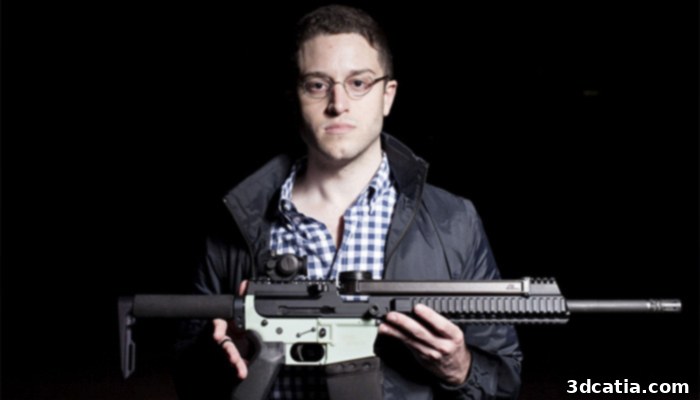
Cody Wilson
A Pivotal Legal Victory: First Amendment Triumphs
After nearly half a decade of intense legal litigation against the Department of Justice, Cody Wilson and Defense Distributed ultimately emerged victorious. The groundbreaking court agreement affirmed that the government’s previous ban on sharing these CAD files indeed violated the First Amendment, recognizing the right to publish such digital information as a protected form of expression. This ruling represented a significant blow to the government’s attempts to control the dissemination of technical information related to firearms. Furthermore, the agreement explicitly stated that “non-automatic 50-caliber firearms are not inherently military.” This finding directly countered a primary argument used by opponents of online file sharing, who often classify semi-automatic sporting rifles as “weapons of war” unsuitable for civilian possession or unrestricted distribution.
This landmark approval comes at a particularly sensitive time for the United States, a nation grappling with an ongoing crisis of gun violence marked by numerous mass shootings and attacks throughout the year. The timing of the decision has intensified the national debate surrounding gun control and public safety. Critics argue that making untraceable firearms easier to produce could exacerbate existing problems and undermine efforts to prevent violence. Adding to the complexity, despite the previous government blockade, the digital files for 3D printed weapons had already permeated the internet, circulating widely and illegally on the dark web and various torrent sites. On these platforms, 3D models of illicit weapons could be obtained for prices as low as $12, highlighting the inherent difficulty in regulating information once it enters the digital sphere. This underground circulation further underscored the futility of attempts to completely suppress these designs, strengthening the argument that an open, legal framework for distribution might be more transparent than an unregulated black market.

the “Liberator”
Reacting to the verdict, Alan Gottlieb, founder and Executive Vice President of the Second Amendment Foundation (SAF), declared in a press release, “Not only is this a First Amendment victory for free speech, it also is a devastating blow to the gun prohibition lobby. For years, anti-gunners have contended that modern semi-automatic sport-utility rifles are so-called ‘weapons of war,’ and with this settlement, the government has acknowledged they are nothing of the sort.” This statement encapsulates the sentiment among Second Amendment advocates, who view the ruling as a validation of both free speech and gun rights, potentially weakening the arguments of those who seek stricter gun control measures.
3D Printed Guns: Back Online and Reshaping the Debate
Following this significant legal triumph, Defense Distributed began to re-upload its 3D weapon models online, effectively making them available to the public once again. The agreement empowers Wilson to publish his designs on the Internet, but this right simultaneously ushers in a new era of complex challenges and profound ethical debates. The primary concern revolves around the proliferation of “home-made weapons” or “privately manufactured firearms” (PMFs), and the inherent difficulty in detecting and regulating them, not only within the United States but across the globe.
Defense Distributed aims to establish itself as a central repository for various 3D printable weapon models, primarily focusing on semi-automatic firearms. Beyond merely hosting its own designs, the organization envisions a collaborative network where users can share their self-created models for all types of firearms. While current legal permissions primarily allow the sharing of semi-automatic weapon files, the precedent set could influence future regulations. The prospect of readily available blueprints for 3D printed guns has sent ripples of alarm through a significant portion of the global citizenry. Many fear that this development could render the regulation of weapon possession virtually impossible. The ease with which an individual can download a file and manufacture a firearm at home circumvents traditional background checks, licensing requirements, and serial number tracking, posing unprecedented challenges for law enforcement and governments worldwide.
The Main Issue: The Proliferation of “Ghost Guns”
One of the most pressing concerns for regulators, law enforcement, and public safety advocates revolves around the emergence of “ghost guns.” This term refers to firearms that are privately manufactured and lack commercially applied serial numbers, making them untraceable by traditional methods. The current system of firearm regulation heavily relies on serial numbers to identify weapons, track their ownership history, and facilitate investigations. However, 3D printing technology bypasses this critical component of gun control. While laws may dictate that privately manufactured firearms *should* include a serial number, the nature of 3D printing makes it incredibly easy for individuals to produce components that assemble into a fully functional weapon without any identifying marks. This effectively allows individuals to achieve the ultimate goal of owning a firearm that cannot be traced back to them, making it a true “ghost gun” in every sense.
The implications of ghost guns are far-reaching. Without serial numbers, law enforcement agencies face immense hurdles in solving crimes involving these firearms, tracking illegal gun flows, or identifying perpetrators. The anonymity afforded by ghost guns can attract individuals prohibited from owning firearms—such as convicted felons or those with domestic violence restraining orders—who can now bypass conventional background checks and acquire weapons with relative ease. Moreover, the materials used in many 3D printed guns (often plastics) can sometimes evade metal detectors, raising security concerns in sensitive locations. While hybrid designs incorporating metal components are common, the ability to produce key parts from non-detectable materials remains a significant worry.
The legality of 3D printed gun files and the ongoing debate surrounding “ghost guns” underscores a fundamental tension between technological advancement, individual liberties, and public safety. As additive manufacturing continues to evolve and become more accessible, the challenges associated with regulating homemade firearms will only intensify, requiring innovative solutions and a careful balancing act from policymakers worldwide.
Do not miss the video about the development of homemade weapons and 3D printed guns here:
What is your opinion on 3D printed guns and the online distribution of their designs? The conversation around these innovative yet controversial firearms is critical for shaping future policy and understanding the societal impact of evolving technology. Let us know your thoughts in a comment below or join the discussion on our Facebook and Twitter pages! And remember to sign up for our free weekly Newsletter to get all the latest news in 3D printing sent straight to your inbox!