

UPS and 3D Printing: Revolutionizing Logistics and On-Demand Manufacturing
United Parcel Service (UPS), a global leader in parcel delivery and specialized transportation and logistics, has a long-standing history of innovation stretching back to its founding in 1907. Today, in an era defined by rapid technological advancements, UPS is strategically embracing cutting-edge solutions, with a particular focus on additive manufacturing technologies, commonly known as 3D printing. This strategic shift is not merely about adopting new tools; it’s about fundamentally rethinking the core principles of supply chain management and logistics in a digital-first world.
Additive manufacturing offers a compelling proposition: the ability to dematerialize physical inventory. Instead of maintaining large stocks of parts, companies can now produce components precisely when and where they are needed. This “just-in-time” or “on-demand” approach presents significant advantages, not only in terms of cost reduction by minimizing warehousing expenses and reducing waste but also in optimizing intricate logistics flows. Furthermore, 3D printing is a pivotal enabler of the ‘manufacturing-as-a-service’ model, allowing for the production of highly customized parts tailored to specific user needs, rather than relying on volume-based, mass production. This technology has already proven its transformative power in diverse sectors, such as driving significant growth in the ceramics industry. Recognizing this profound impact, we delved deeper into how UPS is harnessing 3D printing to reshape the management of logistics and inventory, engaging in an insightful discussion with Jean-François Mathieu, Director EMEA for the industrial sector at UPS.
Meet Jean-François Mathieu: Connecting UPS to the World of Additive Manufacturing

Jean-François Mathieu
Jean-François Mathieu introduces himself as a key figure within UPS, representing a company that operates at the very heart of global commerce. UPS isn’t just a delivery service; it’s a comprehensive supply chain powerhouse, responsible for transporting an astonishing nearly 3% of global GDP across more than 200 countries and territories worldwide. This immense scale necessitates a relentless focus on innovation, exemplified by initiatives like UPS Capital, a subsidiary dedicated to mitigating supply chain risks. As a B2B Segment Manager for UPS EMEA, Mathieu plays a crucial role in defining and executing the company’s go-to-market strategies for critical sectors, including industry, automotive, and aerospace. His position places him at the nexus of technological adoption and strategic customer engagement, making him uniquely qualified to discuss UPS’s evolving relationship with additive manufacturing.
UPS’s Strategic View: Recognizing the Inflection Point of 3D Printing
UPS’s perception of 3D printing today is one of strategic optimism and clear recognition of its growing maturity. Mathieu emphasizes that additive manufacturing has recently reached a crucial “inflection point.” This significant milestone is attributed to rapid advancements in the technology itself, coupled with substantial reductions in production costs over recent years. What was once a niche technology for prototyping is now increasingly economically viable for a wider array of applications, including end-use parts and low-volume production. This economic relevance is expanding daily, opening up new business cases and opportunities across various industries. UPS, with its deep understanding of logistics and supply chain dynamics, is keenly aware of how these advancements are reshaping manufacturing paradigms and, consequently, the movement of goods globally. The ability to produce complex parts with greater efficiency and at competitive costs fundamentally alters the traditional manufacturing and distribution models that have dominated for decades.
The Strategic Alliance with Fast Radius: Pioneering Additive Solutions
A cornerstone of UPS’s additive manufacturing strategy is its strategic partnership with Fast Radius. Fast Radius is widely recognized as a leading company in the additive manufacturing space, a distinction further cemented by its identification by the World Economic Forum (WEF) as a frontrunner in industrial innovation. This collaboration is far more than a simple vendor-client relationship; it’s a synergistic partnership designed to offer comprehensive solutions to customers. Together, UPS and Fast Radius collaborate on a diverse range of topics, addressing both immediate and long-term challenges for businesses. These include critical issues such as dramatically reducing inventory carrying costs – a significant burden for many manufacturers – and enhancing the efficiency and responsiveness of production and supply chain operations. By combining Fast Radius’s expertise in advanced digital manufacturing with UPS’s unparalleled global logistics network, they create a powerful ecosystem capable of delivering on the promise of on-demand production and agile supply chains, directly impacting how businesses design, produce, and distribute their products.
Transformative Impact: Additive Manufacturing Reshaping the Supply Chain
UPS’s profound understanding of additive manufacturing’s potential didn’t just emerge from theoretical discussions. It was forged through direct engagement with its customer base and meticulous analysis of their inventory practices. A recurring pain point identified was the management of critical spare parts for industrial machinery. Manufacturers often maintain extensive inventories of these parts in warehouses globally, adhering to a “just-in-case” philosophy. While intended to ensure quick maintenance and minimize downtime, a substantial portion of these stocked parts rarely see use, incurring significant storage costs, risk of obsolescence, and capital tied up unnecessarily. For decades, companies had few alternatives to this extensive physical storage model. However, additive manufacturing is fundamentally changing this dynamic, offering a paradigm shift from physical inventory to digital inventory.
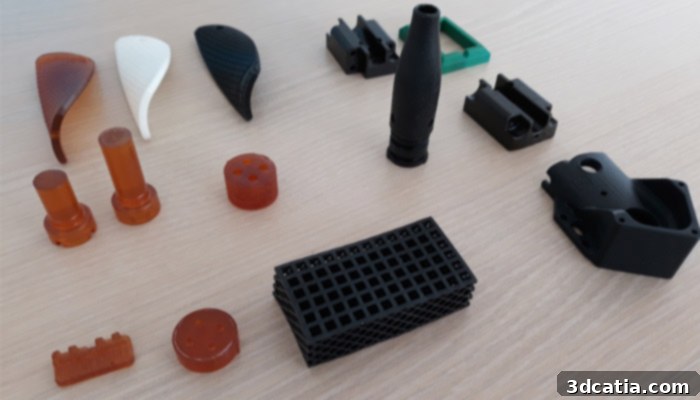
Some 3D printed parts enabled by UPS’s network
Consider UPS’s own infrastructure: over 1,000 warehouses strategically located around the world. Traditionally, these facilities might hold physical stock. With additive manufacturing, the opportunity arises to transform these locations into hubs for digital inventory. Instead of shipping a physical part from a central manufacturing plant to a distant warehouse, then to a customer, a digital file can be sent to the nearest qualified 3D printing facility (potentially even within a UPS warehouse or a partner facility), and the part produced on demand. This significantly reduces lead times, storage costs, and the environmental footprint associated with extensive shipping of unused parts. The shift from holding physical parts “just in case” to printing them “just in time” represents a monumental leap forward in supply chain efficiency and responsiveness.
Embracing On-Demand Manufacturing: The Future of Production
Jean-François Mathieu articulates a compelling vision for on-demand manufacturing, enabled directly by the capabilities of additive manufacturing. This technology is no longer limited to producing simple prototypes; it excels at creating parts with unique, complex geometries that were previously impossible or prohibitively expensive to manufacture using traditional methods. Critically, 3D printing now allows for agile production volumes, ranging from a handful of pieces (e.g., 5-50 parts) to several hundred (up to 500 pieces), all while offering a high degree of customization to meet specific customer requirements. This flexibility, combined with increasingly competitive costs compared to conventional manufacturing techniques, is paving the way for a revolutionary new business model: “manufacturing-as-a-service.”
In this emerging landscape, the supply chain transitions from a mere delivery mechanism to an indispensable, strategic enabler of success. Imagine a scenario where a digital design file for a crucial component is created in one corner of the globe. Within hours, that file can be transmitted to a 3D printing facility on another continent for rapid prototyping or even final production. The next day, the finished part could be dispatched and delivered to the end-user on the opposite side of the world. This level of speed, customization, and global reach fundamentally redefines how products are designed, manufactured, and distributed. UPS, with its vast logistical network and expertise, is perfectly positioned to facilitate this seamless flow, acting as the critical link between digital design and physical realization. They transform the promise of digital manufacturing into tangible, delivered products, ensuring that the supply chain is not just efficient but also incredibly adaptive and responsive to dynamic market needs.
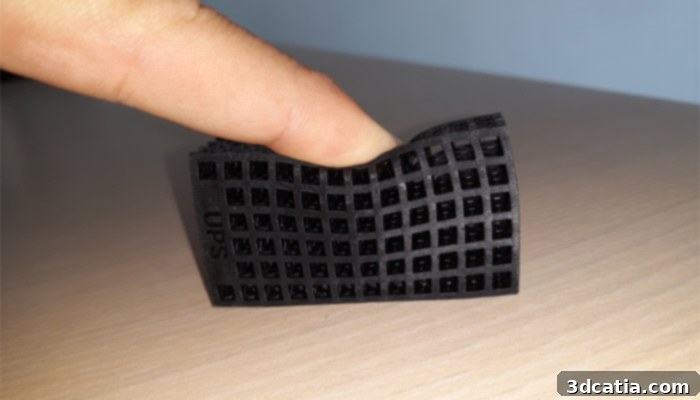
The Strategic Imperative of Logistics in an Additive Future
In his concluding remarks, Jean-François Mathieu reiterates his firm conviction that additive manufacturing will continue to expand its footprint across industrial sectors. The innovative business model of manufacturing-as-a-service, empowered by 3D printing, is poised to secure a significant place in the global economy, particularly through the delivery of high value-added services and the intelligent exploitation of production data. Within this evolving paradigm, the supply chain is not just a supporting function; it assumes a profoundly strategic role.
Its importance extends far beyond basic transportation. The supply chain becomes instrumental in the sophisticated management of inventories, moving from passive storage to active, on-demand fulfillment. It drives the optimization of logistical flows, ensuring that custom-produced parts reach their destination with unprecedented speed and efficiency. Crucially, the supply chain plays a vital role in ensuring a positive reception by the end-user for a piece that has been specifically designed and manufactured for them. This moment of delivery is often referred to as the “Moment of Truth,” where customer satisfaction and loyalty are ultimately forged. To navigate this complex and dynamic future successfully, Mathieu stresses the absolute necessity of fostering the best possible partnerships, guaranteeing an impeccable quality of service throughout the entire manufacturing and delivery process. UPS’s role as a trusted logistics partner becomes even more critical in this new era of digital and additive manufacturing.
What are your thoughts on the profound impact of additive manufacturing on the future of logistics and supply chain management? We invite you to share your insights and opinions in the comments section below, or engage with us on our Facebook and Twitter pages! Don’t miss out on the latest news and developments in 3D printing – be sure to sign up for our free weekly Newsletter, delivered directly to your inbox!