
Revolutionary 3D Printed Soft Robots from UC San Diego Master Challenging Terrains
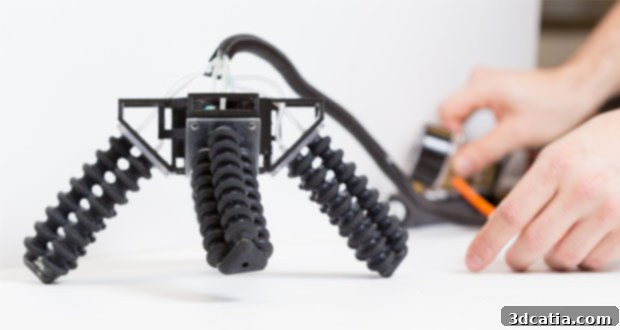
Scientists at the prestigious University of California San Diego have achieved a significant breakthrough in robotics by utilizing advanced 3D printing technology to create innovative robots. These remarkable machines possess the unique ability to navigate and traverse a multitude of demanding surfaces, including loose sand, uneven pebbles, and other forms of rough or unpredictable terrain. This pioneering 3D printed robot holds immense promise for deployment in critical scenarios, ranging from the retrieval of vital information in hazardous, inaccessible environments to playing a crucial role in sensitive search and rescue operations where human access is limited or dangerous.
While the fundamental concept of creating robots for exploring challenging landscapes is not entirely new, with numerous research initiatives and commercial ventures focusing on similar goals—drones often being the most common solution that comes to mind—the UC San Diego researchers have made a truly momentous stride forward. Their innovation lies in successfully developing a robot that masterfully blends the seemingly contradictory characteristics of being both soft and rigid. This ingenious combination allows the robot to adapt and overcome natural obstacles that have historically proven insurmountable for conventional robotic designs, opening up new avenues for exploration and intervention in environments previously deemed out of reach for human or machine alike.
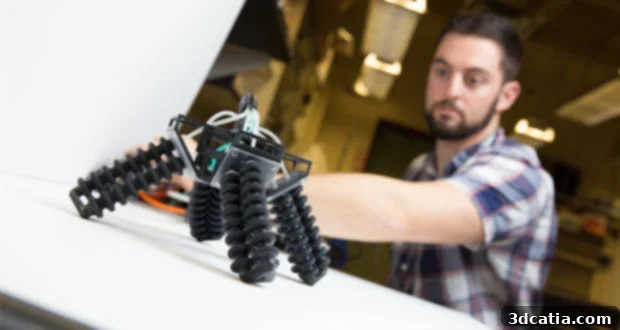
Photo credit: UC San Diego/ David Baillot
Engineering Unstoppable Mobility: The X-Leg Design and Hybrid Materials
A cornerstone of this robot’s extraordinary capability lies in its distinctive X-shaped legs. This clever design empowers the compact robot to confidently walk across diverse and challenging surfaces such as fine sand, jagged pebbles, and various forms of uneven ground. This remarkable versatility is directly attributable to the intricate and sophisticated construction of its legs, which ingeniously integrate both hard and soft materials. The strategic combination of these material properties grants the robot an unparalleled level of adaptability, allowing it to conform to irregularities in the terrain while maintaining sufficient structural integrity for effective locomotion. The X-leg configuration also provides a broad base of support, distributing its weight effectively and preventing it from sinking into softer substrates.
The Visionary Behind the Innovation: Professor Michael T. Tolley’s Approach
Leading this groundbreaking project is Michael T. Tolley, an esteemed Assistant Professor of Mechanical and Aerospace Engineering at the Jacobs School of Engineering at UC San Diego. Professor Tolley emphasizes that the strategic use of both soft and rigid materials has been instrumental in enabling his team to engineer a new generation of robots. These robots are not only highly adaptable to complex environments but are also designed to work safely and seamlessly alongside humans, a critical factor for applications in shared spaces. This focus on compliance and safety contrasts sharply with traditional rigid robots, which often pose a greater risk in proximity to people.
Beyond the material science, Professor Tolley is a staunch advocate for the transformative potential of 3D printing itself. He firmly believes that additive manufacturing democratizes design and production, making advanced robotics more accessible than ever before. Unlike conventional manufacturing methods that often necessitate expensive and time-consuming molds for part creation, 3D printing offers an agile, cost-effective, and rapid alternative. This flexibility allows researchers to quickly iterate on designs, experiment with complex geometries, and produce custom components with unprecedented efficiency, accelerating the pace of innovation in fields like soft robotics.
The Mechanics of Movement: Multi-Material 3D Printing and Pneumatic Actuation
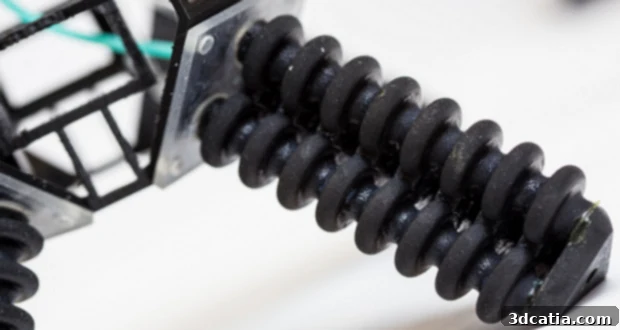
The success of this robot’s intricate leg design is a direct testament to the capabilities of multi-material 3D printing. This advanced manufacturing technique provides the flexibility to create highly complex and functional parts, precisely as demonstrated by the construction of the robot’s legs. Each of the robot’s X-shaped legs is composed of three distinct actuators, which are meticulously printed using a pliable, rubbery material. These actuators are not merely passive components; they are ingeniously designed with internal tubes that function as miniature pneumatic muscles. The mechanism is elegantly simple yet profoundly effective: by precisely controlling the inflation and deflation of these inner tubes with air, the actuators cause the leg to bend, mimicking biological muscle contractions. This coordinated bending action propels the robot forward, making its movement dependent on a precise combination of controlled air pressure and timing.
This sophisticated pneumatic system allows for a wide range of movements. The ingenious mechanism even enables the robot to execute a controlled crawling motion by meticulously adjusting the pressure levels within each actuator and orchestrating the exact sequence in which the internal pistons of its four legs are inflated. This precise control over its locomotion grants it an advancing speed of approximately 20 millimeters (or about 0.79 inches) per second, a respectable pace for navigating highly irregular terrain. Furthermore, the robot’s design is not limited to forward motion; it can also gracefully retreat, skillfully move laterally, and even execute precise rotations, showcasing a remarkable degree of agility and adaptability in challenging environments. This intricate dance of air and material underscores the innovation at the heart of its design.
Bridging the Gap: From Lab to Real-World Applications
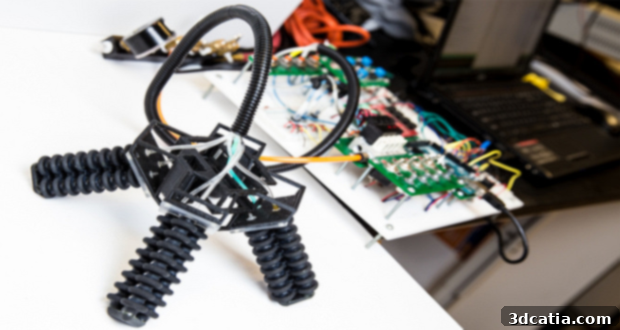
While the initial prototypes of this remarkable 3D printed robot have demonstrated incredible potential, the researchers at UC San Diego acknowledge that there are still several crucial adjustments and enhancements required before widespread deployment. Currently, the robot remains tethered to an external control panel and an air pump, which, while necessary for initial testing and development, inherently limits its operational range and mobility. This tethering presents a practical constraint, restricting the distance and autonomy with which the robot can travel in real-world scenarios. The immediate and primary goal for the research team is to seamlessly integrate both the control system and the air pump directly into the robot’s compact body.
Achieving untethered operation would unlock the robot’s full potential, enabling it to undertake far more significant and complex tasks. Researchers envision this agile, small robot being deployed for critical missions such as autonomously collecting vital information in highly dangerous or otherwise inaccessible terrains. Equipped with an array of advanced sensory sensors, it could gather environmental data, detect hazards, or conduct reconnaissance in situations too perilous for human personnel. Potential applications extend beyond search and rescue to include environmental monitoring in remote areas, infrastructure inspection in hazardous industrial settings, and even extraterrestrial exploration, where its ability to navigate alien landscapes would be invaluable.
The Future Landscape of Soft Robotics and Additive Manufacturing
The work at UC San Diego represents a powerful synergy between the burgeoning field of soft robotics and the revolutionary capabilities of additive manufacturing. Soft robots, with their inherent compliance and ability to deform, offer distinct advantages over their rigid counterparts. They are intrinsically safer for interaction with humans, capable of manipulating delicate objects without causing damage, and remarkably resilient to impacts, making them ideal for unpredictable environments. When combined with multi-material 3D printing, the design possibilities become virtually limitless, allowing engineers to craft intricate structures with spatially varying material properties that would be impossible with traditional manufacturing methods.
This research not only pushes the boundaries of robotic design but also highlights the critical role of advanced manufacturing techniques in accelerating scientific discovery and technological innovation. The ability to rapidly prototype complex, functional soft robotic components with integrated pneumatic systems is a game-changer. It suggests a future where robots are not confined to factory floors or predictable environments, but are instead ubiquitous, adaptable, and capable of operating safely and effectively in the messy, unstructured world we inhabit. The implications for industries ranging from healthcare and logistics to exploration and disaster relief are profound, promising more intuitive, resilient, and human-friendly robotic solutions.
Check out their incredible robot in action:
Do you believe that continuous advancements in 3D printing technology will revolutionize and dramatically improve the field of robotics in the coming years? Share your thoughts and insights in a comment below, or join the discussion on our Facebook and Twitter pages!