
Revolutionizing Wireless: Harvard Researchers 3D Print Device to Braid Micro-Filaments for Next-Gen Antennae
The world of additive manufacturing, commonly known as 3D printing, continues to expand its horizons at an astonishing pace. From groundbreaking applications in bioprinting, where researchers are developing functional organs and tissues, to transforming the very foundations of urban development through 3D printed construction, the versatility of this technology seems boundless. Now, an innovative team of engineers and scientists at the Harvard John A. Paulson School of Engineering and Applied Sciences (SEAS) has unveiled a novel application that promises to redefine the future of wireless communication. They have successfully developed a remarkably simple 3D-printed device designed to precisely braid filaments as fine as 1 micrometer in diameter. This pioneering advancement could pave the way for creating highly sophisticated antennae capable of accessing increasingly higher frequency ranges, ultimately powering the next generation of smartphones and advanced wireless devices.
Our reliance on seamless, high-speed wireless connectivity has grown exponentially since the advent of cellular phones in the early 1970s and Wi-Fi in the late 1990s. The demands of an interconnected, globalized, and online society have propelled rapid technological advancements, constantly pushing the boundaries of what’s possible. For instance, Wi-Fi speeds have seen remarkable improvements, with countries like South Korea leading the charge, boasting average speeds of up to 28.6 Mbps. Similarly, over the past two decades, mobile phones have transformed from bulky, basic communication tools – though internet access and email were nascent features in the early 2000s – into the powerful, sleek mini-computers we carry in our pockets today. However, to continue this trajectory of innovation and unlock even greater performance, we face a critical challenge: creating new antennae capable of operating effectively across higher and higher frequency bands. The current industrial fabrication techniques used for traditional antennae are simply inadequate for working with the extremely fine fibers required for these next-generation devices, especially when it comes to braiding them together. This is precisely where the ingenuity of 3D printing steps in, offering a solution to a previously insurmountable manufacturing hurdle.
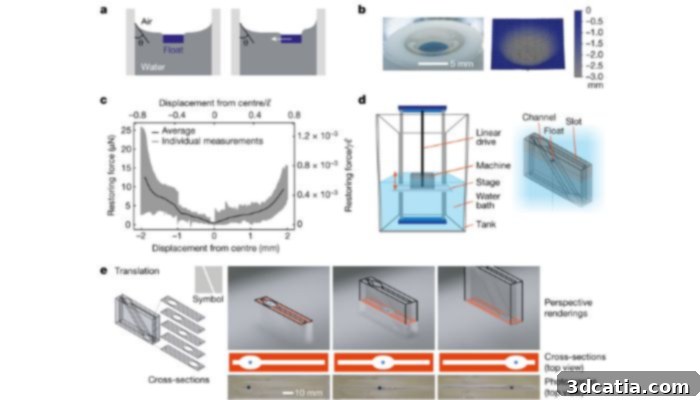
The Harvard SEAS team utilized 3D printed devices to intricately manipulate microscopic objects through capillary forces, as illustrated in these explanatory diagrams (photo credits: SEAS)
Unlocking Micro-Manipulation: How 3D Printing Facilitates Advanced Braiding
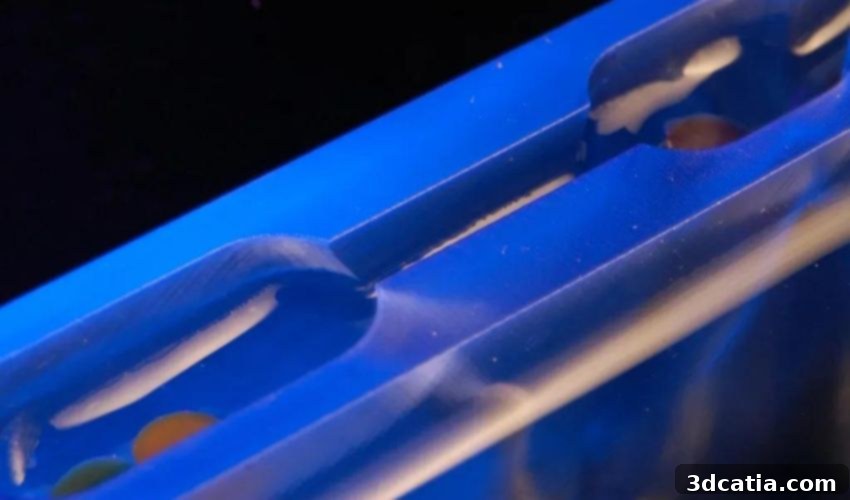
For the brilliant minds at Harvard SEAS, the key to manipulating microscopic objects lay in a deceptively simple yet elegant principle: harnessing the inherent surface tension of water. To achieve this, the team engineered a device that, in its essence, is a 3D-printed plastic rectangle. Roughly the size of a classic Nintendo game cartridge, its interior is intricately carved with a network of intersecting channels. These channels vary in width, alternating between broad and narrow sections, much like a natural river that widens in some areas and constricts in others. Crucially, the channel walls are designed to be hydrophilic, meaning they possess a natural affinity for water. What makes this even more remarkable is the accessibility of the manufacturing process: the team emphasizes that this sophisticated rectangle can be produced using a standard 3D printer, even one readily available in a public library. While they confirmed the use of an SLA 3D printer, they refrained from specifying a particular brand, highlighting the broad applicability of the technique.
The operational genius of this device stems from its clever utilization of capillary forces. Capillary action describes the phenomenon where a liquid flows into a narrow space or a porous material against external forces like gravity, driven solely by the interplay of adhesive and cohesive forces. This principle is fundamental to processes such as water moving through plants or ink spreading on paper. In the Harvard setup, the device is submerged in water, and millimeter-sized plastic floats are introduced into its channels. The hydrophilic nature of the channel walls, combined with the surface tension of the water, creates a repulsive force against these floats. When a float enters a narrow section of the channel, it is compelled to move as far away from the walls as possible. Conversely, in a wider section, the float becomes trapped, held firmly in place by the equilibrium between the repulsive forces from the walls and the float itself. The researchers made a pivotal discovery when they attached microscopic fibers to these floats: by carefully altering the water level, which in turn caused the floats to move, they could precisely induce the fibers to twist and intertwine around each other. This elegant method offers unprecedented control over micro-scale materials, making it possible to manipulate individual fibers with a precision previously unachievable by traditional means.
Maya Faaborg, an associate at SEAS and a co-author of the seminal paper detailing this research, recounted the breakthrough moment with palpable excitement: “The eureka moment came when we found we could move the objects by changing the cross-section of our trapping channels. It was a shout-out-loud-in-joy moment when — on our first try — we crossed two fibers using only a piece of plastic, a water tank, and a stage that moves up and down.” This initial success laid the groundwork for further advancements. The team then scaled up their innovation, adding a third float with an attached fiber and meticulously designing the channels to guide this float in a complex braiding pattern. This refined setup proved highly successful, enabling the researchers to precisely braid micrometer-scale Kevlar fibers, a material renowned for its strength and resilience. This achievement represents a significant leap forward in micro-fabrication, demonstrating the feasibility of creating intricate, multi-strand structures at dimensions previously thought impossible.
While this groundbreaking research is still in its nascent stages, its ramifications for the future of technology are immense. The Harvard SEAS team is committed to continuing their work, with plans to design even more sophisticated devices capable of manipulating numerous fibers simultaneously. Their ultimate goal is to investigate whether these intricate micro-braids can be fashioned into high-frequency conductors. If successful, such conductors could become the core components of next-generation wireless devices, leading to significantly more powerful and efficient Wi-Fi systems, as well as ultra-fast, high-bandwidth cellular phones capable of supporting future communication standards like 5G and even 6G. This would unlock unprecedented data speeds, lower latency, and enable a new era of connected technologies, from advanced IoT applications to smart cities and autonomous vehicles.
Crucially, throughout this entire innovative process, 3D printing has played an indispensable role. Its accessibility, combined with its unparalleled ability to create complex geometric structures with high precision, made it the ideal manufacturing method for developing the specialized device. Without the flexibility and rapid prototyping capabilities of 3D printing, achieving such intricate designs and quickly iterating on them would have been significantly more challenging, if not impossible. This research stands as a testament to the transformative power of additive manufacturing, not just in creating end-use products, but also as a vital tool for scientific discovery and engineering innovation. For those interested in delving deeper into the methodology and findings, the full study can be accessed HERE. Additionally, a compelling video demonstrating the intricate process in action is provided below, offering a visual insight into this remarkable scientific endeavor.
What are your thoughts on how these researchers leveraged a 3D-printed device to achieve such a significant breakthrough in micro-braiding and its potential impact on future wireless communication? Share your insights and comments below, or connect with us on our LinkedIn, Facebook, and Twitter pages! Don’t miss out on the latest advancements in additive manufacturing—be sure to sign up for our free weekly Newsletter here, delivering the freshest 3D printing news directly to your inbox! You can also explore all our fascinating videos on our dedicated YouTube channel.
*Cover Photo Credits: SEAS