
Unlocking Potential: The Transformative Impact of 3D Printing and Makerspaces in K-12 Education
In an increasingly digital and innovation-driven world, equipping students with future-ready skills is paramount. Educational institutions globally are recognizing the power of emerging technologies to foster creativity, problem-solving, and critical thinking. Among these, 3D printing and the concept of Makerspaces have emerged as revolutionary tools, reshaping the learning landscape. A groundbreaking one-year study conducted by a team of researchers at Macquarie University in Australia delved deep into the benefits of integrating these technologies into primary schools. This comprehensive research observed and interviewed over 500 students, alongside their educators, to understand how 3D technologies influence them both inside and outside the classroom environment. While the study acknowledged that there’s still considerable work to be done in empowering teachers to fully integrate 3D printing in schools, the findings are overwhelmingly encouraging, pointing towards a significant positive shift in student engagement and pedagogical approaches.
The Global Rise of Makerspaces and Additive Manufacturing in Education
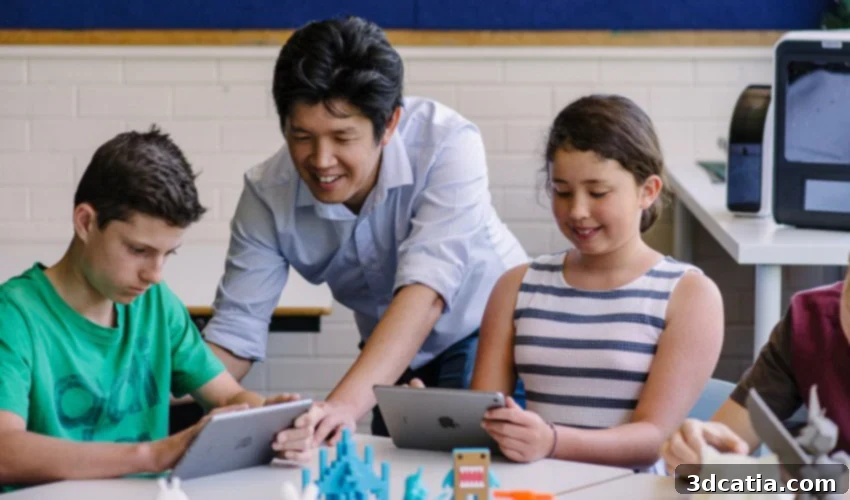
The integration of Makerspaces into school curricula is not merely a fleeting trend but a growing global movement. These dynamic manufacturing spaces provide students with an unparalleled environment to bring their ideas to life, fostering innovation and cultivating their innate creativity. Within Makerspaces, students are exposed to a diverse array of cutting-edge technologies, including robotics, computer programming, and, crucially, 3D printing. These hands-on learning environments move beyond traditional theoretical instruction, allowing students to engage directly with design, fabrication, and iterative problem-solving processes. For schools unable to establish dedicated Makerspaces, the alternative of integrating one or more 3D printers directly into classrooms, or even communal areas like a canteen, demonstrates the flexibility and accessibility of these powerful tools. This flexibility ensures that regardless of infrastructural limitations, the benefits of digital fabrication can still reach students, offering them invaluable practical experience.
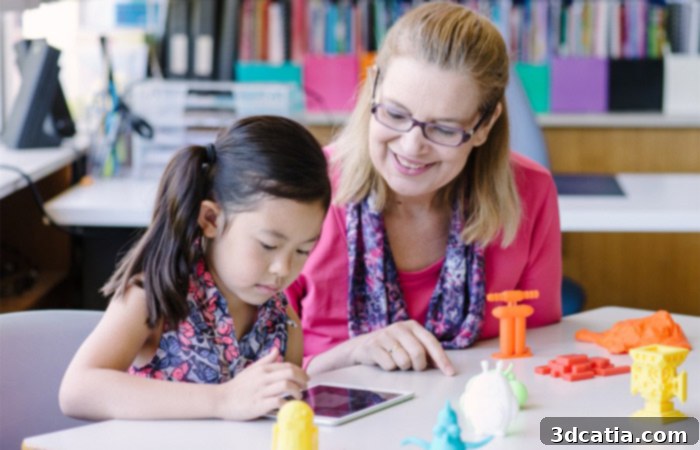
Photo Credits: Empire Makers
Delving into the Macquarie University Study: Methodology and Participation
The Macquarie University research was meticulously structured to provide comprehensive insights into the adoption and impact of 3D printing in primary education. Central to the study’s methodology was a professional development initiative: 27 dedicated teachers from three distinct Australian schools participated in the specialized “Makers Empire Learning by Design Professional Development” course. This intensive training equipped educators with the necessary skills and confidence to effectively teach 3D design and printing. Following their training, these teachers delivered a total of 24 courses focused on 3D printing and design to more than 500 students, utilizing the intuitive Makers Empire 3D software. To ensure a thorough analysis, most of these teaching sessions were meticulously recorded. Furthermore, detailed lesson plans, comprehensive lesson observations, and invaluable comments from the participating teachers were collected, forming a rich dataset that allowed researchers to gain a holistic understanding of the technological integration and its effects.
Transformative Results: Enhancing Student Engagement and Cultivating Future Skills
The analysis of the collected data yielded profoundly positive results, underscoring the immense potential of 3D printing and design in primary education. The findings showcased significant improvements in student engagement, creativity, and their aspirations for future technological involvement.
Unprecedented Student Engagement and Active Learning
Perhaps one of the most striking findings was the revelation that 100% of the 3D printing and modeling courses exhibited a high degree of student engagement. This complete immersion is a testament to the inherently hands-on and interactive nature of 3D design and fabrication. Unlike passive learning, 3D printing requires active participation, problem-solving, and iterative refinement, which naturally captivates young minds. Students are not just consumers of information; they become creators, designers, and innovators. This active involvement fosters a deeper connection to the learning material, making abstract concepts tangible and immediately applicable. The excitement of seeing a digital design transform into a physical object in real-time is a powerful motivator, encouraging students to experiment, learn from mistakes, and persevere through challenges.
Fostering Creativity and Deeper Conceptual Understanding
Beyond mere engagement, the study highlighted significant gains in higher-order thinking skills. Students demonstrated a pronounced interest in creativity (71%) and a strong conceptual approach (64.5%). 3D design encourages imaginative thinking as students are tasked with envisioning and designing solutions to problems, or simply creating objects from scratch. This process nurtures their ability to think outside the box, explore different possibilities, and iterate on their designs. Furthermore, the conceptual approach is enhanced as students grapple with spatial reasoning, understanding dimensions, material properties, and the mechanics of how objects fit together. They learn about design constraints, optimization, and the practical application of mathematical and scientific principles, transforming theoretical knowledge into practical understanding. For example, designing a functional bridge or a geometric puzzle requires a deep conceptual grasp that goes beyond rote memorization.
Inspiring Future Pathways and STEM Interest
The long-term impact on students’ aspirations was equally impressive: 94% of students surveyed expressed a desire to continue 3D designing after school. This interest was not limited to mere entertainment; many saw it as a valuable skill for their future professional careers. This finding holds immense significance for STEM (Science, Technology, Engineering, and Mathematics) education, as 3D printing acts as a powerful gateway to these fields. By engaging with design software, understanding engineering principles, and experiencing the thrill of bringing ideas to life, students develop a foundational interest in careers that rely heavily on innovation and technology. It helps bridge the gap between theoretical subjects and real-world applications, encouraging a new generation of engineers, designers, and entrepreneurs.
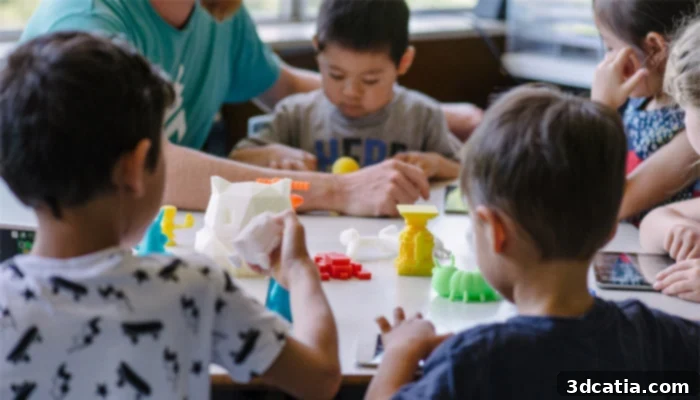
Photo Credits: Empire Makers
Empowering Educators: A Profound Shift in Teaching Pedagogy
The study also shed light on the profound impact 3D printing integration had on educators themselves. Teachers, initially perhaps hesitant or unfamiliar with the technology, became significantly more comfortable and enthusiastic about teaching it, with their confidence increasing by a remarkable 35%. This boost in confidence is critical, as teacher comfort is a key factor in successful technology integration. The professional development program not only taught them how to operate the technology but also how to weave it effectively into their curriculum, transforming their pedagogical approaches.
Moreover, the relationship between technology and teachers went further than just comfort. Several educators indicated a significant shift towards more collaborative, flexible teaching methods, even expressing a desire to introduce similar pedagogies for other courses, beyond the confines of Makerspaces. As the study’s authors succinctly stated, “Several teachers indicated that they had shifted to be more collaborative, flexible, and comfortable with technology.” This suggests that the principles of design thinking, iterative problem-solving, and project-based learning inherent in 3D printing can positively influence teaching across the curriculum. Crucially, “Many teachers entered learning partnerships with students, and as a result, students came to see their teachers as models of lifelong learning.” This transformation from sole knowledge dispensers to co-learners and facilitators creates a dynamic, supportive learning environment where both students and teachers are engaged in continuous discovery.
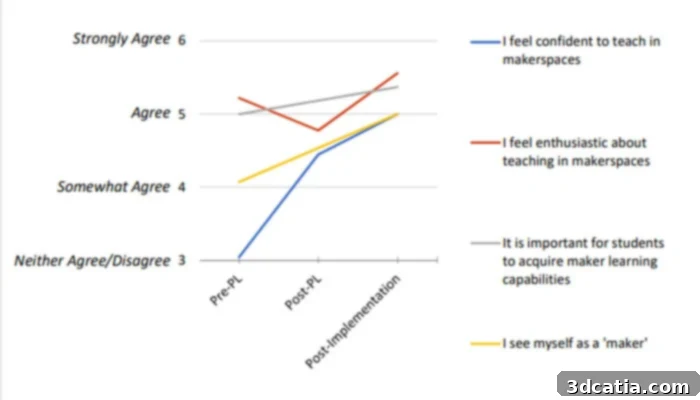
Likert’s scale shows the evolution of teachers’ feelings
The accompanying Likert scale, illustrating teachers’ attitudes towards Makerspaces before, during, and after the implementation of learning outcomes, vividly demonstrated this positive attitudinal shift. It quantified the evolving comfort levels and enthusiasm of teachers, underscoring the critical importance of providing educators with the necessary training and support to confidently integrate 3D technologies into the school environment. This data provides compelling evidence that with the right resources and professional development, teachers can not only embrace new technologies but also champion them as integral components of modern education.
Recommendations for Successful 3D Printing Integration in Educational Settings
In conclusion of their insightful study, the Australian researchers developed a series of actionable recommendations, primarily informed by the invaluable comments and experiences of the observed and interviewed teachers. They strongly encourage schools to proactively support both their students and educators in finding the essential time and resources required to master 3D printing and explore 3D design during class time. This recommendation is critical because successful integration is not just about acquiring equipment; it requires dedicated time for learning, experimentation, and curriculum development. Schools need to consider providing:
- Adequate Training: Ongoing professional development for teachers to keep pace with evolving technologies and pedagogical best practices.
- Accessible Resources: Ensuring access to reliable 3D printers, design software, and necessary consumables (filaments).
- Curriculum Integration Support: Helping teachers develop lesson plans that seamlessly incorporate 3D printing across various subjects, not just as an isolated activity.
- Dedicated Time: Allocating sufficient time within the school day for students to engage in design and printing projects, and for teachers to prepare and refine their lessons.
These recommendations emphasize that for 3D printing to truly flourish in educational settings, a holistic approach that addresses both technological and human resource needs is indispensable. Further detailed information on the study and its broader implications can be accessed directly on the Macquarie University website HERE.
The Broader Impact of Additive Manufacturing on Future Learning
The Macquarie University study serves as a powerful testament to the transformative potential of 3D printing and Makerspaces in primary education. It highlights how these technologies can not only elevate student engagement and foster critical 21st-century skills like creativity, critical thinking, and problem-solving, but also empower educators to embrace innovative teaching methodologies. By making abstract concepts tangible and providing platforms for hands-on experimentation, 3D printing is preparing students for a future where digital fabrication and design thinking will be increasingly vital across numerous industries. Investing in these technologies and supporting their integration means investing in a generation of innovators, designers, and thinkers who are well-equipped to navigate and shape the complexities of tomorrow’s world. This isn’t just about teaching a new tool; it’s about fundamentally changing how students learn, perceive challenges, and develop solutions, fostering a lifelong love for learning and creation.
What are your thoughts on this comprehensive study regarding 3D printing in schools and its implications for the future of education? We invite you to share your perspectives in a comment below or join the conversation on our Facebook and Twitter pages! Don’t miss out on the latest news and insights in the world of additive manufacturing – remember to sign up for our free weekly Newsletter, delivered straight to your inbox!