
Scaling Additive Manufacturing: Joseph Crabtree on AMT’s Advanced Post-Processing Solutions for End-Use Parts
The landscape of additive manufacturing, commonly known as 3D printing, is currently undergoing a profound transformation. What once began primarily as a technology for rapid prototyping and conceptual modeling is now rapidly evolving into a robust method for producing high-quality, functional end-use parts across diverse industries. This pivotal shift demands a re-evaluation of the entire production workflow, placing unprecedented emphasis on post-processing technologies. As 3D printing matures, the journey from a raw printed object to a market-ready component requires intricate finishing steps to achieve the desired aesthetic, mechanical properties, and performance standards. Recognizing this critical need, AMT (Additive Manufacturing Technologies) emerged in 2017 as a pioneering startup. With a clear vision, AMT set out to provide patented, state-of-the-art post-processing solutions specifically designed for 3D printed parts. Their overarching goal is to facilitate the widespread, application-driven adoption of sustainable additive manufacturing at an industrial scale. In today’s competitive environment, simply possessing advanced materials and cutting-edge 3D printers is no longer sufficient. Companies must meticulously consider the application performance of their components to truly unlock the potential of additive manufacturing and drive its adoption at scale. To delve deeper into this exciting evolution and understand the crucial role of post-processing, we recently had the distinct pleasure of engaging in a conversation with Joseph Crabtree, the visionary Founder and CEO of AMT. During our discussion, he shared his insightful perspective on the current market dynamics, elaborated on the paramount importance of advanced post-processing, and shed light on AMT’s innovative and patented solutions that are shaping the future of industrial 3D printing.
3DN: Can you introduce yourself and your relationship with 3D printing?
“My name is Joseph Crabtree, and I am the proud founder and CEO of AMT,” he began. “My journey into the world of 3D printing wasn’t immediate; it was a progression stemming from a solid foundation. I established AMT in 2017, building upon a comprehensive 14-year background steeped in engineering and traditional manufacturing processes. This extensive prior experience provided me with a unique vantage point, allowing me to observe firsthand the opportunities and challenges within industrial production. It was during this period that I identified what I perceived as a significant bottleneck hindering the widespread adoption and scaling of the additive manufacturing industry. This realization ignited a passion within me to develop and introduce more pragmatic, efficient solutions that could effectively address these challenges and truly enable the industry to reach its full potential.”
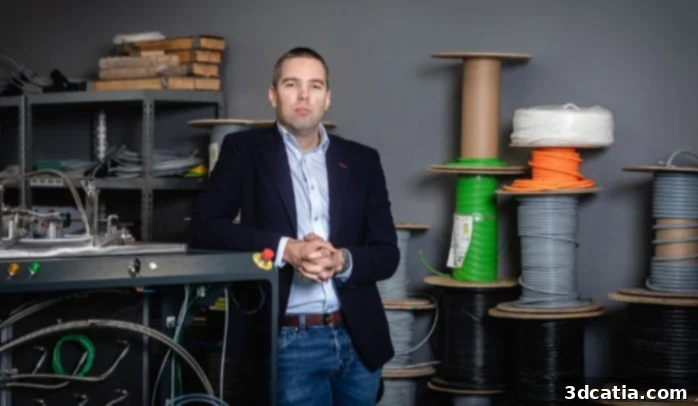
Joseph Crabtree is the Founder and CEO of AMT
Mr. Crabtree further elaborated on AMT’s core offering: “At AMT, our fundamental purpose is to deliver advanced, patented, and comprehensive post-processing solutions for 3D printed parts. Our flagship product line, known as PostPro, embodies our commitment to innovation. These systems are not only fully automated, ensuring consistent quality and reduced labor, but they are also designed with safety and environmental sustainability at their forefront. The proprietary PostPro technology is engineered to unlock the true power of industrial additive manufacturing, specifically enabling the efficient production of high-quality end-use parts. This means delivering components that meet stringent performance criteria for each unique application, all while ensuring optimal cost-effectiveness and timely production. Our goal is to transform how businesses approach additive manufacturing, making it a viable and superior alternative to traditional methods for a growing number of applications.”
3DN: What is AMT PostPro’s mission?
Joseph Crabtree articulated AMT’s foundational mission by reflecting on the historical context of additive manufacturing. “In the mid-2000s, it became unequivocally clear to me that a significant barrier was impeding the additive manufacturing industry from realizing its boundless potential,” he explained. “This bottleneck was primarily centered around the traditional post-processing steps: they were excessively laborious, inherently inconsistent, and significantly costly, often relying on manual labor which introduced variables and inefficiencies into the production chain. This manual approach contradicted the very essence of automation and precision that 3D printing promised.”
AMT quickly carved out a prominent niche in the market. “Despite being a newcomer, AMT rapidly established strong partnerships with leading brands and prominent service centers,” Mr. Crabtree noted. “We achieved this by introducing a revolutionary standard of efficiency, uncompromising quality, and compelling economic rationale that fundamentally challenged the existing paradigms of 3D part finishing. Our innovative approach was designed to disrupt the status quo, offering solutions that were both scalable and reliable.” The rapid growth of the company is testament to its impact: “Just two years after our inception, our core team of three engineers had expanded dramatically into a dedicated team of 34 engineering professionals.” Beyond mere technological advancement, AMT has fostered a collaborative ecosystem. “What is truly remarkable,” he added, “is that AMT has not only redefined additive manufacturing post-processing capabilities but has also cultivated a vibrant community dedicated to design, manufacturing excellence, and specialized expertise. This collaborative spirit, coupled with our proprietary intellectual property, forms a robust foundation that can be powerfully leveraged across the entire market.”
Crabtree then underscored the critical evolution of the industry: “Understanding the historical trajectory is vital. When additive manufacturing first emerged, its primary focus was largely confined to academic research, low-volume prototyping, and highly specialized, niche projects. However, as we transitioned from the early 2000s to the present day, the industry has traversed a significant phase we refer to as Additive 1.0. This era marked the initial widespread adoption of the technology, characterized by burgeoning hype and a growing public awareness of 3D printing’s potential as a viable production method. What profoundly interests us at AMT, as we bridge the legacy of Additive 1.0 into the current iteration, Additive 2.0, is the dramatic and sustained increase in the demand for and production of end-use parts. This fundamental shift from prototyping to functional components represents not only a monumental leap for the industry but also precisely aligns with AMT’s strategic growth objectives.”
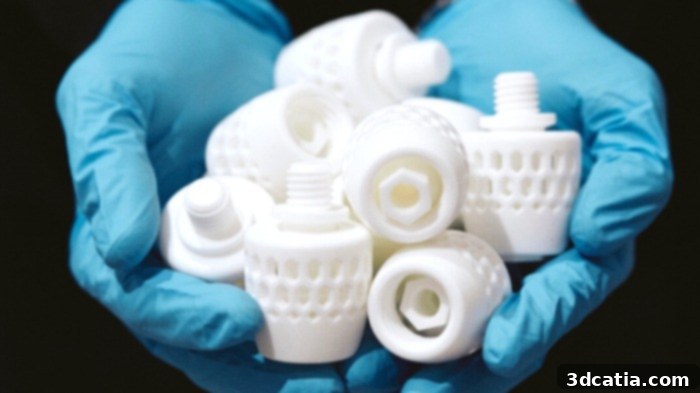
There is a huge increase in end-use part production
“Our explicit mission,” he stated, “is to achieve global leadership as the first-choice, application-centric provider of end-to-end industrialized automated post-processing systems. We are committed to delivering comprehensive solutions that empower our customers throughout their entire manufacturing process. This means a seamless workflow where they can introduce raw material into a 3D printer, and subsequently, a finished, high-performance part emerges from our automated systems—a part that is immediately suitable for demanding end-use applications across a multitude of industrial verticals. This holistic approach ensures efficiency, quality, and reliability from start to finish.”
Crabtree emphasized the visionary aspect of AMT’s long-term goals: “Our vision is inherently aspirational, deeply rooted in enabling the widespread, application-driven adoption of sustainable additive manufacturing at an unprecedented scale. Within this vision, two words resonate with particular importance: ‘application’ and ‘sustainable.’ The ‘application’ aspect is paramount because, regardless of the sophistication of your materials, the advanced capabilities of your 3D printer, or the presence of post-processing equipment, if the manufactured parts are not consistently produced with their specific application performance requirements explicitly in mind, then the industry will struggle to drive additive manufacturing adoption at scale. The parts must meet real-world demands for strength, durability, aesthetics, and functionality. Equally crucial is ‘sustainable.’ If the current manufacturing practices within the additive industry are not environmentally and economically sustainable, especially at lower volumes, then we are fundamentally limited in our ability to truly unlock the full, transformative potential of additive manufacturing. Sustainability isn’t just an ideal; it’s a prerequisite for long-term growth and true industrialization.”
3DN: What is the importance of post-processing in the 3D printing workflow? Would you say most companies have a good understanding of post-processing solutions and steps?
Addressing the perception of 3D printed parts, Joseph Crabtree highlighted a common misconception. “Historically, and even until quite recently, there was a noticeable lack of focused attention on the critical stages of post-processing and finishing for 3D printed components,” he observed. “Many individuals, particularly those outside the immediate additive manufacturing community, tend to view 3D printing as a ‘magic box’ where a fully finished, ready-to-use part emerges directly from the printer. This perception assumes that the parts are immediately suitable for demanding end-use applications, but that is rarely the case in reality. In truth, when parts are initially extracted from a 3D printer, especially those produced through powder bed fusion or other industrial methods, they are often raw, unfinished, and require significant refinement. They must undergo essential post-processing or finishing steps to impart the necessary aesthetic appeal, tactile quality (feels), and crucially, the performance characteristics that would be expected from a conventionally manufactured part or a highly refined 3D printed component.”
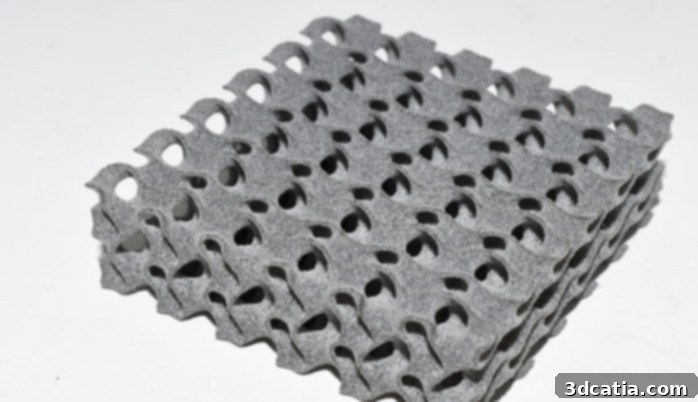
Part that hasn’t been post-processed | Image via AMT
Crabtree emphasized the indispensable role of these finishing stages. “The post-processing and finishing steps are, without exaggeration, absolutely critical. They represent the missing piece in the complex puzzle of industrial 3D printing,” he affirmed. “Effectively, ‘post-processing’ serves as an umbrella term encompassing a diverse array of techniques and methodologies designed to transform these initially unfinished 3D printed parts into functional, visually appealing, displayable, or readily marketable products. Without these steps, the full potential and viability of additive manufacturing for end-use applications simply cannot be realized.”
While awareness is growing, a knowledge gap persists. “Most companies today are indeed familiar with the fundamental necessity of post-processing,” Joseph acknowledged. “However, there remains substantial room for further education and deeper understanding when it comes to fully grasping the transformative power and extensive benefits of automated post-processing solutions. Traditional or manual post-processing methods, for instance, are often inadequate; they typically cannot achieve a complete sealing of part surfaces, and paradoxically, vigorous manual finishing can even introduce undesirable polymer micro-fibers, compromising surface integrity and performance. Furthermore, merely adding additional coatings as a workaround often limits material choice and can even degrade the part’s inherent performance properties. Beyond these technical limitations, manual post-processing is inherently time-consuming, highly labor-intensive, and prone to inconsistency, making it unsuitable for industrial scale production.”
A significant shift in industry understanding is now underway. “We are currently witnessing a pivotal shift in how the industry perceives and prioritizes post-processing,” Crabtree stated. “The rapid evolution and acceleration of industrial-scale 3D printing means that pioneering companies and early adopters are now keenly recognizing the indispensable and critical role of automated post-processing. It is no longer an optional add-on but an integral component for seamlessly completing high-volume manufacturing lines and ensuring that 3D printed parts are truly market-ready, meeting stringent quality and performance specifications.”
Looking ahead, Crabtree conveyed profound optimism. “The future is incredibly exciting for our entire industry,” he enthused. “Additive manufacturing is poised to achieve its full, revolutionary potential, and advanced post-processing is the key enabler. By integrating efficient post-processing, we can dramatically speed up overall production times, substantially lower manufacturing costs per part, ensure unparalleled repeatability and consistency, and consistently meet rigorous industry standard requirements. This comprehensive approach is what will ultimately transition 3D printing from a specialized tool to a mainstream, industrial manufacturing powerhouse.”
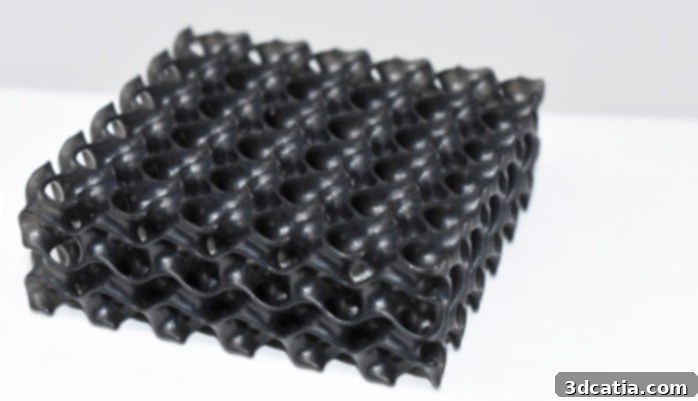
Part has undergone post-processing | Image via AMT
3DN: Can you tell us more about your technology?
Diving into AMT’s technological core, Joseph Crabtree elaborated, “Our primary expertise lies in the innovative field of chemical vapor smoothing. We have developed and deployed a uniquely patented system globally, which has fundamentally redefined surface finishing for 3D printed parts. The PostPro chemical vapor smoothing technology is not merely an improvement; it’s a transformative process designed to empower manufacturers to significantly scale their operations. By achieving unparalleled surface quality, our technology enables the production of entirely new applications—parts that, until recently, could only be efficiently manufactured through traditional methods like injection molding. This breakthrough allows additive manufacturing to compete directly with conventional techniques in terms of surface finish and part performance.”
He further detailed the specific advantages of this technology: “The vapor smoothing process directly addresses some of the most critical performance challenges frequently encountered by companies leveraging additive manufacturing. Beyond a dramatically improved visual aesthetic, our PostPro technology fundamentally enhances the mechanical integrity of the parts. It effectively eliminates microscopic crack initiation sites on the surface, which is crucial for improving key performance indicators such as fatigue resistance and elongation at break. Perhaps most importantly, PostPro technology meticulously seals the surface of the part. This sealing effect means that the component not only looks superior, feels premium to the touch, and performs exceptionally well under stress, but it also becomes impermeable, which is vital for applications requiring sterility, fluid containment, or enhanced hygiene. The following video beautifully illustrates how this sealed surface profoundly impacts subsequent processes like surface coating and dying, showcasing the dramatic difference it makes:”
Crabtree presented a compelling real-world application: “A prime example of how PostPro chemical vapor smoothing has been instrumental in enabling a groundbreaking new 3D printed application is its use in the development and high-volume production of nasal swabs for critical testing. Just a few short years ago, such a sensitive and mass-produced medical component would exclusively have been manufactured using injection molding due to stringent surface finish and sterilization requirements. However, PostPro’s ability to consistently deliver a perfectly smooth and sealed surface for HP-printed parts has made it possible for these swabs to achieve the necessary certifications for use in demanding medical applications. This represents a monumental development for the entire additive manufacturing industry, marking one of the first high-volume instances where 3D printing, combined with advanced post-processing, has successfully challenged and surpassed traditional manufacturing methods in a critical medical supply chain.”
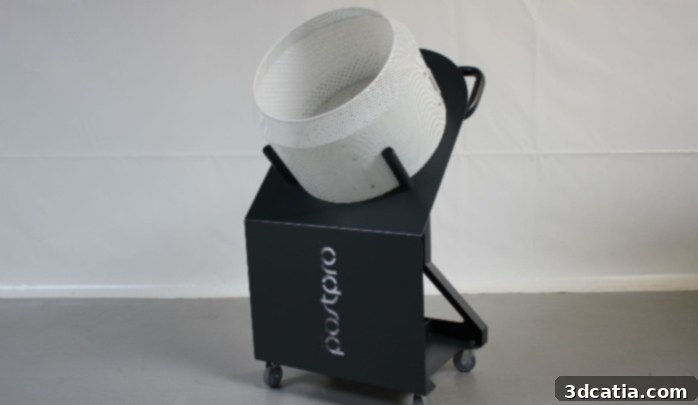
Beyond vapor smoothing, AMT offers another essential system: “The second crucial system we provide are our advanced machines designed for depowdering. This constitutes a vital precursor step in the overall additive manufacturing workflow, essentially the initial cleaning phase. These systems efficiently remove any residual, unbound powder from the freshly printed parts, a necessary stage before they proceed to be further refined and finished in our state-of-the-art vapor smoothing machines. This ensures a clean base for optimal smoothing results and maintains process integrity.”
Summarizing the operational benefits, Joseph concluded: “From a broader throughput and operational efficiency perspective, all of AMT’s systems are engineered for complete automation, ensuring consistency and minimizing manual intervention. They are also designed to be highly accessible, user-friendly, and cost-effective, making industrial post-processing achievable for a wider range of manufacturers. Furthermore, our commitment to environmental responsibility is reflected in their sustainable and eco-friendly operation. Critically, all our machines are rigorously UL and CE certified, underscoring their safety and compliance with international standards. An additional significant advantage is that our solutions are fundamentally technology and material agnostic, meaning they can effectively process parts from various 3D printer manufacturers and across a broad spectrum of polymer materials, offering unparalleled versatility to our clients.”
3DN: Any other projects, plans or words you would like to share with our readers?
Concluding our insightful discussion, Joseph Crabtree shared his forward-looking perspective, particularly in light of recent global events. “The unprecedented challenges posed by the COVID-19 pandemic undeniably served as a powerful catalyst, significantly expediting strategic thinking regarding the future roadmap of 3D printing,” he reflected. “The crisis dramatically compressed the timescales within which many organizations had previously considered adopting additive manufacturing. This acceleration was primarily driven by an urgent need for robust supply chain mitigation and the imperative to rapidly produce critical components. Consequently, this shift in perception will, in parallel, also accelerate the industry’s understanding and prioritization of post-processing. To consistently achieve the stringent performance levels required for end-use parts, especially within highly regulated sectors such as the medical industry, post-processing can no longer be relegated to an afterthought or an optional step. It must be integrated as a fundamental solution from the very inception of the manufacturing problem, driving a holistic transformation of manufacturing processes overall.”
Crabtree painted a picture of a revitalized manufacturing landscape: “Looking ahead, we anticipate a profound transformation across the entire manufacturing industry. This change will be propelled by the myriad positive impacts inherent in adopting advanced additive manufacturing techniques. These benefits include significantly risk-reduced and resilient supply chains, the ability to operate with much lower stock inventory due to on-demand production capabilities, the profound flexibility of manufacturing on demand, and the strategic advantage of ‘local for local’ production—where goods are manufactured close to their point of use. These efficiencies, coupled with countless other advantages offered by industrial 3D printing and advanced post-processing, are setting the stage for a new era of agile, sustainable, and highly responsive global manufacturing. For readers interested in learning more about AMT PostPro’s innovative solutions and how they are contributing to this future, comprehensive information is available directly on our website: HERE.”
We invite our readers to engage with this important topic. What are your thoughts on AMT PostPro and their revolutionary post-processing solutions? We encourage you to share your insights and comments below, or join the conversation on our Facebook and Twitter pages! Don’t miss out on the latest advancements in additive manufacturing—sign up for our free weekly Newsletter to receive all the essential news straight to your inbox.