
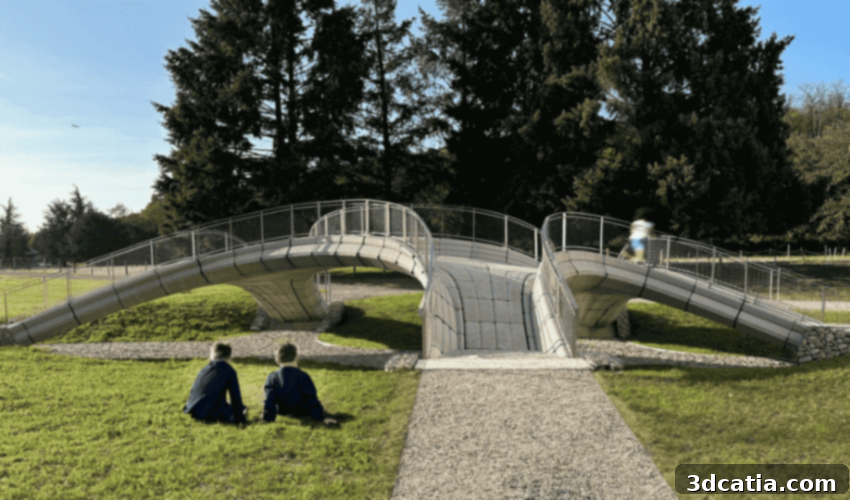
Phoenix Bridge: Pioneering Sustainable Construction with Circular 3D Printed Concrete and Advanced Design
In an era demanding transformative solutions, additive manufacturing is rapidly reshaping traditional construction paradigms. This revolutionary technology is unlocking unprecedented potential for efficiency, bespoke customization, and crucial sustainability within a continually evolving industry. At the forefront of this innovation, Holcim, a global leader in sustainable building solutions with a strong specialization in concrete 3D printing, has proudly unveiled the completion of the “Phoenix” bridge. This groundbreaking 3D printed concrete structure stands as a testament to profound collaboration and cutting-edge engineering. The Phoenix project is the culmination of a synergistic partnership involving the acclaimed Block Research Group of ETH Zurich, the visionary Computation and Design Group of Zaha Hadid Architects, and the innovative specialists at Incremental3D. This alliance has proven indispensable in pushing the boundaries of what’s possible, driving the pursuit of truly sustainable infrastructure solutions for a better, greener future.
The inception of the Phoenix Bridge represents a significant leap forward in circular construction. A pivotal aspect of its creation involved the ingenious recycling of aggregates derived from the original Striatus blocks. Striatus, unveiled at the Venice Architecture Biennale in 2021, was hailed as the world’s first reinforcement-free 3D printed concrete bridge, demonstrating the immense potential of this nascent technology. Building on this legacy, Phoenix was meticulously molded using an innovative mixture specifically developed by Holcim. This special concrete incorporates an impressive 10 tons of recycled materials, making it a tangible example of closed-loop material cycles in action. Furthermore, Holcim modified the composition of this concrete to significantly reduce its carbon impact by an remarkable 40% at the material level. This optimization translates into a substantial 25% reduction in the structure’s total carbon footprint over its lifecycle. Edelio Bermejo, Holcim’s esteemed Head of Research and Development, passionately underscored the ecological imperative of the project. He emphasized that Phoenix unequivocally “[is] demonstrating that essential infrastructure can be designed and built in a way that is circular and low-carbon today,” setting a precedent for global construction practices and proving that sustainability is not a distant goal but an achievable reality.
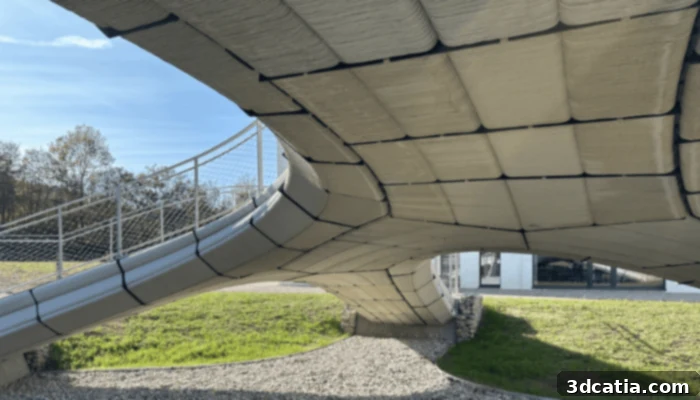
Circular construction methods, including 3D printing, can reduce the use of materials by up to 50% through optimized design and precise material placement, as brilliantly showcased by the Phoenix Bridge.
The Phoenix bridge stands as a powerful symbol of a more environmentally conscious future for infrastructure development. Its very existence highlights the tangible benefits of adopting advanced sustainable practices. A cornerstone of this achievement is Holcim’s innovative ECOCycle® technology, which was instrumental in developing the unique concrete mix for the Phoenix bridge. This advanced circular technology enables the incorporation of significant quantities of recycled materials, specifically aggregates recovered from building demolitions, which are then combined with Holcim’s fully recycled ECOPlanet cement. This integration creates a closed-loop system that drastically minimizes waste and reduces reliance on virgin resources. The paradigm of circular construction, which seamlessly merges the precision of computer-aided design (CAD) with the efficiency of 3D printing, unlocks unparalleled opportunities for material optimization. This powerful combination allows for the creation of intricate, structurally optimized geometries that use material only where it is absolutely necessary. As a result, it is possible to reduce the overall use of materials by an astounding 50% compared to conventional construction methods, all while uncompromisingly maintaining and often enhancing structural performance, durability, and safety. This groundbreaking approach demonstrates how intelligent design and cutting-edge technology can deliver superior infrastructure with a significantly lighter environmental footprint.
The philosophical underpinnings and structural innovations of the Phoenix Bridge are further elucidated by its creators. Philippe Block, co-director of the Block Research Group at ETH Zurich, offers profound insights into its design principles: “Concrete is an artificial stone, and like stone, it does not want to be a straight beam, it wants to be a masonry arch.” This statement encapsulates a return to timeless architectural wisdom, where structures are designed to follow natural load paths, mimicking the strength and efficiency found in historical masonry. By embracing these principles, the Phoenix Bridge achieves inherent structural stability that minimizes the need for internal reinforcement and excessive material. Block further explains the critical benefits of this approach: “Following these historical principles allows us to keep materials separated for easy recycling and to dry-assemble the structure for easy deconstruction and reuse.” This means that the bridge isn’t just sustainable in its creation, but also throughout its entire lifecycle, facilitating future recycling and circularity. The synergy with additive manufacturing is pivotal here: “3D concrete printing allows us to use material only and exactly where needed. The result is a sustainable and truly circular approach to concrete construction.” This precision, enabled by digital fabrication, translates into unparalleled material efficiency and a dramatically reduced environmental impact. Johannes Megens, co-founder of incremental3D, adds a crucial update on the project’s evolution: “Now, after two years and in its second iteration, Phoenix adds a largely reduced carbon footprint and permanence according to building codes along with many other further improvements.” This highlights the continuous refinement and progress in the technology, moving beyond initial prototypes to a robust, compliant, and enduring infrastructure solution that meets the highest standards of safety and longevity.
The successful realization of the Phoenix Bridge using Holcim’s cutting-edge circular ECOCycle® technology marks a significant milestone, transforming what was once conceptual into tangible reality. This achievement is not merely a standalone project but a beacon illuminating the path forward for the entire construction industry. Building on this monumental success, Holcim and its esteemed partners are now vigorously exploring opportunities to extend the profound impact and lessons learned from Phoenix into a much wider deployment of sustainable infrastructure solutions globally. This involves scaling the technology for diverse applications, from urban bridges and pedestrian walkways to elements of larger architectural structures and even housing. The collaborative ecosystem fostered by this project serves as a powerful model, demonstrating how combined expertise can accelerate innovation and drive the adoption of truly regenerative practices in construction. The Phoenix Bridge stands as a testament to the fact that ecological responsibility and engineering excellence are not mutually exclusive but can, in fact, synergistically lead to superior and more resilient infrastructure for future generations. To delve deeper into the intricate details, design philosophies, and sustainable methodologies that brought the Phoenix bridge to life, interested readers are encouraged to visit Holcim’s official website, where comprehensive information is available HERE.
The Phoenix Bridge represents a pivotal moment in sustainable construction, blending ancient wisdom with modern technology to create resilient, eco-friendly infrastructure. What are your thoughts on the implications of 3D printed concrete and circular economy principles for future urban development? Let us know your perspective in a comment below or join the conversation on ourLinkedIn,Facebook, andTwitter pages! Don’t forget to sign up for our free weeklyNewsletter here, to receive the very latest 3D printing news straight to your inbox! You can also find all our innovative videos and project showcases on our dedicatedYouTube channel.
*All photo credits: Block Research Group