
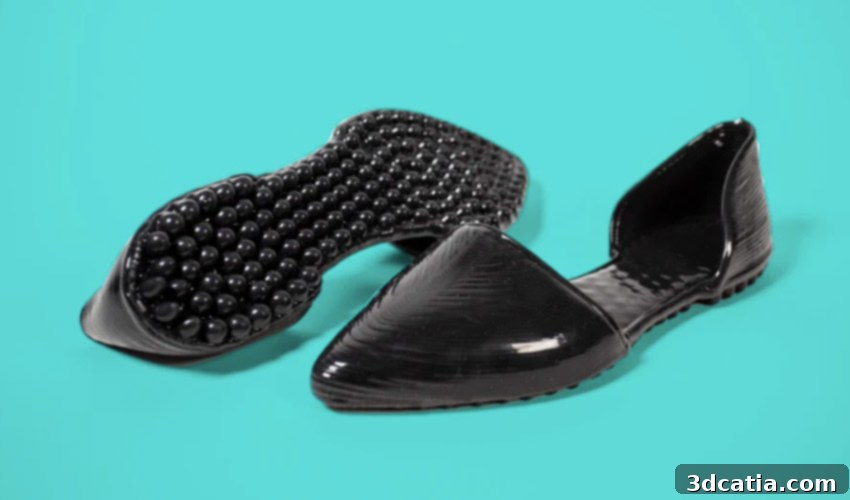
Revolutionizing Footwear: Native Shoes and MIT Pioneer 3D Printed Liquid Rubber Designs
In a groundbreaking collaboration set to redefine the future of footwear, Canadian shoe manufacturer Native Shoes has partnered with the esteemed Self-Assembly Lab at MIT to engineer a revolutionary line of 3D printed shoes. This innovative project, aptly named Liquid Printed Natives, leverages cutting-edge technology to transform everyday products, from casual sneakers to elegant ballerinas, through futuristic manufacturing methods. At its core is the pioneering Rapid Liquid Printing (RLP) technique, developed by the Self-Assembly Lab, which allows for the creation of intricate designs directly within a gel container, resulting in highly original, entirely personalized, and uniquely comfortable footwear.
This partnership marks a significant leap forward in the application of additive manufacturing within the fashion industry. While 3D printing has already made considerable inroads into various niches, particularly in the realm of athletic and custom footwear, this project stands out by experimenting with liquid rubber – a material traditionally less common in 3D printing processes. This choice underscores Native Shoes’ longstanding commitment to sustainability and circular economy principles, a philosophy deeply embedded in their brand DNA. Known for utilizing eco-conscious materials, such as pineapple and corn husks in some of their existing shoe lines, Native Shoes continues to push the boundaries of responsible innovation, making liquid rubber a natural yet pioneering extension of their material exploration.
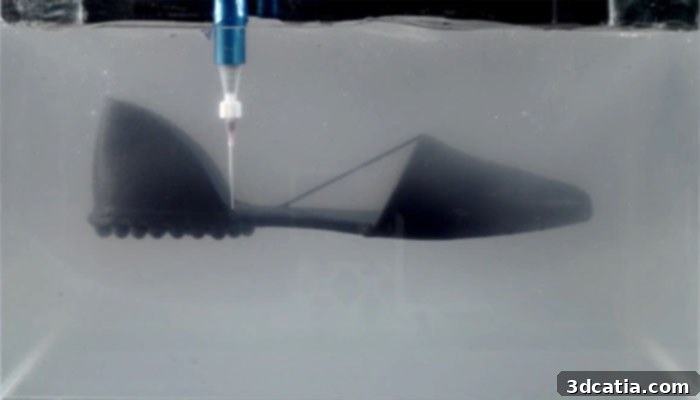
The Rapid Liquid Printing (RLP) technique itself is a marvel of modern engineering. Unlike conventional 3D printing methods that often rely on layer-by-layer deposition, RLP involves extruding liquid material, in this case, rubber, into a tank filled with a dense, reusable water-based viscous gel. This gel acts as a dynamic support medium, allowing the liquid rubber to solidify in complex, free-form shapes without the need for additional support structures. The nozzle precisely traces the desired design within this gel bath, creating a seamless, robust, and highly detailed object. This unique process not only accelerates the printing of intricate geometries but also enables the use of diverse liquid materials, opening up a vast spectrum of possibilities for product design and functionality.
The advantages of RLP are multi-faceted. Firstly, it allows for significantly faster print speeds compared to many traditional 3D printing techniques, which are often limited by the curing time of individual layers. Secondly, it offers unparalleled design freedom, enabling the creation of objects with internal structures and geometries that would be impossible or exceedingly difficult to achieve with conventional manufacturing. Furthermore, the ability to print directly into a support medium minimizes material waste, contributing directly to a more sustainable production cycle. For the Liquid Printed Natives project, this means the potential for entirely new shoe designs that are not only aesthetically unique but also engineered for optimal comfort and performance, leveraging the inherent properties of liquid rubber.
Credits: MIT Self Assembly Lab
Delving into the specifics of the materials, Native Shoes revealed that the footwear in the Liquid Printed Natives collection utilizes a formulation comprising 50% recycled ethylene-vinyl acetate (EVA). EVA is a thermoplastic copolymer widely recognized for its rubber-like softness, flexibility, and excellent shock absorption properties, making it an ideal choice for comfortable and durable shoe soles. By incorporating a significant percentage of recycled EVA, Native Shoes is not only reducing its reliance on virgin plastics but also giving new life to post-industrial or post-consumer waste, thereby closing the loop in its manufacturing process. This commitment to using recycled content aligns perfectly with the brand’s overarching mission to minimize its environmental footprint and promote a more circular economy in the footwear sector.
Thomas Claypool, the visionary founder of Native Shoes, provided insightful commentary on the production process. He noted that while the actual 3D printing time for a single shoe, approximately two hours, is currently longer than traditional injection molding methods (which can produce a pair in as little as 40 minutes), the overall benefits far outweigh this difference. The significantly faster time-to-market, coupled with an unprecedented level of personalization, fundamentally transforms the value proposition. Additive manufacturing empowers Native Shoes to respond more agilely to market trends, produce on-demand, and drastically reduce inventory levels. This lean manufacturing approach not only cuts down on storage costs but also significantly minimizes material waste, as products can be created precisely when and where they are needed, moving away from mass-production models that often lead to surplus and environmental strain.
The ambition for personalization extends beyond just exclusive designs. Native Shoes is also actively developing a system to allow customers to scan their feet, either conveniently in-store or through a dedicated mobile application. This advanced foot-scanning technology promises an unparalleled degree of customization, ensuring each pair of shoes is perfectly tailored to the unique contours and requirements of the wearer’s foot. Such precision fit not only enhances comfort and reduces common foot ailments but also elevates the overall user experience, transforming footwear from a mass-produced commodity into a bespoke item. This vision represents the true promise of mass customization, where every consumer can receive a product that feels as if it was made exclusively for them.
Claypool himself experienced the prototype firsthand, offering valuable insights into the current state of the technology. “The shoes are comfortable and adhere better to the foot,” he remarked, highlighting the immediate benefits of the customized fit and the properties of the liquid rubber material. However, ever the innovator, he also acknowledged areas for improvement, stating, “I think we can improve the quality of our material.” This candid feedback underscores the ongoing research and development efforts, demonstrating a commitment not just to novel manufacturing but also to continuous product refinement. The journey to perfect sustainable, personalized, and high-performance footwear is iterative, and Native Shoes, in collaboration with MIT, is clearly dedicated to pushing these boundaries.
While the excitement surrounding these 3D printed liquid rubber shoes is palpable, the exact market availability date remains under wraps. Nevertheless, the prospect of experiencing such a fusion of innovation, comfort, and sustainable design is something eagerly anticipated by consumers and industry watchers alike. This project isn’t just about making shoes; it’s about pioneering a new paradigm for manufacturing, where technology, sustainability, and individual needs converge to create products that are both advanced and responsible. The implications for the entire fashion industry, particularly in how products are designed, produced, and consumed, are profound.
What are your thoughts on this exciting venture by Native Shoes and MIT? Do you believe 3D printed liquid rubber shoes represent the future of sustainable and personalized footwear? Share your insights and join the conversation by leaving a comment below or connecting with us on our Facebook and Twitter pages! For all the latest news, innovations, and developments in 3D printing delivered directly to your inbox, don’t forget to sign up for our free weekly Newsletter.