
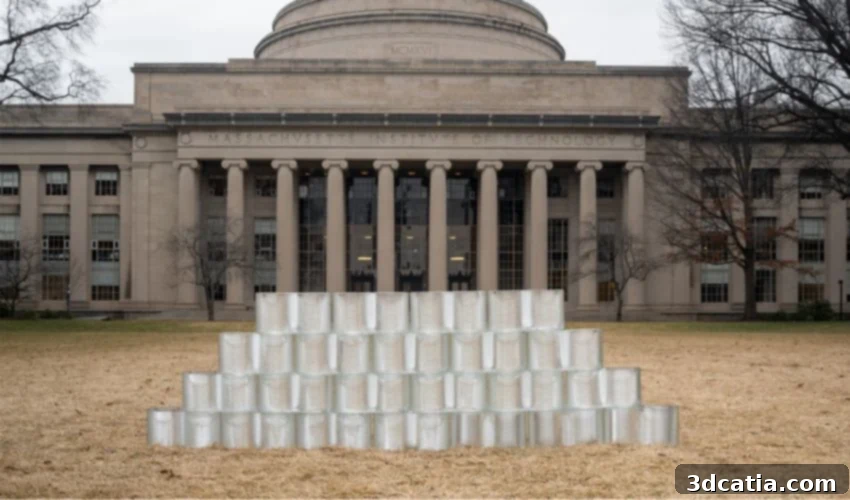
Revolutionizing Construction: MIT Engineers 3D Print Stackable, Sustainable Glass Bricks
Glass, a material revered for its elegance and versatility, holds a truly remarkable characteristic: as long as it remains uncontaminated, it can be infinitely recycled without any degradation of its inherent properties. This inherent sustainability makes it an incredibly appealing candidate for modern manufacturing techniques, particularly in the realm of additive manufacturing. Compared to conventional glass casting methods, additive manufacturing (AM) promises not only greater design freedom and architectural innovation but also a significant potential for reduced production costs. Recognizing these profound advantages, a pioneering team of engineers at the Massachusetts Institute of Technology (MIT) embarked on an ambitious journey to explore the viability of leveraging AM techniques to produce structural building components from glass. Their groundbreaking work focuses on developing novel 3D printed glass masonry units, ingeniously designed to be stacked and interlocked much like classic LEGO bricks, paving the way for a new era of sustainable and flexible construction.
The meticulous research behind these innovative glass bricks was spearheaded by a dedicated group of MIT engineers: Daniel Massimino, Ethan Townsend, Charlotte Folinus, Michael Stern, and Kaitlyn Becker. Collaborating closely, this team successfully fabricated robust, multi-layered bricks crafted from soda-lime glass, a common and easily recyclable type of glass. Each brick features a distinctive figure-eight shape, a design choice critical to their functionality. Mimicking the iconic studs of LEGO bricks, each glass block incorporates two round pegs, enabling them to be effortlessly arranged, disassembled, and reconfigured. This ingenious design not only allows for an almost limitless diversity in architectural compositions but also ensures an extended, potentially indefinite, lifecycle for the building components. Should a structure be redesigned or dismantled, the individual bricks can be seamlessly melted down and reprinted, embodying the ultimate principle of material circularity.
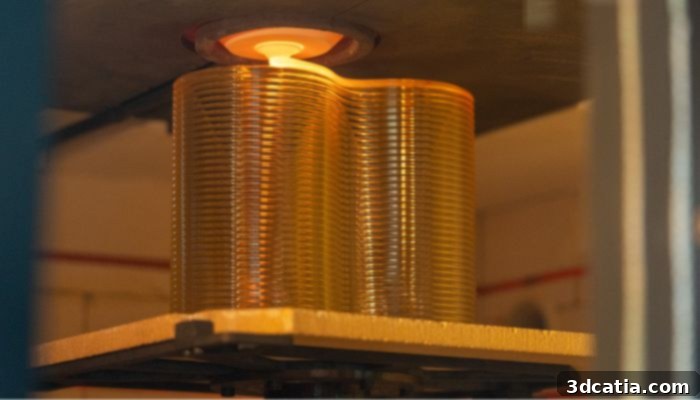
Printing the glass brick with the custom 3D printing process (photo credits: Ethan Townsend)
The unique figure-eight geometry of the bricks is more than just an aesthetic choice; it’s a functional marvel. As Daniel Massimino explained in an article by MIT News, “With the figure-eight shape, we can constrain the bricks while also assembling them into walls that have some curvature.” This capability to create curved, structurally sound walls opens up new avenues for architectural expression, moving beyond the rigid linearity often associated with traditional masonry. Crucially, the engineers’ vision for reconfigurable glass masonry aligns perfectly with the burgeoning concept of circular construction. This philosophy advocates for the maximum reuse and recycling of building materials throughout their lifecycle, with the overarching goal of dramatically reducing the carbon emissions linked to a building’s entire construction and subsequent deconstruction. The inherent sustainability and recyclability of the glass blocks were not merely incidental benefits but served as a primary driving force behind the entire research endeavor, underscoring a commitment to environmentally conscious building practices.
Advancing Material Science: The Glass 3D Printing Process
To bring their innovative designs to life, the MIT engineers utilized a highly specialized, custom-built glass 3D printer known as Glass 3D Printer 3 (G3DP3). This state-of-the-art machine was developed by Evenline, an MIT spinoff company, showcasing the university’s prowess in translating academic research into practical applications. The G3DP3 employs an advanced furnace system designed to melt crushed glass bottles, transforming them into a molten, printable form. This molten glass is then precisely deposited layer by layer, solidifying to form the intricate brick structures. This method not only offers exceptional control over the material but also champions sustainability by directly repurposing waste glass. The printer boasts an impressive maximum print volume of 32.5 x 32.5 x 38 cm, a capacity specifically tailored to produce full-size masonry units, making it suitable for real-world construction applications rather than mere prototypes. This significant printing envelope distinguishes G3DP3 from many other experimental glass 3D printers, pushing the boundaries of what is achievable in architectural scale.
The research team meticulously experimented with three distinct types of brick designs: fully hollow, print-cast, and fully printed units. Each variation was conceived to explore different balances between material usage, structural integrity, and manufacturing feasibility. Their findings revealed compelling insights: “Hollow masonry units provide a more immediate path to implementation, while fully printed units have the potential to provide an entirely glass, transparent, and circular building component fabrication method.” The hollow designs offer practical benefits like reduced weight and material consumption, making them quicker to adopt in current construction paradigms. In contrast, the fully printed units represent the pinnacle of their ambition – entirely transparent, aesthetically striking components that maximize the circularity of glass as a building material, allowing for breathtaking architectural aesthetics that harness natural light.
Ensuring the structural integrity of these novel glass bricks was paramount. The team subjected the blocks to rigorous strength tests using an industrial hydraulic press, a standard method for evaluating the load-bearing capacity of building materials. The results were highly encouraging: the strongest of the glass blocks demonstrated an impressive ability to withstand pressures comparable to those endured by traditional concrete blocks, a testament to the effectiveness of their design and material processing. Intriguingly, the blocks exhibiting the highest strength incorporated a separate, interlocking feature at their base, fabricated from a different material. This specific detail highlights some of the inherent complexities of working with glass, as Kaitlyn Becker noted in the same MIT News article, saying, “Glass is a complicated material to work with. The interlocking elements, made from a different material, showed the most promise at this stage.” While the long-term vision is to print these interlocking elements entirely from glass, the current use of a complementary material is not perceived as a barrier to scaling up the project. It serves as an effective interim solution, allowing the core concept to advance while further material science challenges are addressed. The team is actively investigating methods to fully integrate glass into these critical interlocking components, pushing the boundaries of material fusion and structural design.
Future Outlook: Pioneering Sustainable and Aesthetically Pleasing Structures
To vividly demonstrate the immense potential of their 3D printed glass bricks, the engineers constructed an impressive glass wall directly on MIT’s campus. This tangible showcase serves as a powerful visual testament to the technology’s capabilities, illustrating not only the structural stability but also the unique aesthetic qualities achievable with these innovative building units. Looking ahead, the team harbors ambitious plans to design and construct progressively larger and more intricate structures using these versatile blocks. Their vision extends beyond mere experimental walls; they foresee these 3D printed glass components becoming integral elements in modern architecture, particularly for building facades and interior walls. Imagine buildings bathed in natural light, with walls that offer both transparency and robust structural support, all while being infinitely recyclable.
The implications of this research are far-reaching. By combining the intrinsic sustainability of glass with the design flexibility of additive manufacturing, MIT engineers are not just creating new building blocks; they are forging a path towards truly circular construction. This approach minimises waste, reduces embodied carbon, and promotes a regenerative built environment. The ability to reconfigure and reuse components multiple times transforms the traditional linear model of construction—build, use, demolish—into a dynamic, adaptive system. This innovation could inspire architects and urban planners to rethink material choices and design methodologies, favoring materials that contribute to a healthier planet. Furthermore, the aesthetic appeal of transparent or translucent glass structures offers unparalleled opportunities for architects to create visually stunning and unique spaces, blurring the lines between inside and outside, and maximizing natural light penetration, which has proven benefits for occupant well-being.
While the project has demonstrated remarkable progress, challenges remain in scaling up production and addressing potential issues like thermal performance, fire resistance, and full compliance with diverse building codes. However, the foundational research and successful prototypes by the MIT team provide a robust framework for overcoming these hurdles. The ongoing exploration into printing the interlocking elements entirely from glass signifies a commitment to perfecting the material and manufacturing process, aiming for a fully integrated, single-material glass construction system. This continuous innovation ensures that the project remains at the forefront of sustainable construction material development. For those eager to delve deeper into this groundbreaking work, further details are available in MIT News’ comprehensive article or by reading the full scientific study published here.
What are your thoughts on integrating 3D printed glass into construction materials? Do you believe this innovative approach will become a more heavily implemented practice in the future of architecture and building? Share your insights and join the conversation by leaving a comment below or connecting with us on our LinkedIn, Facebook, and Twitter pages! Don’t miss out on the latest 3D printing news—sign up for our free weekly Newsletter here, delivered straight to your inbox! You can also explore all our engaging videos on our YouTube channel.
*Cover Photo Credits: Ethan Townsend/MIT News