
Revolutionizing Aerospace: Skoltech Pioneers 3D Printed Bronze-Steel Alloys for Extreme Applications
In a significant leap forward for materials science and additive manufacturing, a dedicated team of researchers at the Skolkovo Institute of Science and Technology, widely known as Skoltech, has successfully engineered a novel bronze-steel alloy. This groundbreaking development, achieved through advanced additive manufacturing techniques, represents a first for the market, offering unprecedented possibilities for high-performance engineering. The researchers specifically leveraged direct laser deposition to fabricate intricate components composed of these two distinct metals, paving the way for innovations in demanding industrial sectors, particularly aerospace. Their pioneering work holds immense promise for critical applications such as the construction of combustion chambers for advanced aircraft and rockets, where material integrity under extreme conditions is paramount.
The strategy of combining different materials to harness their individual superior properties is not new; indeed, composite 3D printing is a rapidly advancing field built on this very principle. However, the Skoltech project distinguishes itself by forging a bronze-steel alloy that was previously considered unknown or unachievable within traditional material science paradigms. The judicious selection of bronze and steel for this composite material stems from their remarkably complementary characteristics. Bronze is celebrated for its exceptional resistance to corrosion, its impressive electrical conductivity, and its high wear resistance. In stark contrast, steel is renowned for its formidable resistance to breakage and impact, its resilience against electrical deformation, and its inherent high hardness. By synergistically integrating these properties, the Skoltech team has overcome the limitations of using either metal in isolation, yielding a material that offers a “best of both worlds” solution for structural and functional requirements.
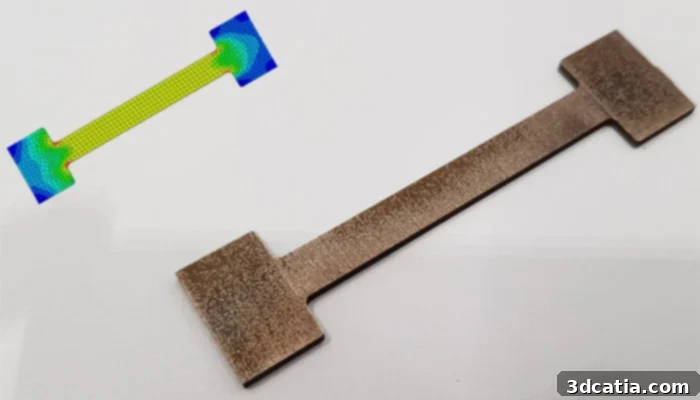
A 3D printed part developed to test the mechanical properties of the new bronze-steel alloy (photo credits: Konstantin Makarenko/Skoltech)
At the heart of this innovation lies the sophisticated application of direct laser deposition (DLD), a process analogous to directed energy deposition (DED), to realize their ambitious project. The researchers employed two distinct yet equally ingenious techniques to fabricate their bronze-steel components. The first method involved meticulously creating an almost homogeneous alloy. This was achieved by uniformly mixing bronze and steel powders before the deposition process. This pre-alloyed powder was then fed into the DLD machine to design and produce various test parts, allowing for an examination of the material’s overall integrated properties. The second, equally innovative technique involved printing “sandwich” parts. This entailed alternately depositing layers of bronze and steel, each precisely 0.25 millimeters thick. This layered approach enabled the researchers to precisely control the material distribution. Throughout their experiments, they systematically varied the proportion of bronze within these layered structures, ranging from 25% to 50%, while maintaining a consistent steel content. This methodical variation allowed them to explore a spectrum of material compositions and their resulting characteristics, providing invaluable insights into the optimal blend for specific applications.
Professor Igor Shishkovsky of Skoltech articulated the profound implications of this research, emphasizing the transformative potential of 3D printing for creating composite parts endowed with the synergistic properties of their constituent materials. He elaborated on the practical benefits by illustrating a scenario within an operating engine: “3D printing is promising for manufacturing composite parts, endowed with the properties of the two distinct materials that make up the composite. Consider, for example, that steel is resistant to the high temperatures created by fuel combustion in an operating engine. This is great, but compared with bronze, steel is a modest thermal conductor, so the engine coolant cannot siphon heat away from it as effectively to prevent overheating and damage. Well, with 3D printing, you can actually get the best of both worlds by manufacturing a combustion chamber that seamlessly goes from being bronze on the inside for better temperature management to being steel on the outside for holding the structure together.” This insight underscores the ability of additive manufacturing to overcome traditional engineering trade-offs, allowing for functionally graded materials where properties vary precisely where needed, optimizing both thermal management and structural integrity in extreme environments. This level of functional customization is simply unattainable with conventional manufacturing methods, highlighting the disruptive power of DLD in material design.
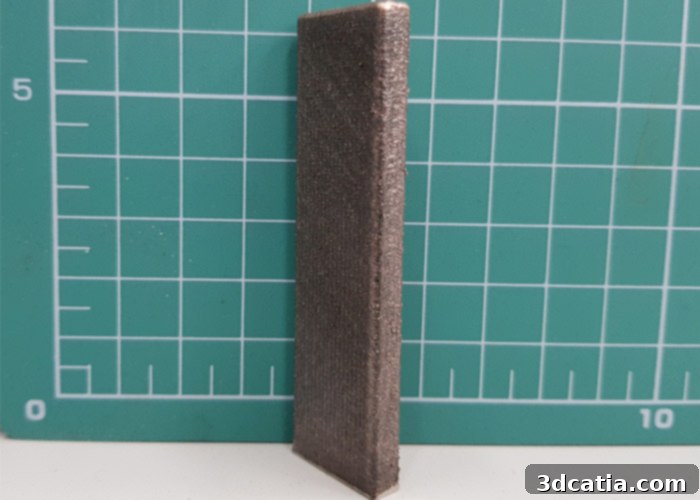
A 3D printed part showcasing a quasi-homogenous bronze-steel mix (photo credits: Konstantin Makarenko/Skoltech)
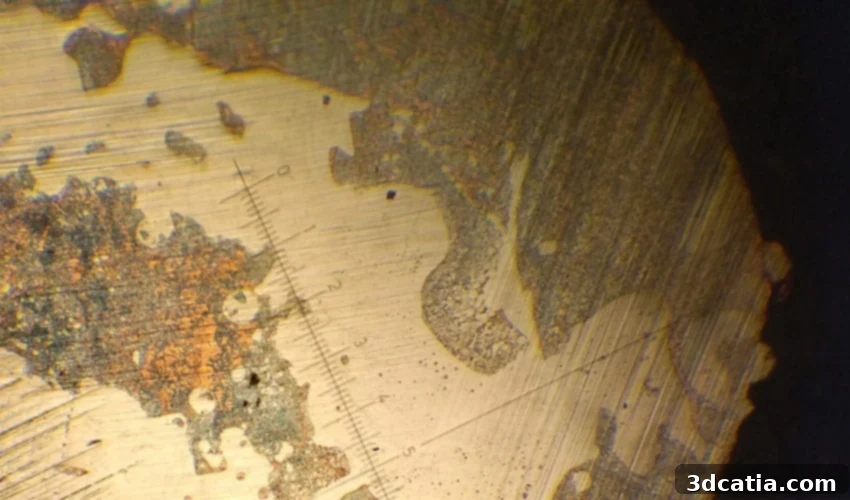
The exhaustive study ultimately confirmed the successful metallurgical fusion of the two materials, with no anomalies or defects detected at the interfaces—a critical indicator of the robustness of the additive manufacturing process. To thoroughly characterize their innovation, the researchers embarked on a comprehensive series of tests to investigate the structural and mechanical properties of the newly developed alloy. These examinations utilized advanced analytical techniques, including optical and scanning electron microscopy, which provided crucial insights into the material’s microstructure, grain boundaries, and overall homogeneity. The findings confirmed that the direct laser deposition method effectively created a strong bond between the bronze and steel, validating the potential for this material in demanding applications. This meticulous validation process is essential for ensuring reliability and performance in real-world scenarios, particularly in the high-stakes aerospace industry where material failure can have catastrophic consequences.
Konstantin Makarenko, a fourth-year PhD student at Skoltech Materials, expressed profound optimism regarding the future trajectory of their research. He concluded, “Now that we have confirmed that steel and bronze can be combined in an alloy and are compatible with 3D printing via direct laser deposition, and we know the mechanical characteristics of the new material, we can explore its possible applications. Looking forward, I would like to manufacture and test a steel-bronze combustion chamber at Skoltech, but beyond that, other items are possible and other metal combinations could be used. The next step would be to create turbine blades made of a strengthened superalloy with cooling channels made of bronze. It’s all about combining the benefits of two distinct materials in one seamless product without any welding or other junctures.” This forward-looking perspective highlights the immediate potential for direct application in aerospace, such as testing a fully functional combustion chamber. More significantly, it points to a revolutionary concept for turbine blades, where an exceptionally strong superalloy could be enhanced with integrated bronze cooling channels—a design that would dramatically improve efficiency and longevity by enabling superior heat dissipation in high-temperature components. This vision underscores a paradigm shift in material design, moving beyond traditional joining methods like welding, which often introduce weak points, towards truly integrated, functionally optimized components. The ability to seamlessly integrate diverse materials opens up a vast new frontier for engineering innovation, promising to unlock unprecedented performance in various industries from automotive to energy.
The pioneering work by Skoltech researchers in developing this novel 3D printed bronze-steel alloy marks a significant milestone in additive manufacturing and materials science. By demonstrating the feasibility of combining metals with such disparate properties into a single, cohesive, and high-performance material, they have not only pushed the boundaries of what is possible but also provided a clear pathway for future innovations. This research exemplifies how advanced manufacturing techniques can unlock superior material performance, offering solutions to long-standing engineering challenges in extreme environments. We are keen to follow the next steps in this transformative project and will keep our readers updated on its progress. In the meantime, for those interested in a deeper dive into the specifics of this groundbreaking study, more detailed information can be found HERE.
What are your thoughts on this revolutionary bronze-steel alloy and its potential impact on future technologies? Share your insights and comments below, or engage with us on our social media platforms: LinkedIn, Facebook, and Twitter. Don’t miss out on the latest advancements in 3D printing; subscribe to our free weekly Newsletter here to receive top industry news directly in your inbox! You can also explore our extensive video library on our YouTube channel.
*Cover Photo Credits: Konstantin Makarenko