
Unlocking Industrial Scale: The Evolution of Large-Format Additive Manufacturing with Discovery 3D Printers
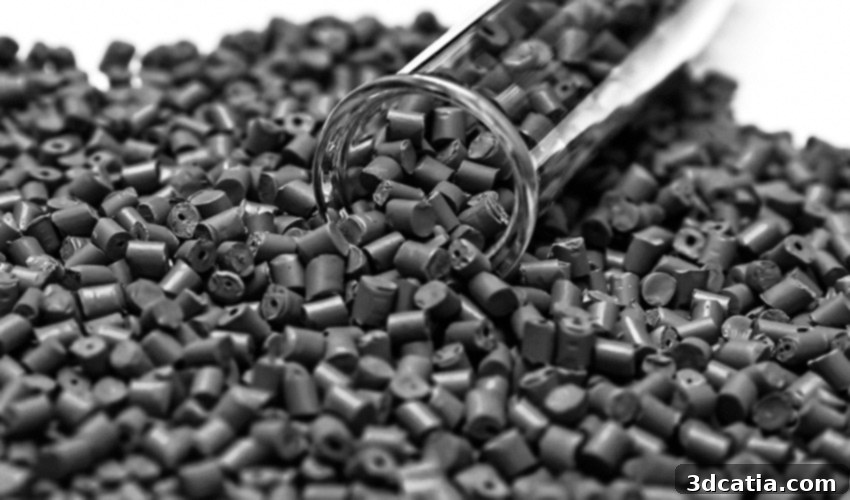
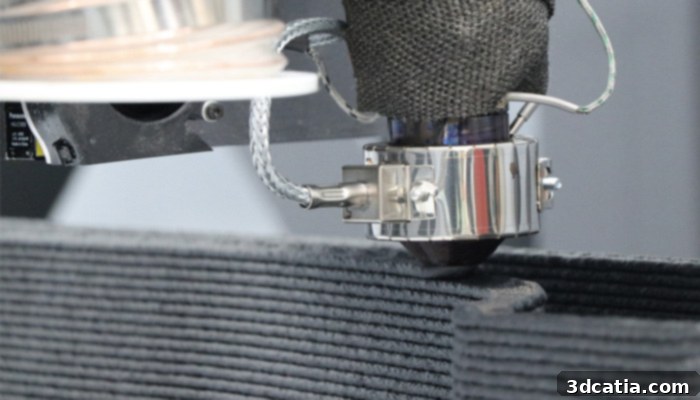
Large-format additive manufacturing (LFAM), specifically through direct pellet extrusion—also known as Fused Granular Fabrication (FGF)—has rapidly transformed the landscape of industrial production. For years, this groundbreaking technology, which involves depositing molten plastic pellets layer by layer to construct three-dimensional objects, was often perceived as an exclusive domain. It typically demanded substantial upfront investment, posed challenges in achieving profitability, and presented certain limitations regarding design freedom and the quality of surface finish. The fundamental process of FGF involves feeding plastic pellets into an extrusion head, where they are heated and compressed into a homogeneous molten plastic mass, subsequently extruded onto a printing bed. In this intricate dance of material and machine, a higher system performance generally translates to increased build speed but often results in a less refined surface finish, and conversely, prioritizing surface quality might necessitate slower operational speeds.
At the forefront of making this advanced technology more accessible and versatile is Discovery 3D Printers, the dedicated additive manufacturing division of the renowned Spanish engineering firm, CNC Bárcenas. Specializing in the development of professional-grade solutions built upon the robust foundation of FGF technology, Discovery 3D Printers has been a pivotal innovator in the field. According to Francisco Bárcenas, the visionary CEO of CNC Bárcenas, “The growing and increasingly diverse market demand has been a significant catalyst, driving us to continually innovate and offer more customized, and crucially, more economical solutions. Our goal is to democratize access to this powerful technology for a wider range of customers.” This commitment to innovation and accessibility is deeply embedded in the company’s history. Headquartered in Valdepeñas, Ciudad Real, Spain, the company marked a significant milestone in 2016 with the launch of the Super Discovery 3D Printer. This machine was not just a product; it was a European pioneer in FGF additive manufacturing technology, heralding a new era for large-scale industrial 3D printing. With an impressive initial build volume of 3.25 cubic meters (1.3 x 2.5 x 1 meter), its inaugural customer was Navantia, a leading Spanish shipbuilding company, integrating this advanced system as a core component of its ambitious “Shipyard 4.0” strategy, aimed at digitalizing and modernizing shipbuilding processes. This early adoption by an industrial giant underscored the immense potential of Discovery 3D Printers’ technology.
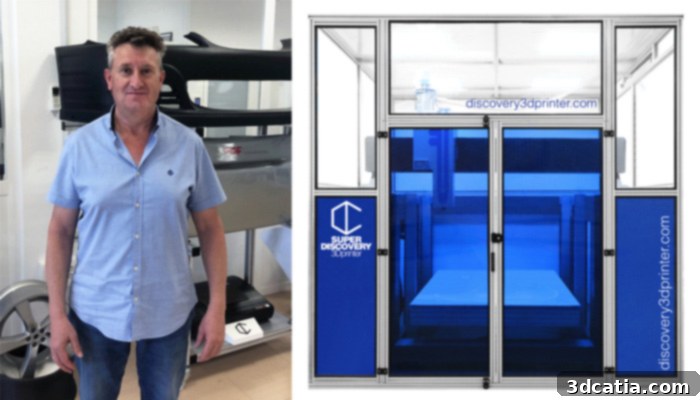
On the left, Francisco Bárcenas, CEO. On the right, the pioneering Super Discovery 3D Printer. (Photo Credits: Discovery 3D Printers)
Recognizing the burgeoning needs within the industrial market and responding directly to specific customer requests, Discovery 3D Printers embarked on a strategic development path in 2019. This initiative focused on engineering models capable of significantly higher production rates, reaching up to 10 kilograms per hour, and substantially larger print volumes, ultimately achieving an astonishing 11.25 cubic meters. This relentless pursuit of scale and efficiency led them to create what was, at the time, Europe’s largest 3D printer, setting a new benchmark for industrial additive manufacturing capacity. During this period of intense development and expansion, Francisco Bárcenas recalls a critical insight gleaned from customer feedback: “Several of our customers articulated important challenges concerning the finishing quality of certain final parts and tooling, particularly complex molds, which often necessitated time-consuming and costly post-processing via traditional machining. Given our extensive history of manufacturing high-precision CNC milling machines since 2009, we saw a unique opportunity to integrate both additive and subtractive manufacturing technologies directly into our solutions.” This revelation sparked the idea for a truly hybrid approach to digital fabrication.
This innovative vision materialized into the Super Discovery 3D Printer Workstation – another pioneering piece of equipment that seamlessly merges large-format additive manufacturing with precision subtractive capabilities. The Workstation was designed to address the critical need for parts that require both rapid production and high-quality surface finishes, eliminating the logistical complexities and time delays associated with separate manufacturing steps. Its first customer, the prototyping department of the esteemed UNEX Group, quickly recognized the immense value of this integrated system. The Workstation has since gained international traction, finding homes with diverse clients such as the construction division of the Belgian Willy Naessens Group, where it facilitates large-scale custom parts, and the Brandenburg University of Technology, supporting advanced research and educational initiatives in digital fabrication. Concurrently, through extensive collaboration with private companies, academic institutions, and technology centers, CNC Bárcenas identified additional market demands. These new requirements revolved around optimized part design, the exploration of novel materials for FGF technology, and the persistent challenges of space and budget constraints for many potential adopters. This understanding led to the development and prototyping of the Super Discovery 3D Printer Compact in 2020. This innovative machine offered all the significant advantages and robust capabilities of the standard Super Discovery model but in a much smaller footprint (1,000 x 800 x 500mm) and, crucially, at a far more accessible price point. The Compact model opened doors for smaller businesses, academic labs, and research facilities to harness the power of large-format pellet extrusion without the prohibitive space or financial commitments typically associated with such industrial-grade equipment.

On the left, the space-efficient Compact version of the Super Discovery 3D printer. On the right, the versatile Hybrid version. (Photo Credits: Discovery 3D Printers)
Throughout its journey, Discovery 3D Printers has consistently distinguished itself by its unwavering commitment to delivering tailor-made industrial 3D printing solutions that are within reach for a broad spectrum of users. This ethos extends even to integrating disparate manufacturing technologies into a single, cohesive piece of equipment, ensuring maximum versatility and utility. Beyond the pioneering Workstation model, one of their most recent and ambitious undertakings has been the successful development of the Super Discovery 3D Printer Hybrid model. This innovative machine represents a significant leap forward, as it not only incorporates the highly efficient direct pellet extrusion (FGF) system but also features a second, independent filament extruder, enabling Fused Deposition Modeling (FDM) capabilities. The brilliance of the Hybrid model lies in its unparalleled flexibility: both FGF and FDM technologies can be deployed either sequentially within the same print job, allowing for the creation of complex multi-material or multi-resolution parts, or utilized individually, depending on the specific requirements of the project. This dual-technology approach dramatically expands the range of applications and materials that can be processed, making it an incredibly powerful tool for advanced manufacturing.
Sharing the same compact print volume as the Compact model, the Hybrid version boasts a respectable output of up to 2 kilograms per hour, offering a strategic balance between size, speed, and precision. Its dual extrusion capabilities empower users to manufacture more intricate and structurally complex parts with superior resolution and finer details, all while maintaining a highly competitive price point. This strategic pricing makes advanced large-format additive manufacturing not only accessible to large-scale industrial enterprises but also to small and medium-sized enterprises (SMEs), cutting-edge technology centers, and vital educational institutions. The comprehensive Super Discovery 3D Printers ecosystem, encompassing the Workstation, Compact, and Hybrid models, has effectively democratized the additive manufacturing of substantial parts. This includes essential tools, intricate molds, rapid prototypes, and short series of both final and spare parts, allowing them to be produced in significantly shorter lead times and at a much lower cost than traditional methods. Now, this transformative capability is firmly within the grasp of professional users, dedicated researchers, and innovative educators across various sectors. For those interested in exploring the full potential of these groundbreaking additive manufacturing solutions and how they can revolutionize production processes, further detailed information is readily available on the manufacturer’s official website, which can be accessed HERE.
What are your thoughts on Discovery 3D Printers’ innovative solutions for FGF and hybrid additive manufacturing? We’d love to hear your insights! Share your comments below or engage with us on ourFacebook,Twitter, andLinkedIn pages. For the latest breaking news and developments in the world of 3D printing delivered directly to your inbox, sign up for our free weeklyNewsletter here!