
Unseen Surveillance: Carnegie Mellon Reveals How Wi-Fi Routers Can Scan Human Bodies and Deepen Privacy Concerns
Over recent decades, technological advancements in fields like 3D scanning have transitioned from rudimentary concepts to sophisticated realities. Light Detection and Ranging (LiDAR), a prime example, has evolved from barely detecting basic shapes to meticulously recreating intricate objects and even human forms with astonishing precision. This evolution underscores a broader trend: technologies that once seemed like science fiction are rapidly becoming integrated into our daily lives, pushing the boundaries of what’s possible. However, as these capabilities expand, so do the ethical considerations and potential for misuse. A groundbreaking research paper from Carnegie Mellon University, published in December 2022, has brought these concerns into sharp focus by demonstrating a truly unsettling capability: using standard Wi-Fi routers in conjunction with machine learning techniques to estimate human locations and even detailed poses within a room, without the need for cameras or specialized scanning equipment.
The potential for technology to cross ethical boundaries and veer into dystopian territory is a perennial human fear, deeply ingrained in our collective consciousness. This apprehension is not merely speculative; it is a recurring theme in literature and cinema, often reflecting valid concerns about the unforeseen consequences of innovation. Philip K. Dick’s seminal 1968 novel, Do Androids Dream of Electric Sheep?, famously adapted into the film Blade Runner, masterfully explored the chilling implications of a world where distinguishing between humans and highly advanced androids becomes nearly impossible. This narrative serves as a powerful metaphor for our anxieties about artificial intelligence and the erosion of what it means to be human in an increasingly technological landscape. Each new invention, from the printing press to the internet, has been met with both excitement and trepidation, and often for good reason.
Even within the generally beneficial realm of the 3D industry, specific downsides have emerged. For instance, the use of industrial 3D printers often necessitates strict safety protocols, including specialized preventive gear to protect workers from inhaling fine metal or polymer powders, which can pose significant respiratory health risks. Similarly, there have been growing concerns regarding the potential health effects of certain resins used in 3D printing on the human body, particularly reproductive health. These examples highlight that even when technology offers enormous advantages, it can also introduce new forms of risk. The latest findings from Carnegie Mellon University elevate these ongoing concerns to a new level, directly impacting our fundamental right to privacy. As our technology becomes more sophisticated and pervasive, the methods by which our movements and presence can be detected are becoming increasingly subtle, raising urgent questions about personal autonomy and the boundaries of surveillance in our own homes and private spaces.

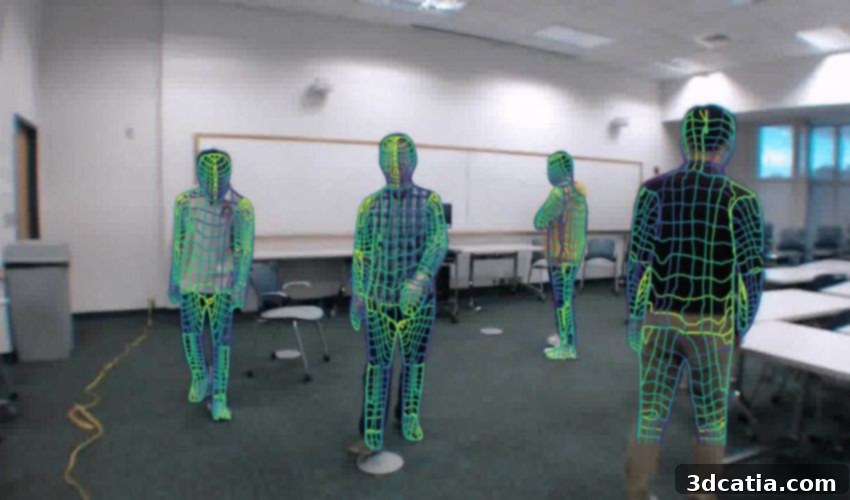
Leveraging Wi-Fi signals, researchers successfully identified the dense pose of human bodies, pushing the boundaries of ambient sensing (photo credits: Carnegie Mellon University).
How Can Wi-Fi Routers Scan Human Bodies So Accurately?
It is crucial to understand that this groundbreaking research was not an accidental discovery but the direct result of a highly targeted study. The Carnegie Mellon researchers explicitly set out to achieve this outcome, driven by the ambition to conduct dense pose estimation using only Wi-Fi signals. Dense pose estimation is a complex computer vision task that aims to map every pixel of a human body in a 2D image to its corresponding 3D surface coordinates. Traditionally, this has been achieved through advanced motion capture systems involving markers, specialized cameras, or depth sensors. The novelty of this research lies in its ability to achieve similar results by leveraging the ubiquitous and seemingly innocuous signals emitted by standard Wi-Fi antennas.
To accomplish this feat, the research team developed a sophisticated deep neural network, a type of artificial intelligence designed to learn from vast amounts of data. This neural network was meticulously trained to interpret the subtle changes in the phase and amplitude of Wi-Fi signals as they propagate through a room and interact with human bodies. Think of it like this: when a person moves within a Wi-Fi field, their body subtly alters the radio waves, causing minute distortions in their phase (timing) and amplitude (strength). The neural network was designed to recognize these distortions and map them to “UV coordinates within 24 human regions.” These UV coordinates essentially provide a 2D map of a 3D surface, allowing the system to understand the precise location and orientation of different body parts. For example, specific Wi-Fi signal patterns would correspond to the position of an arm, a leg, or the torso.
The results of this pioneering work were remarkably successful. The model proved capable of accurately estimating the dense pose of multiple individuals simultaneously, with Wi-Fi signals serving as the sole input. This achievement is particularly significant because it bypasses the need for visual cameras, which are often perceived as intrusive, or expensive specialized hardware. Instead, it harnesses existing infrastructure – the Wi-Fi routers already present in most homes and offices – to gather highly detailed information about human presence and movement. This opens up entirely new avenues for “ambient sensing,” where environments can understand and respond to human activity without explicit human interaction or overt surveillance devices.
Implications and Future Outlook: Balancing Innovation with Privacy
Given these capabilities, a natural and immediate concern might be: do we need to start worrying about our Wi-Fi routers becoming silent, unseen trackers in our homes? In the short term, probably not in a malicious, widespread manner. This research, while undeniably interesting and scientifically profound, primarily demonstrates a *possibility*. It lays the groundwork for future development rather than presenting an immediately deployable surveillance tool for the masses. The researchers themselves were quick to emphasize the potentially positive applications of their findings, suggesting that the results could pave the way for the creation of more accessible, low-cost, and crucially, *privacy-preserving* algorithms for human sensing. Imagine a future where smart homes can detect falls in elderly residents, adjust lighting based on presence, or control devices through gestures, all without intrusive cameras, relying instead on passive Wi-Fi signal analysis. Such applications could offer significant benefits, particularly in assisted living, health monitoring, and advanced home automation, enhancing quality of life and safety.
However, the long-term implications are less clear-cut. As artificial intelligence continues its rapid advancement, and as scanning and ranging technologies become even more refined and integrated into everyday devices, the likelihood of such capabilities being widely deployed and potentially misused could increase significantly over the years. The concept of “dual-use technology”—innovations that can serve both beneficial and harmful purposes—is highly pertinent here. While the current research aims for positive outcomes, the underlying technology could, in different hands or with different intentions, be adapted for unauthorized surveillance, data harvesting, or even more concerning applications. This raises critical questions about data ownership, consent, and the regulatory frameworks needed to govern such powerful sensing capabilities.
The rise of the Internet of Things (IoT) means our environments are already populated by countless sensors, from smart speakers to connected appliances, constantly collecting data about our habits and preferences. Wi-Fi-based human sensing could add another invisible layer to this data collection, potentially creating a comprehensive “digital footprint” that extends beyond our conscious interactions with devices. This necessitates a proactive and robust public discourse on privacy, security, and the ethical responsibilities of technology developers and policymakers. Understanding how such technologies work and their potential ramifications is the first step towards ensuring that future innovations serve humanity’s best interests while safeguarding fundamental rights.
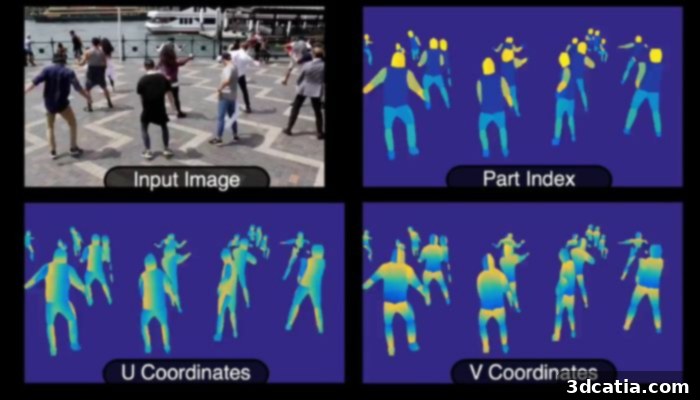
A visual representation of DensePose mapping human body pixels to a 3D surface (photo credits: DensePose).
For those intrigued by the intricate details and methodology of this pioneering work, the full research paper provides a comprehensive deep dive into the technical aspects. You can download the complete study HERE to explore the algorithms, experimental setups, and further discussions presented by the Carnegie Mellon team. This research stands as a testament to human ingenuity, pushing the boundaries of what is conceivable with existing technology, and simultaneously serving as a powerful reminder of the ongoing need for ethical vigilance in the age of advanced AI and pervasive sensing.
What are your thoughts on the implications of using Wi-Fi routers to detect and map human bodies in a room? Do you foresee these technologies leading primarily to enhanced convenience and safety, or do the privacy concerns outweigh the potential benefits? Where do you envision the next significant advancements in ambient sensing and privacy-aware technology occurring? We invite you to share your perspectives and engage in this vital conversation by leaving a comment below or joining the discussion on our LinkedIn, Facebook, and Twitter pages! Don’t forget to sign up for our free weekly Newsletter here to receive the latest updates in 3D printing and related technologies directly to your inbox. You can also explore all our insightful videos and interviews on our YouTube channel, where we delve deeper into the future of innovation.
*Cover Photo Credits: Carnegie Mellon University