
Bone-Inspired 3D Printed Structures: Revolutionizing Durable and Lightweight Construction
Pioneering research from a collaborative effort involving scientists at Cornell University, Purdue University, and Case Western Reserve University is poised to transform the landscape of the construction industry. Drawing profound inspiration from the intrinsic resilience and sophisticated architecture of human bone, these researchers are developing innovative 3D printed structures designed for unparalleled durability. Such advancements hold immense potential for applications within the construction sector, enabling buildings and infrastructure to support substantial loads and withstand continuous stress over extended periods, much like our bones endure a lifetime of activity without faltering. While 3D printing in construction is still in its nascent stages, with early adopters just beginning to explore its full capabilities, the promise of this technology, especially when coupled with biomimetic design principles, is undeniable. Despite numerous R&D initiatives and pilot projects, real-world case studies are emerging, showcasing the immense potential of additive manufacturing applications in construction.
The core of this groundbreaking research involved an in-depth study into how the microscopic ‘beams’ within human bone material manage to resist a lifetime’s worth of mechanical wear and tear. Pablo Zavattieri, a distinguished professor in Purdue’s Lyles School of Civil Engineering, elegantly articulates this biological marvel: “Bone is essentially a finely-tuned building. It features these vital columns that bear the majority of the load, interconnected by robust beams. By understanding and replicating these sophisticated natural designs, we can engineer significantly more robust 3D printed materials suitable for future buildings, bridges, and other critical infrastructure.” Through meticulous experimental tests and advanced simulations, the research team made a pivotal discovery: by artfully mimicking these crucial bone beams and strategically increasing their thickness by approximately 30%, the resulting artificial material exhibited an astonishing lifespan increase of up to 100 times. This finding marks a significant leap forward in understanding and applying biomimicry to create next-generation materials for a more resilient built environment.

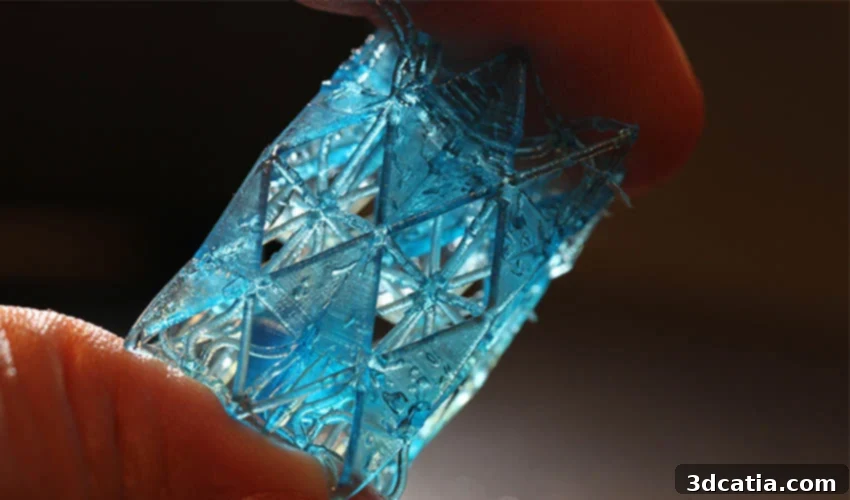
Researchers discovered that by mimicking and thickening crucial bone beams by 30%, the artificial material could last up to 100 times longer, offering a pathway to stronger 3D printed structures | Credits: Purdue University photo/Pablo Zavattieri
Unlocking Bone’s Secret: The Trabecular Network for Enhanced Durability
The remarkable durability of human bones, a characteristic we often take for granted, stems from an intricate and sophisticated internal architecture known as the trabeculae. This spongy, porous structure is not merely a random mesh but a highly organized network resembling a carefully engineered scaffold. It comprises interconnected vertical plate-like struts, functioning much like load-bearing columns, and horizontal rod-like struts, acting as critical bracing beams. The effectiveness of this design is evident in its ability to adapt and respond to various mechanical stresses. Essentially, the denser and more robust this trabecular network, the greater the bone’s resistance to fracture and fatigue. This density naturally changes as humans age, highlighting the dynamic nature of bone health.
Crucially, the scientists identified the horizontal rod-like struts as disproportionately significant contributors to the bone’s overall resistance and mechanical integrity. Dr. Hernandez, a distinguished professor of mechanical, aerospace, and biomedical engineering at Cornell, emphasizes this point: “When people age, one of the primary structural degradations in their bones is the preferential loss of these horizontal struts. This loss significantly increases the likelihood that the bone will fail from multiple, repetitive cyclic loads, leading to common age-related fractures.” This insight underscores the critical role of these specific elements in maintaining long-term structural resilience and provides a clear target for biomimetic design. Understanding how these horizontal components contribute to strength, especially under dynamic loading conditions, offers a blueprint for engineering superior, fatigue-resistant materials for a wide range of applications.
The practical implications of this research for architecture and structural engineering are profound. Imagine applying this nuanced understanding of bone mechanics to design buildings and infrastructure that are inherently stronger, more resilient, and better equipped to withstand extreme conditions, such as natural disasters like earthquakes or hurricanes. To test their theoretical findings, Pablo Zavattieri’s lab embarked on a series of experiments, utilizing advanced 3D printing techniques to fabricate polymer structures with internal architectures meticulously designed to mimic the trabeculae of bone. These sophisticated simulations were critical, allowing researchers to observe how different architectural modifications affected material performance under various cyclic loading scenarios. The results were compelling: the simulations unequivocally revealed that increasing the thickness of the horizontal struts within these biomimetic polymers dramatically prolonged their lifespan and enhanced their load-bearing capacity. Adwait Trikanad, a co-author of this seminal work and a civil engineering Ph.D. student at Purdue University, elaborated on the findings: “When we conducted simulations of the bone microstructure under cyclic loading, it became evident that the strains were concentrating precisely in these horizontal struts. By strategically increasing the thickness of these specific horizontal struts, we were able to significantly mitigate some of the most critical observed strains, thereby enhancing the material’s overall durability.” This targeted approach to design, directly inspired by nature’s efficiency, paves the way for a new generation of high-performance construction materials.
The Future of Construction: Lightweight, Resilient, and Sustainable 3D Printed Materials
One of the most exciting aspects of this research is the discovery that enhancing the thickness of these critical horizontal struts did not lead to a significant increase in the overall weight of the 3D printed polymer. This breakthrough suggests a revolutionary pathway toward designing materials that are simultaneously highly resistant and remarkably lightweight. The combination of strength and low weight is a holy grail in material science and engineering, offering myriad benefits across numerous industries, especially construction. Lightweight materials reduce the structural load on foundations, decrease transportation costs and associated carbon emissions, and enable faster, more efficient construction processes. They also open up possibilities for modular construction, where large components can be fabricated off-site and easily transported to the construction site for rapid assembly.
Pablo Zavattieri encapsulates the profound implications of this finding: “The ability to create a substantially stronger material without adding significant weight is a game-changer. It means that complex 3D printed structures could potentially be fabricated in one location and then efficiently transported to remote sites, drastically reducing on-site construction time and logistical challenges. These insights derived directly from the study of human bone are not just academic curiosities; they are a powerful enabler for truly integrating sophisticated architected materials into the mainstream construction industry.” This paradigm shift towards bio-inspired, architected materials promises to usher in an era of more sustainable, resilient, and economically viable construction practices. By mimicking nature’s optimized designs and leveraging the precision of additive manufacturing, we can move towards building structures that are not only stronger and lighter but also contribute to a reduced environmental footprint, aligning with global efforts towards sustainable development.
The ongoing evolution of 3D printing technologies and advanced material science is rapidly redefining what is possible in design and engineering. This research exemplifies how biomimicry – drawing inspiration from natural designs and processes – can unlock innovative solutions to complex engineering challenges. The ability to precisely control the internal geometry of materials through 3D printing, enabling the replication of intricate structures like trabeculae, represents a significant advantage over traditional manufacturing methods. While challenges remain in scaling up these laboratory-proven concepts to industrial-level applications, including material selection, cost-effectiveness, and regulatory approvals, the foundational principles established here are robust. This work paves the way for a future where our buildings are not just strong but also inherently efficient, built with materials that are both lightweight and exceptionally durable, ultimately enhancing safety and sustainability in our built environment.
What are your thoughts on this groundbreaking research and its potential to create stronger 3D printed buildings in the future? We encourage you to share your insights and comments below, or engage with us on our Facebook and Twitter pages! Don’t miss out on the latest advancements and news in the world of additive manufacturing – be sure to sign up for our free weekly Newsletter, delivered straight to your inbox!