
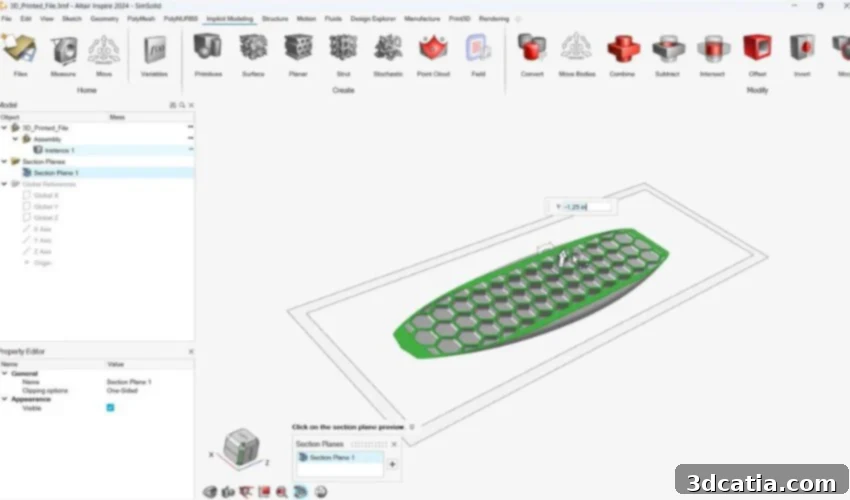
Unlocking Innovation: The Critical Role of DfAM and Altair Inspire in 3D Printing Design
When envisioning the creation of 3D printed parts, initial thoughts often gravitate towards the specific 3D printing process or the chosen materials. However, there’s a foundational step that profoundly influences every subsequent stage of additive manufacturing: the design phase itself. The ultimate success or failure of a printed component frequently hinges on the quality and thoughtfulness of its initial design. This underscores the immense importance of advanced tools and software, such as Altair Inspire, especially as the additive manufacturing sector continues its rapid industrialization. To delve deeper into this crucial aspect, we recently connected with TrueInsight, an expert partner for the Altair Engineering software portfolio, to gain valuable insights into the significance of Design for Additive Manufacturing (DfAM) and the strategic use of appropriate tools for creating optimal 3D printable parts.
Introducing TrueInsight: Expertise in Additive Manufacturing Software Solutions
TrueInsight stands as a prominent partner for Altair Engineering’s software solutions within the United States, bringing a wealth of experience to the dynamic landscape of additive manufacturing. According to Tyler Haggin, COO at TrueInsight, their company emerged from a robust legacy as the largest global partner for SOLIDWORKS (CAD) and Stratasys (AM) solutions. This rich history provides their leadership team with nearly four decades of collective industry experience, having closely collaborated with numerous clients through the evolution of 3D printing from an emerging “trend” into a business-critical process. Today, integrating additive manufacturing is a standard practice within most product development workflows, a testament to the industry’s maturation and TrueInsight’s foundational role in this significant transition.

Tyler Haggin, the COO at TrueInsight, discussing the importance of DfAM and Altair Inspire for modern manufacturing.
TrueInsight’s journey highlights the significant shift in perception and application of 3D printing technologies. What was once considered a niche or experimental capability is now deeply embedded in the industrial design and manufacturing ecosystem. Their profound understanding of both traditional CAD and advanced additive manufacturing processes positions them uniquely to guide companies through the complexities of integrating cutting-edge design software into their established workflows. This extensive experience is vital for helping businesses leverage the full potential of tools like Altair Inspire to achieve superior results in terms of part performance, efficiency, and manufacturability.
Altair Inspire: Driving Innovation in Additive Manufacturing Design
Altair has long been recognized as a trailblazer in the field of topology optimization, a critical methodology for advanced engineering design. This innovative approach empowers designers and engineers to significantly reduce the mass or volume of their designs while meticulously preserving their intended structural integrity and performance requirements. The resulting forms from topology optimization often exhibit organic, intricate shapes that are inherently challenging, if not outright impossible, to produce using conventional manufacturing techniques. This is precisely where additive manufacturing shines, providing the unparalleled capability to fabricate these complex geometries, thereby unlocking new levels of innovation and design freedom.
In a significant advancement that further solidifies its position, Altair has recently enhanced its Altair Inspire tool with integrated implicit modeling functionality. Implicit modeling is a field-driven design paradigm that allows users to effortlessly create highly complex lattice structures, encompassing various patterns such as planar, strut, and stochastic models. This capability is revolutionary for additive manufacturing, as it enables the design and creation of parts that are not only stronger and lighter but also incredibly efficient in terms of material usage. The ease with which these advanced structures can be generated and manipulated within Altair Inspire makes it an indispensable tool for engineers seeking to push the boundaries of part performance and efficiency through intelligent 3D printing design.
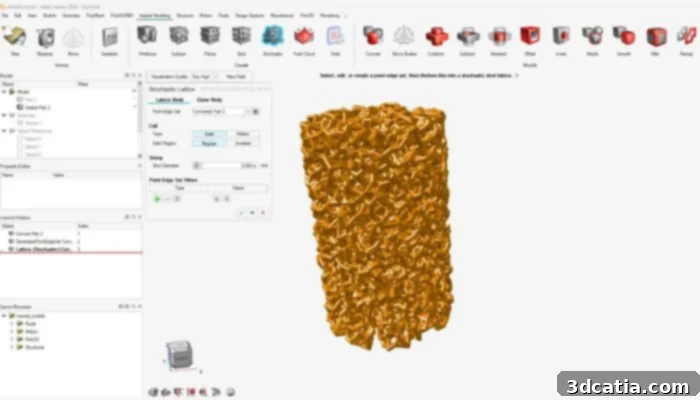
Altair Inspire empowers users to create complex lattice shapes, including stochastic models (pictured above), optimizing material use and strength for 3D printing.
The Indispensable Role of DfAM for Superior Part Performance
As additive manufacturing transitions from a novel technology to a standard process across a multitude of industries, the discipline of Design for Additive Manufacturing (DfAM) has concomitantly become an essential requirement for success. DfAM fundamentally challenges designers to rethink their conventional approaches, liberating them from the long-standing constraints imposed by traditional manufacturing methods where parts needed to be easily manufacturable or cost-effective using processes like machining or injection molding. This shift is metaphorical: it allows designers to “release the handcuffs” of outdated design paradigms and embrace true innovation.
With DfAM, a comprehensive new set of parameters must be carefully considered during the design phase. For instance, a deep understanding of specific design guidelines concerning minimum feature size, maximum overhang angles, and minimum wall thicknesses is crucial. These parameters directly inform what can be realistically and successfully 3D printed, guiding designers away from unprintable geometries and towards optimized designs that leverage the unique capabilities of additive manufacturing. By rigorously adhering to DfAM principles, engineers can create parts that are not only innovative in their function but also practical, efficient, and cost-effective to produce through additive processes.
The ability of additive manufacturing to effortlessly create complex lattice structures is one of its most compelling advantages, enabling superior strength-to-weight ratios and customized material properties. Consequently, an increasing number of modern designs are now integrating these sophisticated structures. However, traditional Boundary Representation CAD (BREP) systems often struggle with the generation and manipulation of lattice structures. Attempting to model them with conventional CAD software can result in astronomically large file sizes, frequently making the models unmanageable or even impossible to create. These enormous file sizes then translate into time-consuming and inefficient slicing processes, which are necessary steps before a part can be printed.
This is precisely where the implicit modeling capabilities within Altair Inspire deliver significant impact. By generating lattice structures through field-driven definitions rather than explicit geometric boundaries, implicit modeling dramatically reduces file sizes and computational overhead. This efficiency directly addresses the common “pain point” of complex lattice designs, making the entire workflow—from design conception to slicing and final printing—much more streamlined and efficient. Altair Inspire thus empowers designers to fully capitalize on the potential of intricate lattice structures without encountering the typical computational bottlenecks, leading to faster design iterations and more economically viable 3D printing projects.
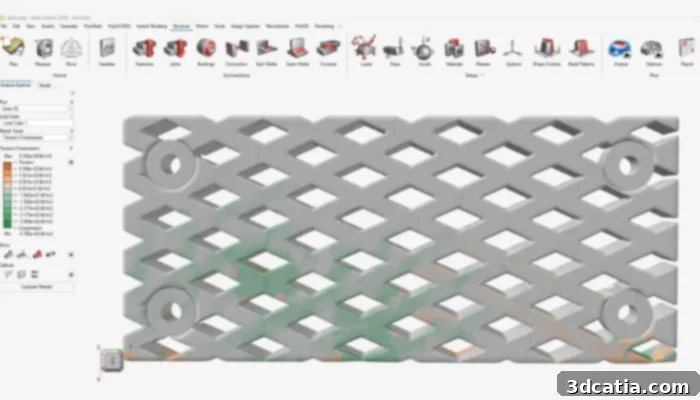
Altair Inspire is instrumental in improving efficiency in 3D printing, ensuring that designs are not only innovative but also optimized for the manufacturing process.
Overcoming Design Challenges in 3D Printing with Altair Inspire
A common misconception among users approaching design for 3D printing is the perceived complexity and cost barrier of integrating advanced tools into existing workflows. Tyler Haggin from TrueInsight believes that raising awareness about the accessibility and comprehensiveness of these solutions is key. Altair Inspire, for instance, offers a truly comprehensive suite of functionalities that make it exceptionally user-friendly and cost-effective. It effectively bridges the gap between traditional CAD and advanced simulation, providing a holistic environment for additive manufacturing design that simplifies complex tasks.
Within Altair Inspire, users can leverage both conventional BREP (Boundary Representation) processes, which are familiar from most CAD tools, and the innovative implicit modeling for generating complex lattice structures with remarkable ease. Beyond geometry creation, the software seamlessly integrates the Altair OptiStruct optimization solver, a powerful and industry-leading tool for lightweighting parts. Crucially, all these capabilities—from design and optimization to advanced simulations like stress testing and CFD (Computational Fluid Dynamics)—are accessible directly within the intuitive Inspire interface. This integrated approach eliminates the need for switching between multiple software packages, streamlining the design process significantly. Given Inspire’s established reputation for ease-of-use and its competitive price point, the primary hurdle lies in educating end-users about its enhanced accessibility and the breadth of its integrated features.
Beyond the technological learning curve, another prevalent challenge that people encounter when designing for additive manufacturing is insufficient consideration of the actual printing process. Design engineers often dedicate considerable effort to optimizing part performance; for example, they might run finite element simulations and topology optimization to achieve a new part design that reduces mass by a significant percentage (e.g., 30%) while meticulously maintaining stiffness. However, this perfectly optimized design might ironically present significant manufacturing challenges during the actual 3D printing stage, such as problematic overhang angles, extensive support structure requirements, or internal stresses that lead to increased material waste or costly post-processing efforts.
This is where Altair’s integrated tools truly stand out as a game-changer. They empower users to not only design with fewer constraints, enabling more creative and performance-driven geometries, but also to simultaneously ensure the manufacturability of the part. All these critical checks and optimizations—from structural analysis to manufacturing feasibility assessment—can be performed directly within the same intuitive interface. This holistic approach allows engineers to iterate rapidly and confirm that their innovative designs are indeed practical and efficient to produce via additive manufacturing, preventing costly redesigns and ensuring that the theoretical benefits of an optimized design translate into tangible gains in the physical world.
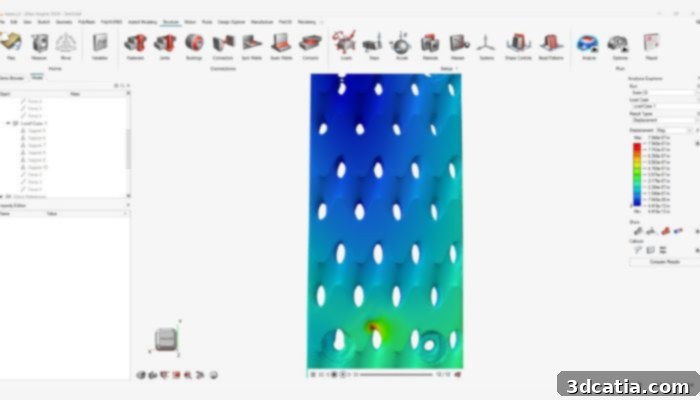
Altair Inspire integrates powerful tools that allow users to design with fewer constraints and simultaneously ensure the manufacturability of the part for 3D printing, all within one interface.
Real-World Impact: Altair Software in Action Across Industries
The adoption of Altair software, particularly Altair Inspire and OptiStruct, has been most pronounced in sectors where lightweighting and performance optimization are critical drivers. The aerospace and automotive industries are prime examples, consistently pushing the boundaries of material efficiency and structural integrity. However, in recent years, TrueInsight has observed a significant and growing trend of users across various other industries embracing these advanced technologies to create truly unique and innovative designs that were previously unattainable or economically unfeasible.
Let’s consider a few specific examples illustrating these broader industry applications and the tangible benefits derived from Altair’s solutions:
- Gondola Lift Station Building Optimization: In a compelling case study, a topology optimization solver was strategically deployed to significantly enhance the design of lift brackets used in a gondola lift station. This application demonstrates how even in infrastructure and construction-related fields, optimizing structural components for weight and performance can lead to substantial benefits in terms of material usage, increased safety margins, and improved operational efficiency over the lifespan of the structure.
- Valve Spring Press Tools by Etteplan: Etteplan, a leading engineering services company, successfully utilized Altair OptiStruct™ and Altair Inspire™ to redesign their valve spring press tools. These are critical components used for mounting cylinder head valves in internal combustion engines. Through the meticulous use of these advanced simulation solutions, Etteplan performed extensive topology optimization and finite element (FE) analyses to generate innovative design concepts that were lighter yet equally robust. The outcome was remarkable: the redesigned part was 3D printed within just one week, meeting both stringent cost targets and achieving efficient material usage objectives, showcasing the rapid prototyping and cost-saving potential of Altair’s integrated tools for complex industrial applications.
- Medical Self-Injector by Nolato: Nolato, a global leader in injection molded parts, collaborated with Altair and Avalon Innovation to develop a state-of-the-art medical self-injector. For vital medical devices like autoinjectors, which are critical for patients managing conditions such as diabetes, the part design is paramount to ensure exceptional quality, durability, precise functionality, and reliable performance. Altair’s comprehensive suite of tools proved ideal, providing a seamless single workflow that extended from initial conceptual sketches through various detailed design iterations. The resulting prototypes performed exactly as expected under rigorous testing, fostering immense confidence in the design process. Altair’s integrated multidisciplinary tools consistently deliver timely, robust, and accurate answers, making them invaluable for critical and life-sensitive medical device development.
These diverse case studies powerfully underscore Altair’s versatility and profound impact across a multitude of sectors. From optimizing heavy industrial components to refining intricate medical devices, Altair’s software facilitates the creation of superior parts that not only meet complex engineering demands but also leverage the unique advantages of additive manufacturing. The focus on lightweighting, enhanced structural integrity, and efficient manufacturability makes Altair an indispensable partner for companies seeking to innovate and achieve competitive advantages through advanced design and simulation capabilities.
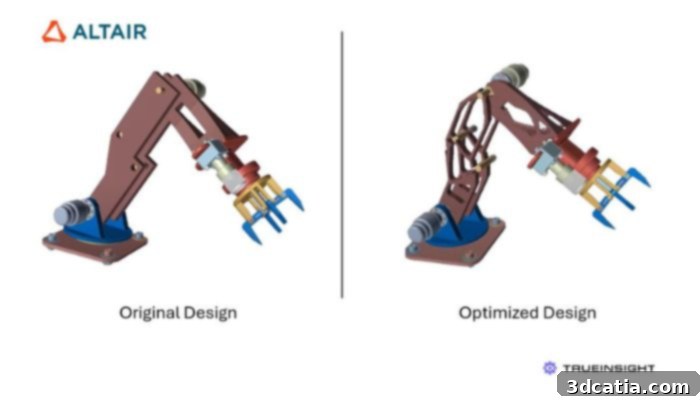
Altair Inspire can significantly help optimize a design for additive manufacturing, as effectively seen with this compelling before and after comparison image.
The Future of Design in Additive Manufacturing
The ongoing evolution and industrialization of the additive manufacturing sector place an increasing and undeniable emphasis on the software and design components of the process. Tyler Haggin from TrueInsight expresses genuine excitement about this intensified focus, believing that it will empower designers to truly unlock their creative potential in addressing the most complex engineering challenges. As the industry continues to mature and integrate further into mainstream production, the integration of powerful CAE (Computer-Aided Engineering) tools becomes not just beneficial but absolutely essential for achieving optimal results. Altair, long renowned for its leading CAE solutions across various engineering disciplines, has significantly advanced its offerings specifically for additive manufacturing design in recent years, solidifying its position as a top-tier solution provider, rivaling or even surpassing others in the industry.
The future of 3D printing is undeniably intertwined with intelligent design software. Tools that can seamlessly handle complex geometries, optimize for performance objectives, accurately simulate manufacturing processes, and robustly ensure manufacturability—all within a cohesive and intuitive environment—are critical for accelerating innovation and driving efficiency. TrueInsight remains at the forefront of this transformative period, diligently guiding clients to harness the full capabilities of Altair’s robust portfolio. For readers eager to explore these possibilities further and discover the right Altair solution for their specific needs, more comprehensive information about TrueInsight and their specialized services can be found HERE.
What are your thoughts on Altair’s significant impact on additive manufacturing? How do you perceive the importance of advanced software in streamlining the design process for 3D printed parts and achieving optimal results? We invite you to share your valuable insights in a comment below or engage with us on our LinkedIn, Facebook, and Twitter pages! Don’t forget to sign up for our free weekly newsletter here for the latest 3D printing news straight to your inbox! You can also find all our videos on our YouTube channel.
*All Photo Credits: TrueInsight