

Optimizing Digital Fabrication & Engineering Workflows: The Power of MakerOS
In the rapidly evolving landscape of digital fabrication and engineering services, efficiency, collaboration, and seamless communication are paramount for success. Recognizing a significant void in the market, MakerOS emerged in 2017 as a pioneering solution. Headquartered between the bustling tech hubs of New York City and Detroit, MakerOS launched its version 1.0 collaboration platform with a clear mission: to revolutionize how digital fabrication companies manage their operations. The genesis of MakerOS stemmed directly from the firsthand experiences of its founder, Mike Moceri, who observed the inherent complexities and numerous efficiency challenges associated with juggling multiple clients and orchestrating intricate project workflows. At the time, no comprehensive solution existed to adequately address these pain points. This realization spurred Moceri to develop sophisticated software specifically designed to empower fabrication and engineering service providers. His vision was to create a centralized, online ecosystem where all critical business activities – from initial client communication and project submission to detailed invoicing and production management – could be seamlessly integrated and managed. This innovative central online portal is precisely what MakerOS delivers. In a testament to its continuous development and commitment to excellence, the startup announced the release of its significantly enhanced version 2.0 software platform in September 2020. This evolution prompts a crucial question for businesses in this sector: what profound value can be derived from tightly syncing sales, engineering, and client interactions within a unified system when operating a fabrication or engineering service? And, more importantly, what tangible benefits can companies expect to unlock by adopting such an integrated approach?
Bridging Silos: How Enhanced Collaboration Fuels Business Growth
Virtually every fabrication and engineering service operates with a defined process for acquiring new projects and a separate, distinct process for their production. In a typical sales pipeline, a company utilizes tools to gain a visual snapshot of where prospects stand, enabling the sales team to forecast potential deal closures within a specific timeframe. These prospective deals invariably represent projects that will eventually require assignment to the production or engineering department. However, a pervasive challenge in many organizations is the disconnect between sales pipelines and production workflows. It is common for companies to rely on two, or even more, disparate software systems to track these crucial, yet often isolated, functions. This operational fragmentation creates significant inefficiencies and communication breakdowns.
The consequences of such disorganization are far-reaching. If the sales team needs an update on a project’s progress, or if the engineering team requires clarification on client specifications, direct and often disruptive inquiries become necessary. This manual back-and-forth, as one can easily imagine, is far from ideal. It consumes valuable time, introduces delays, and can lead to frustration among team members. Furthermore, accurate pricing becomes an intricate and error-prone task when sales and engineering teams lack synchronized data and close collaboration. Mispricing is a regrettably common mistake in fabrication and engineering services, directly leading to eroded profit margins, missed revenue opportunities, and even client dissatisfaction due to unexpected changes or inflated costs. The inability to seamlessly transfer information and collaborate in real-time creates a bottleneck that stifles growth and undermines overall operational efficiency, making it incredibly difficult for businesses to scale effectively.
MakerOS Features: Transforming Challenges into Opportunities
Recognizing these pervasive shortcomings was the first step; crafting an effective, holistic solution was the next. The innovative American startup, MakerOS, tackled this by fundamentally rethinking the workflow. They decided to combine the traditionally separate sales pipeline and production workflow into a singular, integrated system, further enhanced by an advanced automated quoting process. These two core solutions are known as the Projects Board and the Autoquoter, both integral components of the MakerOS platform.
The Projects Board: Unifying Project Management
On the Projects Board, every team member within the company gains real-time visibility into a project’s status. This includes access to all associated files, messages, quotes, and billing information, all centralized in one easily accessible location. This eliminates the need for endless email chains or fragmented communication, fostering an environment of transparency and accountability. By providing a single source of truth for all project-related data, the Projects Board drastically reduces miscommunication and ensures everyone is working with the most current information. This level of internal synchronization significantly enhances team productivity and responsiveness.
The Autoquoter & Custom Invoicing: Precision Pricing & Flexibility
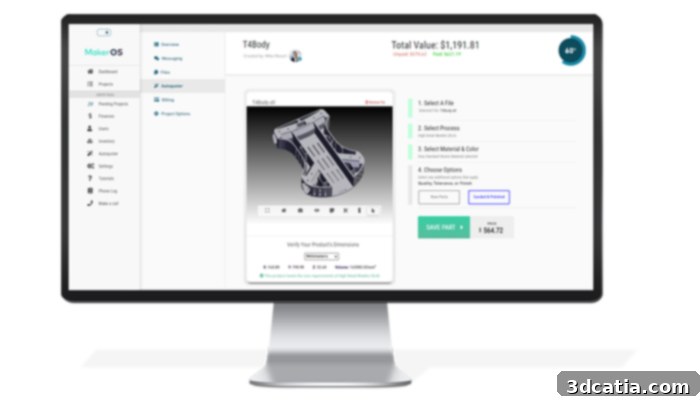
Complementing the Projects Board, all relevant project data is automatically collected by the Autoquoter. This powerful feature enables an automated and highly accurate quoting process for a vast majority of digital fabrication technologies. This automation dramatically accelerates the sales cycle, allowing sales teams to generate quotes quickly and confidently. Once a quote is accepted, the engineering or production team is directly and instantly notified of the specific parts that require fabrication, complete with all necessary specifications. Simultaneously, the sales team is empowered to sell the part at the correct, pre-calculated price, thereby eliminating the costly errors of mispricing and safeguarding profit margins. However, MakerOS understands that not all projects are suited for automatic quoting, especially those with unique requirements or complex custom elements. For such scenarios, MakerOS includes a robust custom invoicing system. This system allows service providers to easily add custom line items, specialized services, or stock products directly from the integrated Product and Inventory Manager. It also offers seamless connectivity with a service’s QuickBooks online SKUs, ensuring financial accuracy and streamlined accounting processes. This dual approach of automation and customization provides unparalleled flexibility for businesses of all sizes and complexities.
The impact of these features on real-world businesses is significant. Robert Lent, VP and Co-Founder at Vision Miner, a leading 3D printing distributor and service provider specializing in industrial-grade materials, provided a compelling testimonial about their experience with MakerOS: “MakerOS has helped us organize everything, stay on top of client communication, and see the statistics of our service over time. It’s also increased the quality of how we process orders, which has translated directly to more orders being processed.” This statement underscores a critical insight: by substantially reducing the time and effort expended on administrative tasks and order processing, companies can strategically reallocate these valuable resources. This often means dedicating more capacity to taking in and completing new orders, effectively scaling their operations without proportionally increasing overhead.
Product and Inventory Manager: Real-time Resource Control
Another indispensable feature within the MakerOS software suite is the Product and Inventory Manager solution. This powerful tool provides companies with comprehensive tracking capabilities for all their resources, materials, and finished products. It offers immediate insights into inventory levels, ensuring that businesses are promptly aware when parts or resources are running low. Crucially, the Product and Inventory Manager seamlessly syncs with the Autoquoter. This integration means that the availability of resources is shared in real-time across the platform, allowing for accurate expectation setting with clients and internal teams. If resources are critically low, the manager intelligently provides a direct link to reorder supplies from within the platform, preventing potential delays and ensuring continuous operations. Beyond physical inventory, it is also possible to add and track services, machine operations/time, or any other billable item that may need to be charged to a client, offering a complete overview of all cost components.
Advanced 3D File Viewer: Universal Compatibility & Cost Savings
Finally, MakerOS elevates convenience and efficiency with its integrated 3D File Viewer. This sophisticated tool allows users to effortlessly view, manipulate, and annotate a wide array of CAD formats. Supported formats include industry standards such as SLDPRT, IGS, STEP, 3MF, 3DM, and many others. A particularly valuable functionality is the ability to convert any uploaded CAD file into a preferred format, including STL, directly within a project’s dedicated file repository. All these converted files are fully compatible with the MakerOS Autoquoter, streamlining the quoting process even further. This eliminates a common headache for fabrication services: dealing with disparate client file formats. More significantly, it removes the necessity of continuing to use expensive, dedicated CAD software purely for inspection and quoting purposes, freeing companies from annual license costs that can easily reach up to $12,000 per year. This feature alone represents substantial operational savings and simplifies the technical workflow significantly.
Why Involve Clients in Your Workflow? The Client Portal Advantage
At this juncture, the suite of solutions offered by MakerOS already represents a monumental leap forward in facilitating the day-to-day activities of fabrication and engineering companies. However, MakerOS took its vision even further. With the release of MakerOS 2.0, the platform made a strategic decision to involve clients in the project workflow at an even higher, more integrated level than its predecessor. The cornerstone of this enhanced client engagement is the intuitive and secure Client Portal, which is fully accessible online.
This dedicated portal empowers your clients with unprecedented access and transparency. They can effortlessly access their ongoing projects, review associated files, manage invoices, and send direct messages to your team with remarkable ease. This shift from fragmented email communication to a centralized hub for all client-team interactions is transformative.
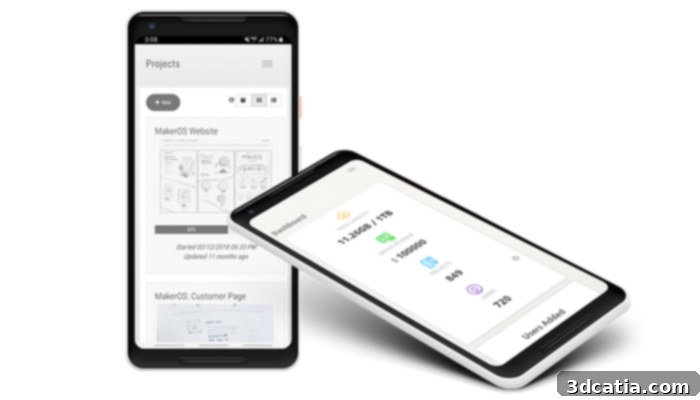
The communication hub within the Client Portal centralizes all messaging between your team and clients, effectively replacing scattered email correspondence. This ensures that all discussions, clarifications, and feedback are recorded and easily traceable within the project’s context. Project managers and their clients can also attach CAD files or any other relevant document types directly to their messages, and these files are then automatically stored within the project’s dedicated file repository. This eliminates the confusion of version control and ensures all stakeholders are working with the latest information.
Beyond communication, the MakerOS platform also functions as a sophisticated project management tool. It provides a comprehensive, at-a-glance overview of all project statuses in one centralized location. This feature, combined with automatic project completion tracking, ensures that clients are consistently kept in the loop regarding the progress of their orders. The transparency and ease of access afforded by the Client Portal invariably lead to significantly higher client satisfaction. In the long run, fostering such strong client relationships, built on trust and efficient communication, is not merely a courtesy; it is an essential strategy for generating repeat business, securing referrals, and ultimately driving sustained sales growth for your fabrication or engineering service.
John Kray, CEO and Co-Founder of Hydra Research, a company at the forefront of additive manufacturing, eloquently attested to the profound usefulness of the Client Portal: “Having a clean client project portal exudes professionalism and we have definitely noticed that it attracts more high-value clients to our business.” This highlights a crucial point: an organized, transparent, and professional client interface is not just about internal efficiency, but also about building brand reputation and attracting a more discerning clientele.
If you’re intrigued by the transformative potential of this comprehensive solution, you can discover a wealth of additional information and explore its functionalities in greater detail on the MakerOS official website. Furthermore, for those looking to embark on the journey of starting or scaling a 3D printing service, we encourage you to watch our insightful recorded webinar featuring Founder Mike Moceri, available HERE. It provides invaluable tips and strategies from an industry veteran.
What are your thoughts on the MakerOS platform and its integrated approach to digital fabrication and engineering workflow management? We invite you to share your perspectives in a comment below or join the conversation on our Facebook and Twitter pages! And don’t forget to subscribe to our free weekly Newsletter to receive all the latest news and updates in the dynamic world of 3D printing delivered directly to your inbox!