
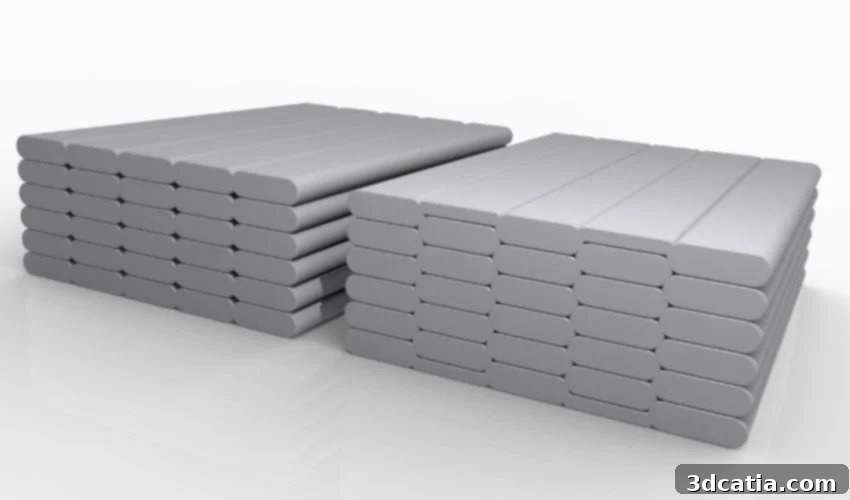
Revolutionizing FDM 3D Printing: ADDMAN’s ADDCAAM Software Delivers Stronger, Denser Polymer Parts
3D printing, particularly polymer Fused Deposition Modeling (FDM), has profoundly reshaped manufacturing across various high-stakes sectors, including aerospace and automotive. Its ability to create intricate geometries and thermal-resistant components has unlocked unprecedented design freedom and functional integration. However, despite its transformative potential, FDM technology has traditionally faced inherent limitations concerning the mechanical performance and integrity of printed parts, primarily stemming from issues like insufficient strength and elevated porosity.
Addressing these critical challenges, ADDMAN, a distinguished American contract manufacturing leader specializing in advanced industrial additive manufacturing services, has pioneered an innovative software solution. Developed in strategic collaboration with Danish software innovator Create It REAL, this groundbreaking platform is known as ADDCAAM. Designed specifically to transcend conventional FDM limitations, ADDCAAM intelligently optimizes the 3D printing process, resulting in significantly reduced part porosity and dramatically enhanced durability and overall performance.
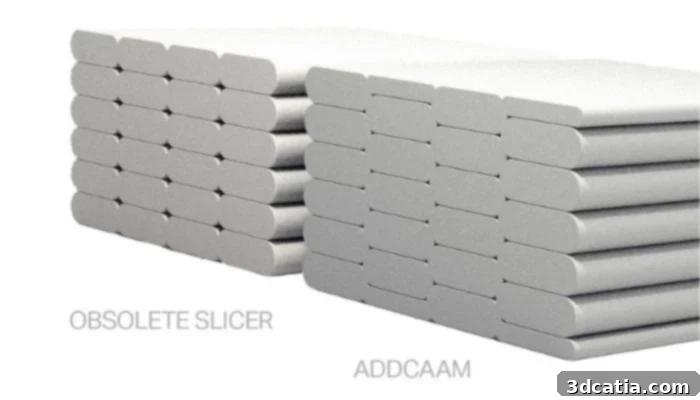
Visualizing the difference: Conventional slicing versus ADDMAN ADDCAAM InterFill 3D method.
ADDMAN’s commitment to engineering superior components extends through its comprehensive “CAAM” (Computer-Aided Additive Manufacturing) philosophy, which underpins the creation of more robust parts across both polymer and metal additive manufacturing. For polymer FDM parts, this advanced methodology is embodied and executed through the proprietary ADDCAAM Software. Complementing this, ADDMAN’s expertise in metal additive manufacturing is showcased at their dedicated facility, Castheon. Here, they have meticulously developed and refined innovative techniques for the 3D printing of high-temperature refractory alloys, specifically engineered to maximize the performance and longevity of metal components in extreme environments.
How Does ADDCAAM Work to Enhance Part Performance?
The foundational concept behind ADDCAAM emerged directly from a pervasive challenge consistently observed by ADDMAN’s clientele: the inherent weakness and anisotropy frequently encountered in the X/Y plane of 3D-printed polymer parts. To systematically overcome this structural vulnerability, ADDMAN embarked on developing a revolutionary build preparation tool that intentionally diverges from the limitations of standard slicers, which predominantly rely on conventional, layer-by-layer slicing techniques. Instead, ADDCAAM introduces two pivotal innovations: InterFill 3D, an advanced interlocking filling method, and the transformative technique of non-coplanar layering. Understanding these core elements is key to appreciating the significant benefits ADDCAAM offers.
Non-coplanar layering in the context of additive manufacturing signifies a paradigm shift from traditional, planar layer deposition. Unlike conventional methods where successive layers are uniformly flat and strictly parallel to the build platform, non-coplanar layering allows for material deposition along complex, curvilinear paths. This means that individual layers can be strategically placed at varying angles, curves, or even undulating surfaces relative to each other. This dynamic approach facilitates the creation of far more intricate, structurally optimized geometries, enabling parts to be designed and printed with a level of structural integrity and performance previously unattainable with standard FDM.
According to ADDMAN, this innovative approach profoundly enhances the mechanical properties of printed parts by optimizing the critical inter-layer adhesion and material orientation throughout the entire component. By intelligently distributing stress and material along non-planar paths, ADDCAAM significantly mitigates anisotropy, a common drawback in traditional additive manufacturing where mechanical properties vary dramatically depending on the print direction. Non-coplanar layering addresses this by fostering more uniform and isotropic properties across the entire part, making it behave more predictably under stress, akin to injection-molded components. Beyond structural integrity, this technique also contributes to remarkably smoother surface finishes and the ability to render finer details, as layers conform more precisely to the contours of the design. This strategic and intelligent placement of material not only optimizes its utilization but also dramatically expands the boundaries of design freedom for engineers and manufacturers.
By enabling more sophisticated, high-performance additive manufacturing, non-coplanar layering, combined with InterFill 3D, produces parts that are not only inherently stronger but also exhibit significantly lower porosity levels compared to industry standards. The unprecedented reduction in porosity achieved through ADDCAAM represents a revolutionary advancement for traditional FDM applications. It directly resolves long-standing issues such as poor sealing capabilities and the presence of internal voids in sliced parts. This enhancement facilitates the reliable creation of truly water-tight containers, drastically reduces air loss in critical ducting systems, and substantially improves the functionality and reliability of components for pneumatics and low-pressure hydraulic applications where seal integrity is paramount. Furthermore, for radio frequency (RF) applications, this dense, homogeneous material structure allows for more predictable and consistent dielectric properties, crucial for high-performance electronic components. The elevated material properties, characterized by improved isotropy, further extend the versatility of FDM parts. This leads to an increased strength-to-weight ratio and a reduction in overall part weight, which translates directly into tangible benefits such as higher fuel efficiency in applications where weight is a critical factor.
Transforming Aerospace: Less Porous and Stronger Parts with ADDCAAM
To vividly illustrate the profound impact of their technology, ADDMAN has highlighted how their innovative software solution, ADDCAAM, is actively driving innovation and effectively addressing complex design and manufacturing challenges within the highly demanding aerospace industry. In aircraft, ducting systems are indispensable for the efficient transport and distribution of air or various fluids, playing crucial roles in vital systems such as engine operation, environmental control, and cooling. These ducts are typically fabricated from a diverse range of materials, including high-strength aluminum, lightweight titanium, and advanced composite materials, with their precise design being absolutely critical for the optimal functioning and safety of the entire vehicle.
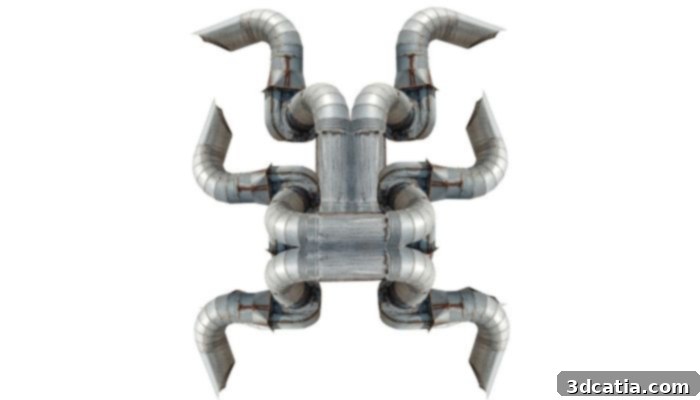
With the help of ADDCAAM, low-pressure ductwork can now be reliably produced from polymer materials, offering an advanced alternative to traditional metal components.
While ducting components designed to withstand high-pressure air or exhaust streams are almost invariably manufactured from robust metal alloys, lower-pressure ductwork applications present a significant opportunity for lightweight polymer materials. Advanced 3D printing technologies such as FDM, SLA, and MJF offer unparalleled capabilities for producing polymer ducts with complex, lightweight designs and high-strength structures—geometries that are often impractical or impossible to achieve with conventional manufacturing methods. However, the pervasive issue of excessive porosity in conventionally 3D-printed parts has historically presented a formidable challenge, particularly in aerospace. Even minuscule leaks in aircraft ducting can have detrimental effects on operational performance, efficiency, and, most critically, overall flight safety.
Leveraging the power of the ADDCAAM software and its innovative methodology, ADDMAN has achieved remarkable breakthroughs in drastically reducing the porosity of FDM 3D-printed ductwork prototypes. This technological advancement has translated into tangible benefits for their customers, including significant cost savings of approximately 15% when compared to relying on other additive technologies for similar applications. Beyond these impressive cost efficiencies, the FDM parts produced using ADDCAAM demonstrated vastly superior mechanical characteristics: they were found to be an astounding 70% stronger and exhibited an incredible 100 times less porosity. These unparalleled improvements in material integrity and mechanical strength directly contribute to enhanced operational performance, extended durability, and heightened reliability for critical aerospace components.
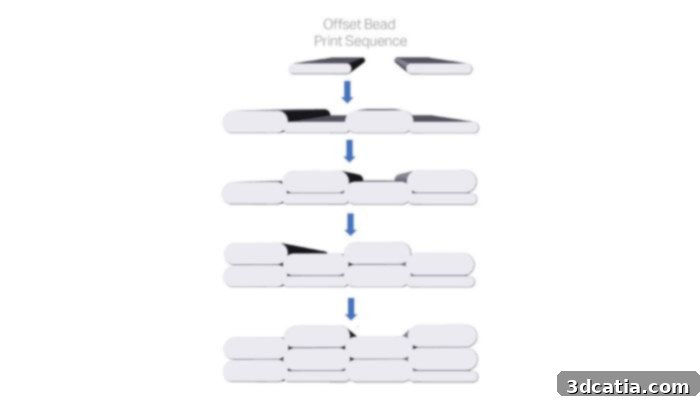
Detailed visualization of the build sequence for beads in ADDCAAM toolpaths, illustrating precision and control.
Mark Saberton, the distinguished CTO of ADDMAN, encapsulates the company’s philosophy perfectly, stating: “Our ADDMAN culture is about starting with problems and working backward. By diligently solving our customers’ most pressing problems, we meticulously identified the critical need for stronger, more reliable parts and, through relentless innovation, developed something truly revolutionary.” The ADDCAAM software solution’s profound impact and innovative approach have garnered widespread recognition and accolades across the additive manufacturing industry. In 2023, it was honorably distinguished as a finalist in both the prestigious TCT Group Software Awards and the highly competitive Advanced Concepts category of AMUG (Additive Manufacturing Users Group). These acknowledgments celebrate ADDCAAM as an exemplary use of additive manufacturing technologies that genuinely “push the envelope” of what is possible. ADDMAN is poised to further showcase the capabilities and benefits of ADDCAAM at the upcoming Rapid + TCT 2024 event, inviting industry professionals to experience this game-changing technology firsthand.
To delve deeper into the transformative capabilities of ADDCAAM software and discover how it can elevate your FDM 3D printing applications, we invite you to visit ADDMAN’s dedicated booth at Rapid + TCT 2024 (Booth 842). Alternatively, for immediate access to comprehensive information and resources, please click HERE. What are your thoughts on ADDCAAM software’s potential to create stronger, less porous FDM 3D-printed polymer parts? We encourage you to share your insights in a comment below or engage with us on our LinkedIn, Facebook, and Twitter pages! Don’t miss out on the latest advancements in additive manufacturing—remember to sign up for our free weekly newsletter here for cutting-edge 3D printing news delivered directly to your inbox! You can also explore all our informative videos and demonstrations on our YouTube channel.
*Cover Image: Illustrates the stark visual and structural difference between bead stacking in traditional slicers versus the optimized method employed by ADDCAAM.
*All Photo Credits: Courtesy of ADDMAN.