
Discover the Most Popular 3D Printers: Insights from the 3Dnatives Comparator’s Biannual Report (Jan-Jun 2017)
Navigating the rapidly evolving world of 3D printing can be a complex endeavor, with hundreds of different 3D printers available on the market. From compact desktop units and enthusiast-friendly RepRap kits to advanced professional and industrial systems, the choices are vast. The 3Dnatives Comparator serves as an invaluable resource, meticulously listing a wide array of 3D printers that cater to every need and budget. Our comprehensive database encompasses models utilizing diverse additive manufacturing processes, including popular technologies like Fused Deposition Modeling (FDM), advanced powder sintering, precise stereolithography (SLA), and efficient binder jetting. You’ll find everything from the most popular consumer models to specialized industrial solutions. Our unique comparison tool empowers users to meticulously evaluate any 3D printer based on crucial factors such as performance specifications, technological capabilities, and pricing, ensuring an informed decision for every potential buyer.
At 3Dnatives, we are committed to simplifying the 3D printer acquisition process. While we regularly conduct in-depth tests of numerous 3D printers to provide expert insights, we recognized the need for an interactive platform that would allow our community to compare devices side-by-side. This vision led to the creation of our Comparator, which has since evolved into an indispensable tool for enthusiasts, professionals, and businesses alike. Its widespread adoption sparked our curiosity: What are the underlying trends influencing user choices? Which 3D printers truly capture the attention of our global audience? To answer these pressing questions, and to better understand the dynamics of the 3D printing market through the lens of our users, we have compiled our first biannual report.
This inaugural report offers a detailed overview of the most viewed 3D printers within the 3Dnatives Comparator, drawing on extensive data collected from our websites. This particular analysis focuses on trends observed from January to June 2017, providing a snapshot of the market’s most sought-after additive manufacturing solutions across various categories. By delving into these trends, we aim to offer valuable insights into what users prioritize when considering a new 3D printer, highlighting the models that resonated most strongly with our community during this period.
Desktop 3D Printers: Blending Accessibility with Performance
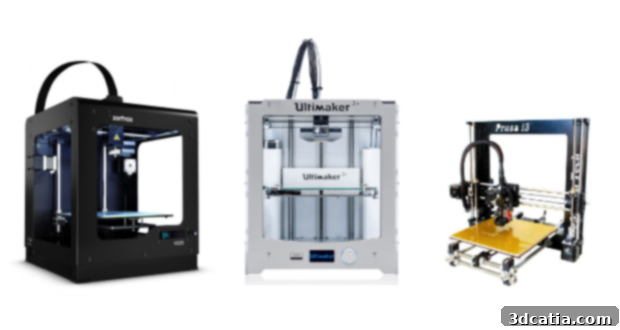
The Zortrax M200 2, the Prusa i3 Rework 1.5, and the Ultimaker 2+
Our first category zeroes in on Desktop 3D Printers, specifically “Plug & Play” models – those that come pre-assembled and are ready to use right out of the box – typically priced under $5,000. These machines are a cornerstone of the burgeoning personal and small business 3D printing market, offering a balance of ease of use and significant capabilities. Leading this competitive segment in our report is the M200 from the renowned Polish manufacturer, Zortrax. Despite its initial launch in 2014, the M200 has demonstrated remarkable staying power, maintaining its status as an incredibly popular model. Its enduring appeal is largely attributed to its exceptional print quality, achieving a minimum layer thickness of 90 microns, which results in remarkably smooth and detailed prints. Furthermore, its reliable heated print bed ensures excellent adhesion and minimizes warping, a common challenge in FDM printing. Priced at just $1,990, the Zortrax M200 continues to offer outstanding value for its robust performance and consistent results, making it a favorite for both hobbyists and professionals seeking reliability.
Following closely behind the Zortrax M200 are two prominent open-source 3D printers that have significantly influenced the desktop segment. In second place, we find the Prusa i3 Rework by eMotion Tech. This model, a testament to the power of open-source innovation, offers a flexible and upgradable platform for users at an accessible price point of €550. Its popularity underscores the demand for customizable and community-supported hardware in the 3D printing world. Securing the third position is the Ultimaker 2+, a machine celebrated for its user-friendly features and superior build quality. Key characteristics of the Ultimaker 2+ include its highly efficient heated build plate, compatibility with 3mm filament, and the innovative ability to quickly swap printing nozzles. These features enhance its versatility and ease of maintenance, allowing users to adapt to various material and resolution requirements with minimal effort. The Ultimaker 2+ is available starting at $2,499, representing a solid investment for those seeking a reliable and high-performance FDM machine.
It’s also important to highlight the significant presence of resin-based printers within our top desktop rankings, signaling a growing interest in higher precision and finer detail. The Formlabs Form 2, utilizing stereolithography (SLA) technology, distinguishes itself by employing a laser to selectively solidify photopolymer resin layer by layer, achieving incredibly smooth surfaces and intricate geometries. This process is ideal for applications requiring high aesthetic quality and tight tolerances, such as jewelry, dental models, and functional prototypes. Also making a strong showing is the Liquid Crystal, which employs an LCD screen for the photopolymerization step, offering an alternative and often more cost-effective approach to resin 3D printing. Both printers demonstrate the increasing adoption of resin technologies in the desktop space, providing users with options beyond traditional FDM for specific, high-resolution applications. The inclusion of these advanced resin printers illustrates the market’s evolving demand for diverse additive manufacturing capabilities, even within the accessible desktop category.
| Position | Model | Manufacturer |
|---|---|---|
| 1 | M200 | Zortrax |
| 2 | Prusa i3 Rework | eMotion Tech |
| 3 | Ultimaker 2+ | Ultimaker |
| 4 | Replicator 2 | Makerbot |
| 5 | Liquid Crystal 10″ | Liquid Crystal |
| 6 | Form 2 | Formlabs |
| 7 | Up Box | TierTime |
| 8 | Sigma | BCN3D Technologies |
| 9 | Ultimaker 3 | Ultimaker |
| 10 | Da Vinci JR | XYZprinting |
Kit & RepRap 3D Printers: The Open-Source Revolution and DIY Empowerment
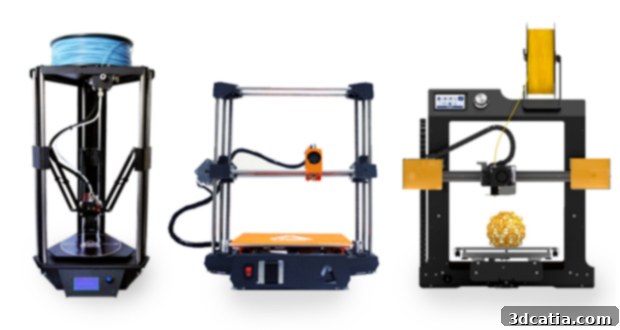
The MicroDelta Rework, the Discoeasy 200 and the Hephestos
The mid-2000s marked a pivotal moment in the history of 3D printing with the emergence of the RepRap movement. This initiative was founded on the radical idea of creating machines capable of self-replication – manufacturing many of their own components. This groundbreaking concept has profoundly impacted the accessibility and affordability of 3D printing, enabling its rapid diffusion beyond industrial settings. Printers adhering to the RepRap philosophy are typically open-source and supplied in kit form, making them an ideal choice for enthusiasts eager to delve into the mechanics of additive manufacturing. The open-source nature is not merely a philosophical stance; it’s a practical advantage, fostering a vibrant community that continuously contributes to improvements, upgrades, and modifications, ensuring these machines remain at the cutting edge of innovation while keeping costs low.
Topping our Comparator’s list in the Kit/RepRap category is the Micro Delta Rework from French manufacturer eMotion Tech. This delta-style 3D printer kit offers an engaging and educational assembly experience, comprising over 200 individual pieces. Delta printers are known for their unique kinematic design, featuring a circular print bed and three vertical arms, which often allows for faster print speeds and a larger build volume relative to their footprint. The assembly process provides users with a deep understanding of the printer’s construction and functionality, a rewarding experience for many in the DIY community. In a strong second position, we find the immensely popular Discoeasy 200 from Dagoma. This model has made 3D printing exceptionally accessible, boasting an impressively low price point of only €299, thereby opening the door to additive manufacturing for a broader audience. Its affordability combined with ease of use has cemented its place as a favorite entry-level kit. Rounding out the top three is the first-generation Hephestos from the Spanish company BQ. As an improved version of the classic Prusa i3 design, the Hephestos is celebrated for its relatively straightforward assembly, often taking only a few hours to put together. Its robust design and reliable performance have made it a go-to choice for those seeking a dependable kit printer.
Beyond these leading models, our comparison tool features a diverse range of other notable kit printers that embody the spirit of the RepRap movement. These include the large-format Rostock Max delta printers, known for their impressive build volumes, and advanced models like the BCN3D+ from BCN3D Technologies, which offers sophisticated features for a kit. Also highlighted is the BQ Hephestos 2, an evolution that showcases a more stable and robust metal chassis, improving overall print quality and reliability. The constant innovation in this segment is exemplified by Spanish manufacturer BQ, who also unveiled the Witbox Go in the first quarter, a pioneering 3D printer based on the Android operating system. This development signifies a major step towards integrating smart, user-friendly interfaces into 3D printing, potentially making these complex machines even more intuitive and connected. The Kit/RepRap category continues to be a hotbed of innovation, driven by community collaboration and a commitment to making 3D printing available to everyone.
| Position | Model | Manufacturer |
|---|---|---|
| 1 | Micro Delta Rework | eMotion Tech |
| 2 | Discoeasy 200 | Dagoma |
| 3 | Hephestos | BQ |
| 4 | Micro Delta 1.1 | eMotion Tech |
| 5 | Hephestos 2 | BQ |
| 6 | A6 HT | Makibox |
| 7 | Prusa Mendel Kit | Mixshop |
| 8 | Rostock Max | SeeMeCNC |
| 9 | CoLiDo DIY | CoLiDo |
| 10 | BCN3d+ Bausatz | BCN3D Technologies |
Professional 3D Printers: Advancing Industrial Additive Manufacturing
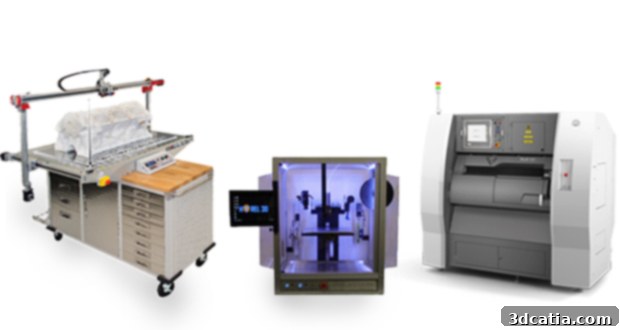
The 3DP Workbench, System 30 M and ProX 300
In the realm of professional 3D printing, the demands shift significantly towards precision, durability, larger build volumes, and compatibility with advanced materials, often for industrial applications and rigorous prototyping. Our report reveals the leading machines that professionals are keenly observing. Taking the top spot in this category is the 3D FDM 3DP Workbench. This all-in-one printer is celebrated for its expansive print volume, making it suitable for manufacturing large-scale prototypes and functional parts. As its name suggests, it ingeniously integrates a workbench, providing a dedicated space for all the tools and equipment necessary for post-processing and project management, thus streamlining the workflow for professional users. Its design emphasizes efficiency and productivity, essential for high-demand environments.
Securing the second position is the System 30 M printer from Hyrel 3D. This FDM 3D printer distinguishes itself with remarkable material versatility. Beyond standard thermoplastics, the System 30 M can extrude a wide array of unconventional materials, including clay, silicone, modeling clay, and even porcelain. This unique capability opens up niche applications in sectors such as ceramics, medical device prototyping, and custom gasket manufacturing, appealing to professionals who require specific material properties that traditional FDM printers cannot offer. Its adaptability makes it a compelling choice for specialized projects and research. Coming in third is the ProX 300, a sophisticated machine from 3D Systems. This printer harnesses a powerful laser sintering process (specifically, Direct Metal Laser Sintering or DMLS) for the creation of high-quality metal parts. This technology is critical for industries requiring components with exceptional strength, intricate geometries, and high temperature resistance, such as aerospace, automotive, and medical fields. The ProX 300’s prominence highlights the growing demand for robust, production-ready metal additive manufacturing solutions.
Indeed, 3D Systems has been a trailblazer in metal 3D printing for years, but the market for metal additive manufacturing is experiencing a rapid expansion, attracting numerous new entrants and significant investments. Several manufacturers are actively positioning themselves to capitalize on this burgeoning segment, indicating a strong future for metal 3D printing technologies. Notable examples include innovative companies like Desktop Metal, renowned for its office-friendly metal binder jetting systems, and Markforged, which offers carbon fiber reinforced composite and metal 3D printing. Other key players include Israeli Xjet, known for its nanoparticle jetting technology; AddUp, a joint venture between Michelin and Fives, focusing on industrial metal production; Swedish Arcam, a pioneer in electron beam melting (EBM); and German Concept Laser, a leader in laser powder bed fusion solutions now part of GE Additive. These companies are pushing the boundaries of what is possible with metal, developing systems that offer higher resolution, larger build volumes, faster production speeds, and wider material choices. It is therefore a safe bet that equipment used to manufacture metal parts will continue to gain significant traction and see substantial advancements in the months and years to come, profoundly transforming manufacturing across various industries with its ability to produce complex, high-performance components previously impossible to create through traditional methods.
| Position | Model | Manufacturer |
|---|---|---|
| 1 | 3DP Workbench | 3DPlatform |
| 2 | System 30 M | Hyrel |
| 3 | ProX 300 | 3D Systems |
| 4 | Bigrep One | BigRep |
| 5 | Projet 1200 | 3D Systems |
| 6 | B9 creator | B9 Creations |
| 7 | Jcr 1000 | Grupo Sicnova |
| 8 | Projet 4500 | 3D Systems |
| 9 | Vector 3SP | EnvisionTEC |
| 10 | Mark X | Markforged |
We hope this initial biannual report has provided valuable insights into the most popular 3D printers and the dynamic trends shaping the additive manufacturing industry. Which printer caught your eye, or perhaps which one is your personal favorite? Share your thoughts and experiences with us in the comments section below, or engage with our vibrant community on our Facebook and Twitter pages. To stay fully updated on all the latest developments, breakthrough technologies, and comprehensive analyses in the world of 3D printing, don’t forget to sign up for our free weekly Newsletter. Get all the essential news and expert content delivered directly to your inbox!