
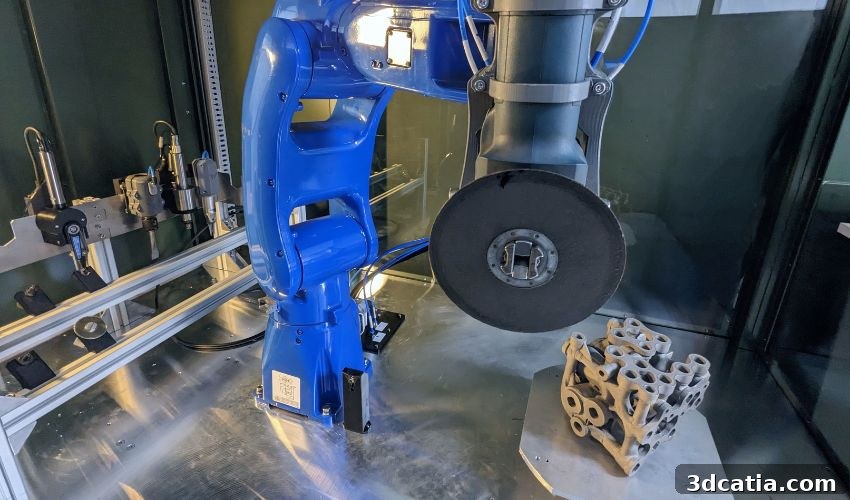
What if a machine could match human dexterity while maintaining the repeatability of a robot? Manual post-processing of 3D-printed parts is often tedious, time-consuming, and inconsistent. To address this, Rivelin Robotics, supported by the United Kingdom’s Defence Science and Technology Laboratory (Dstl), has developed robotic systems that automate finishing for defense and other demanding applications. Rivelin says these solutions produce components faster, more affordably, and with greater reliability than manual labor. The company won Formnext’s Startup Challenge in 2022 for its NetShape robotic solution for metal additive manufacturing parts, technology that has since been adopted across aerospace, medical, automotive, and energy sectors. Rivelin is now expanding into defense work while growing its presence in Spain, France, Germany, and the United States.
The Dstl was established in 2001 as an executive agency of the UK Ministry of Defence. Funding from the UK Defence and Security Accelerator helped advance Rivelin’s concept into an operational system; Dstl describes that support as pivotal. Using Rivelin’s robotics, the Dstl aims to increase UK operational resilience through on-demand defense manufacturing while supporting domestic industrial growth.
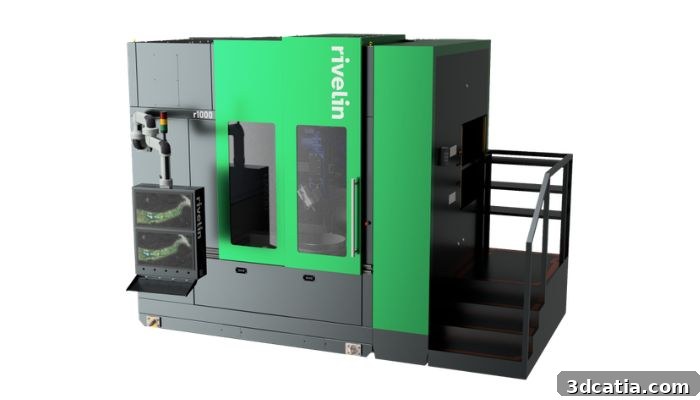
The r1000 from Rivelin Robotics (Photo Credit: Rivelin Robotics)
The Cost of Human Error and Labor
Most 3D-printed parts require post-processing to remove supports, eliminate surface defects, and apply final finishes. Performed by hand, these tasks are slow, inconsistent, and expensive, and they introduce risks that can affect quality and delivery. Rivelin Robotics addresses these challenges with proprietary control systems that give robots human-like dexterity and perception to automate finishing workflows.

Rivelin’s microfactory systems are designed to process complex geometries in metals, polymers, and ceramics. The r1000, one of the company’s primary products, performs a wide range of operations including hammering, chiselling, cutting, nipping, milling, grinding, sanding, polishing, drilling, gripping, 3D scanning, measuring, air-blasting, and engraving. Rivelin reports that the r1000 can deliver up to five times more productive hours than manual finishing while reducing costs for labor, energy, and training to roughly one quarter of traditional expenses. Two additional systems, the r500 and rAD-AT800S, are available for early access requests.
Dstl supports this technology because, when paired with 3D printing, microfactories enable on-demand manufacturing, reduce dependence on extended supply chains, and can lower costs for taxpayers. As of May 15, Rivelin has sold microfactories to five customers, demonstrating early commercial traction in targeted sectors.
What do you think of the microfactory approach to post-processing and on-demand manufacturing? Share your views in comments or on social media. For ongoing updates about additive manufacturing, sign up for relevant industry newsletters and watch related videos to follow developments in robotic post-processing and distributed production.
*Cover Photo Credit: Rivelin Robotics