

Revolutionary 3D Printed Liquid Crystal Elastomers: Unlocking Programmable Stiffness and Shape-Shifting Materials
The quest for materials that can adapt and change form on demand has long been a scientific and engineering holy grail. Such “smart materials” hold the key to unlocking a new generation of technologies, from intelligent robotics to dynamic wearable devices. Researchers at the University of California San Diego (UCSD) have recently made a groundbreaking advancement in this field, developing a novel liquid crystal elastomer (LCE) that can fundamentally shift its form and mechanical properties. This innovation represents a significant leap forward in our ability to design and manufacture materials with unprecedented control over their stiffness and ability to contract, opening up a myriad of possibilities for future applications across various industries.
The Science Behind Programmable Liquid Crystal Elastomers (LCEs)
Liquid crystal elastomers (LCEs) are a fascinating class of materials that combine the elastic properties of rubber with the unique self-organizing behavior of liquid crystals. This dual nature allows them to undergo significant and reversible shape changes in response to external stimuli, most notably heat. What the UCSD team, led by material scientists, has demonstrated is a pioneering method to precisely control the characteristics of these LCEs during the 3D printing process. By meticulously adjusting the printing temperature of the LCE “ink,” they can dictate the material’s degree of stiffness and its capacity for contraction – a property referred to as “actuation.” This means that the material isn’t just a static entity; its inherent flexibility and responsiveness can be programmed directly during manufacturing, providing a foundational advantage for smart material design.
The molecular orientation of the liquid crystal mesogens within the elastomer network is directly influenced by the temperature at which the material is extruded and solidified during 3D printing. At higher temperatures, the mesogens might align in a particular way, leading to one set of mechanical properties. Conversely, lower printing temperatures can induce a different alignment, resulting in distinct stiffness and contractile behaviors. This exquisite control at the microstructural level translates into macroscopic, programmable functionality, allowing for bespoke material characteristics tailored to specific application requirements.
Dynamic Stiffness Control within a Single 3D Print
Perhaps even more remarkably, the UCSD researchers achieved the ability to vary the stiffness of different areas within the same material by locally exposing it to heat after printing. This post-printing thermal treatment allows for an additional layer of customization, enabling engineers to create complex structures where one section might be rigid and supportive, while an adjacent section remains highly flexible and contractile. This level of spatially resolved property control in a single, monolithic material is a game-changer for applications requiring nuanced and heterogeneous mechanical responses. The ability to embed varying degrees of flexibility and rigidity within a singular printed object significantly expands the potential of additive manufacturing for creating truly functional and adaptable devices.
Transformative Applications: Soft Robots, Artificial Muscles, and Wearable Devices
The implications of this advancement are vast, particularly for the burgeoning fields of soft robotics, artificial muscles, and advanced wearable devices. This innovative LCE material provides a pathway to manufacturing devices with integrated, programmable movements and adaptive properties, mimicking the efficiency and complexity found in biological systems.
Revolutionizing Soft Robotics
Traditional robots are often rigid, making them ill-suited for delicate interactions or navigating complex, unpredictable environments. Soft robots, on the other hand, are designed to be flexible and adaptable, mimicking biological organisms like octopi or caterpillars. This new LCE material provides a pathway to manufacturing soft robots with integrated, programmable movements and varying stiffness zones. Imagine a robotic gripper that can gently conform to an irregular object, then stiffen to hold it securely, or a multi-limbed robot whose appendages can mimic the nuanced movements of biological muscles and tendons. This material enables the creation of robots that are safer for human interaction, more capable of traversing diverse terrains, and more adept at handling fragile items.
Advancing Artificial Muscles
The ability to precisely control contraction and stiffness means these LCEs can function as highly effective artificial muscles. This could revolutionize prosthetics, allowing for more natural and intuitive movements for amputees, leading to a significant improvement in their quality of life. Furthermore, this technology could lead to the development of novel medical devices that can perform intricate tasks within the human body, such as targeted drug delivery systems, minimally invasive surgical tools, or active implants that can adjust to physiological changes. The potential for dynamic, self-adjusting implants or therapeutic devices, capable of responding to internal or external cues, is immense.
Innovating Wearable Devices
For wearables, this technology could usher in an era of truly adaptive clothing or smart medical sensors. A garment could change its rigidity to provide support where needed, or dynamically adapt its fit based on activity levels or environmental conditions. Smart bandages that can adjust pressure or deliver medication through controlled mechanical action are also within the realm of possibility. The material’s ability to respond to heat, a readily available stimulus, makes it ideal for integrating into everyday items, enhancing comfort, functionality, and therapeutic effectiveness.
Comparing with Other Shape-Shifting Materials
It’s important to note that the UC San Diego team is not the first to unveil a novel shape-shifting material this year, highlighting the intense research interest in this area. Not long ago, researchers from Harvard University garnered attention for developing a biocompatible 3D printed shape-shifting material using keratin extracted from wool. While both innovations represent significant progress, their underlying material compositions and mechanisms differ. Harvard’s approach leverages the natural properties of keratin, a protein found in hair, skin, and nails, to achieve its dynamic properties. This bio-inspired material offers excellent biocompatibility, making it highly suitable for certain medical applications.
In contrast, UCSD’s breakthrough centers on a synthetic liquid crystal elastomer. This distinction is crucial, as LCEs offer a different set of tunable parameters and potential scalability for various industrial applications. The UCSD team’s method specifically focuses on programming mechanical responses directly through the 3D printing parameters of their unique LCE formulation, providing a high degree of control over stiffness and actuation. While both materials expand the horizon of smart manufacturing, the LCE approach offers a distinct pathway for designing complex, multi-functional mechanical systems with programmed thermal responses.
Inspired by Nature: The Blueprint for Smart Materials
The ingenuity behind this LCE material with its varying degrees of actuation was directly inspired by the remarkable efficiency and adaptability observed in biology and nature. Researchers meticulously studied natural systems that exhibit gradient mechanical properties, where different parts of an organism possess distinct mechanical characteristics to optimize function. Beyond the compelling combination of muscle and tendon, which can contract powerfully and provide flexible connection, respectively, the team also drew significant inspiration from the unique structure of the squid beak. The squid’s beak is an extraordinary natural example of a material that transitions seamlessly from being extremely stiff and sharp at its tip – perfect for tearing prey – to being remarkably softer and more malleable at its base, where it connects to the squid’s mouth. This gradient in stiffness allows for both powerful function and safe integration with delicate biological tissue. Emulating such sophisticated biological designs enables the creation of materials that are not only strong but also adaptable, integrated, and highly efficient in their performance.
Experimental Proof of Concept: Demonstrating Programmable Actuation
This pioneering research was spearheaded by Shengqiang Cai, a distinguished professor in the Department of Mechanical and Aerospace Engineering at the UC San Diego Jacobs School of Engineering. His vision for programmable materials has driven this project forward. Zijun Wang, the paper’s first author and a Ph.D. student in Cai’s research group, articulated the excitement surrounding their findings: “3D printing is a great tool to make so many different things—and it’s even better now that we can print structures that can contract and stiffen as desired under a certain stimuli, in this case, heat.” This statement underscores the transformative potential of combining advanced material science with the precision of additive manufacturing, enabling the creation of ‘smart’ structures directly from design blueprints.
To provide a compelling proof of concept for their innovative material, the UCSD team successfully 3D printed structures using a single ink and in a single printing operation. These structures exhibited variations in stiffness and actuation that spanned orders of magnitude, ranging from virtually zero contraction to an impressive 30 percent. This incredible versatility within a single printed object was vividly demonstrated. For instance, they could print an LCE structure where one specific area was engineered to contract vigorously, much like a biological muscle, while an adjacent part remained highly flexible, emulating the function of a tendon, all within the same continuous material.
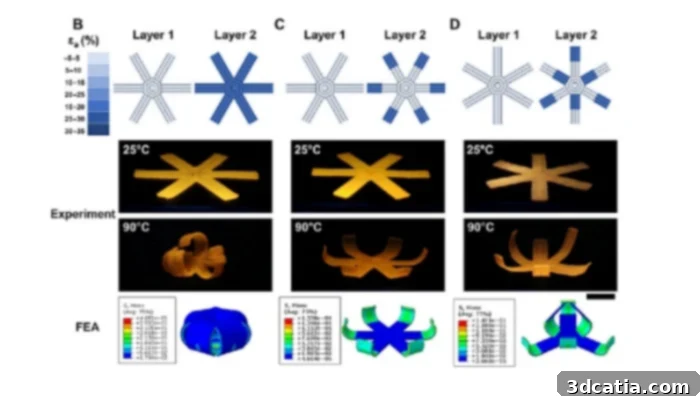
A particularly illustrative experiment involved 3D printing a liquid crystal elastomer disk. When this disk was printed uniformly at 40° C (104 F) and then heated to 90° C (194 F) in hot water, it reliably deformed into a specific conical shape. However, the true power of their method became apparent when they printed an LCE disk composed of areas strategically fabricated at different temperatures – for example, a section printed at 40° C, another at 80° C, and a third at 120° C. When this multi-temperature-printed disk was subsequently heated, it deformed into a completely different and far more complex shape. This demonstrated the direct correlation between the localized printing temperature and the material’s programmed response to heat, allowing for highly intricate and predictable shape transformations that can be engineered during the manufacturing process itself.
Versatile Activation Methods for LCEs
The researchers also explored various methods for activating the material’s actuation, moving beyond simple immersion in hot water. They found that the desired shape changes and stiffness variations could also be triggered by infusing the LCE with heat-sensitive particles. These particles act as localized heaters, generating warmth when exposed to specific external fields, allowing for more precise and remote control over the material’s behavior. Additionally, they investigated the incorporation of particles that absorb light and efficiently convert it into heat. This opens up avenues for light-activated shape changes, potentially enabling wireless and highly localized control over the material’s properties. Such diverse activation mechanisms make these LCEs suitable for a wider array of sophisticated applications, including those involving remote activation, fine-tuned spatial programming, or integration into complex systems where direct thermal contact is not feasible.
The Future of Smart Materials: Self-Repair, Reprogrammability, and Recyclability
Looking ahead, the research team is already charting the course for the next generation of these smart materials. Their immediate focus is on modifying the LCE ink composition to imbue the printed structures with even more advanced functionalities. Specifically, they aim to develop materials that are:
- Self-repairable: Materials that can autonomously mend themselves after damage, extending their lifespan and reducing waste. This is crucial for long-term applications in critical systems like robotics, aerospace components, and medical implants, where manual repair is difficult or impossible.
- Reprogrammable: Enabling the material’s properties and shape-shifting behaviors to be altered multiple times after initial fabrication. This offers unprecedented flexibility and adaptability for evolving needs, allowing a single component to serve multiple functions or to adapt to changing environmental conditions without needing to be replaced.
- Recyclable: Addressing growing environmental concerns by ensuring that these advanced materials can be sustainably reprocessed and reused, aligning with circular economy principles. This minimizes waste and reduces the ecological footprint of high-tech manufacturing, making smart materials a truly sustainable solution.
This ambitious roadmap signifies a commitment to not just creating functional materials but also to developing sustainable, adaptable, and resilient solutions for the future. The ability to autonomously repair, adapt, and be environmentally responsible will be critical for the widespread adoption of smart materials in various industries, from consumer electronics to advanced infrastructure.
Impact on 3D Printing and Advanced Manufacturing
This breakthrough significantly expands the capabilities of 3D printing, transforming it from a tool for merely creating complex geometries to one for fabricating functionally graded materials with integrated intelligence. The capacity to control local mechanical properties within a single print pass, using a single ink, simplifies manufacturing processes and enables the creation of monolithic devices with diverse functions without requiring assembly of multiple components. It moves additive manufacturing closer to replicating the sophisticated, multi-functional designs found in nature, paving the way for truly bio-inspired engineering solutions and ushering in an era of “materials by design” where functionality is embedded from the atomic to the macroscopic scale. This paradigm shift will accelerate innovation in countless sectors, from medical technology to aerospace.
Conclusion: A New Era for Programmable Materials
In conclusion, the development of these novel 3D printed liquid crystal elastomers by UC San Diego scientists represents a monumental step forward in material science. By harnessing the power of precise temperature control during additive manufacturing, they have unlocked the ability to create materials with programmable stiffness and actuation, drawing profound inspiration from the biological world. The potential applications in soft robotics, artificial muscles, and advanced wearable technology are not just exciting but truly transformative. As research continues to push boundaries towards self-repairing, reprogrammable, and recyclable LCEs, we are witnessing the dawn of a new era where materials are not just static components but dynamic, intelligent entities capable of adapting and responding to their environment, revolutionizing how we design and interact with the physical world and fostering innovation across a spectrum of industries.
What do you think about this new shape-shifting material and its potential? Let us know in a comment down below or on our Facebook and Twitter pages! Don’t forget to sign up for our free weekly Newsletter, with all the latest news in 3D printing delivered straight to your inbox!