
The Evolution of Additive Manufacturing Materials: Insights from Wohlers Report and Senvol Database
Every year, the global additive manufacturing industry eagerly anticipates the release of the comprehensive report from Wohlers Associates, Inc. Renowned for its unparalleled depth and breadth of analysis, the Wohlers Report stands as a definitive benchmark for understanding the dynamic landscape of additive manufacturing (AM). Recently, its 25th edition was unveiled, offering a meticulously researched, 380-page document packed with extensive data, pivotal insights, and forward-looking trends shaping the AM market. This landmark publication is particularly noteworthy for its detailed historical analysis of the evolution of 3D printing materials – a critical component influencing the technology’s widespread adoption and industrial advancement. The invaluable data underpinning this specific analysis was expertly contributed by Senvol, leveraging their extensive Senvol Database. Crucially, Senvol has taken the initiative to make this historical material analysis, originally featured within the Wohlers Report, publicly accessible. This unprecedented transparency offers a rare glimpse into the transformative journey of AM materials, vividly illustrating their development, diversification, and increasing sophistication over the past decades. Understanding these material trends is paramount for businesses and researchers alike, as they dictate the capabilities, applications, and future potential of additive manufacturing across various sectors.
The Pivotal Role of Material Diversity in AM Adoption
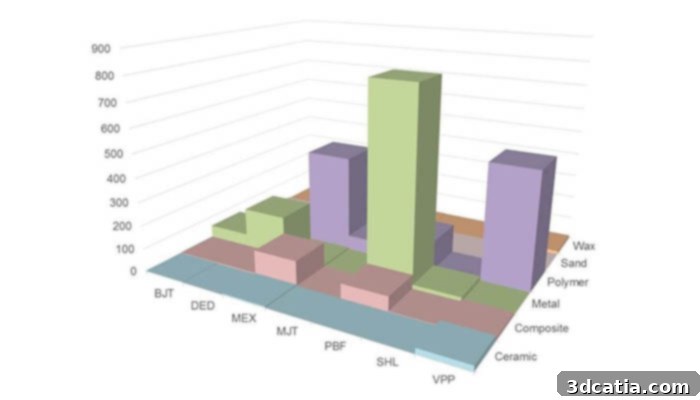
The availability and choice of materials are fundamentally key drivers for the broader adoption of additive manufacturing across various industries. For many companies considering investing in 3D printing for their operations, a limited selection of suitable materials or the prevalence of proprietary, closed systems can act as significant deterrents, stifling innovation and limiting potential applications. Senvol’s comprehensive analysis underscores this point, revealing fascinating insights into material diversity across different AM technologies. Their data indicates that the most diverse materials offering exists, by a substantial margin, for metal Powder Bed Fusion (PBF) systems. This dominance in material variety positions metal PBF as a highly versatile and attractive option for complex industrial applications requiring robust mechanical properties. Following metal PBF, polymer Stereolithography (SLA) – which Senvol refers to as Vat Photopolymerization (VPP) – also boasts a strong material portfolio, offering a wide range of resins for various prototyping and end-use parts. Material Extrusion (MEX) technologies, commonly known for fused filament fabrication (FFF), represent another significant category with a growing selection of polymers. It’s important to note that other key AM processes include Material Jetting (MJT), which uses liquid photopolymers or wax droplets, and Sheet Lamination (SHL), which bonds layers of material such. The continuous expansion of material options directly correlates with the increasing versatility and applicability of 3D printing across diverse manufacturing sectors. This trend was strongly echoed in the previous year’s Wohlers Report (24th edition), which highlighted the robust growth within the metal segment of additive manufacturing, largely attributed to the burgeoning variety of available metal materials. The expanding palette of metals empowers industries to move beyond prototyping into serious industrial-scale applications, delivering parts with superior performance, complex geometries, and tailored properties – a capability increasingly sought after by forward-thinking companies.
The Evolving Landscape of AM Material Suppliers
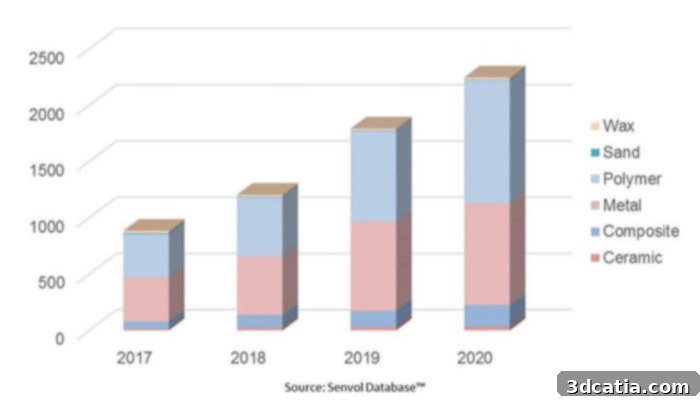
Beyond tracking material types and their adoption, Senvol also diligently monitors the ecosystem of companies that supply additive manufacturing materials. This diverse group includes both manufacturers of AM systems who often produce proprietary materials for their machines, as well as independent producers specializing in third-party materials compatible with various systems. The data reveals a remarkable expansion in this supplier landscape, indicating rapid maturation of the AM market. According to Senvol’s findings, the total number of material suppliers doubled in a mere two years, specifically between 2017 and 2019. This significant increase points to a vibrant and competitive market, fostering innovation, driving down costs, and ultimately broadening the accessibility of a wider range of materials for end-users. While the market sees a strong presence of both polymers and metals, which together constitute the majority of manufactured AM materials, an intriguing and high-growth segment is that of composites. Composite materials, such as those reinforced with carbon fiber or glass fiber, are gaining considerable traction due to their ability to deliver significantly higher performance characteristics compared to traditional plastics. They offer unique properties like enhanced strength-to-weight ratios, increased stiffness, and improved durability, making them exceptionally attractive for demanding applications in critical industries. Sectors like aerospace and automotive, for instance, are increasingly leveraging composite AM materials to create lighter yet stronger components, leading to improvements in fuel efficiency, structural integrity, and overall performance. In contrast, specialized materials like ceramics, sand, and wax cater to very specific applications and often require bespoke systems. Consequently, their availability is typically limited to a narrower selection of highly specialized suppliers, highlighting the fragmented nature of certain niche segments within the broader AM material market.
Key Trends in Metal Additive Manufacturing Materials
Within the dynamic landscape of metal additive manufacturing, certain materials have consistently led the market, largely due to their established industrial applications and robust mechanical properties. Nickel, steel, and titanium products have dominated the metals market by a significant margin. Titanium alloys, renowned for their exceptional strength-to-weight ratio and biocompatibility, are extensively used in aerospace for critical structural components and in medical implants. Various grades of steel, known for their versatility, strength, and cost-effectiveness, find applications ranging from tooling and spare parts to automotive components. Nickel alloys, celebrated for their high-temperature resistance and corrosion properties, are indispensable in sectors like energy, defense, and industrial turbines. However, the market is not static; aluminum products are experiencing notable growth. Aluminum, prized for its lightweight nature, excellent thermal conductivity, and good strength-to-weight ratio, is increasingly being adopted in industries such as automotive, where weight reduction is critical for fuel efficiency, and in consumer electronics. This growth signifies a diversification within the metal AM space, driven by specific application requirements. Beyond these dominant players, the “other” category of metals encompasses materials such as iron, precious metals (e.g., gold, silver, platinum), and refractory metals (e.g., tungsten, molybdenum). While applications for these metals are indeed increasing – for instance, iron for specific industrial tooling or precious metals for intricate jewelry and custom medical devices – their widespread availability remains constrained to a more limited number of specialized suppliers. This limitation often reflects the niche nature of their applications, the complexity of processing, or the inherent cost of the raw materials, posing unique challenges and opportunities for specialized manufacturers.
Dynamics of Thermoplastics in 3D Printing
While the metal segment of additive manufacturing has seen rapid growth and considerable excitement, the thermoplastics segment, despite not expanding at the same vigorous pace as metals, continues to command a larger share of the overall additive manufacturing market in terms of revenue. This enduring dominance is primarily due to the widespread accessibility, versatility, and cost-effectiveness of thermoplastic materials, which are foundational to many prototyping and functional part applications. Thermoplastics are predominantly utilized in two major AM system types: material extrusion, famously embodied by Fused Filament Fabrication (FFF) technology, and powder bed fusion systems, particularly Selective Laser Sintering (SLS) technology. The following chart illustrates the prevailing trends within this vital category. Within the thermoplastics market, Polyamide (PA) products stand out as the undisputed leaders. This leadership is largely attributable to the increasing deployment of Powder Bed Fusion (PBF) machines, especially SLS systems, which are optimally designed to process PA powders. Polyamides encompass numerous grades, including PA6, PA11, and PA12, each offering distinct properties for various applications. Among these, PA12 has emerged as by far the most common, favored for its excellent mechanical properties, chemical resistance, and ease of processing in SLS, making it a go-to choice for durable, functional parts.
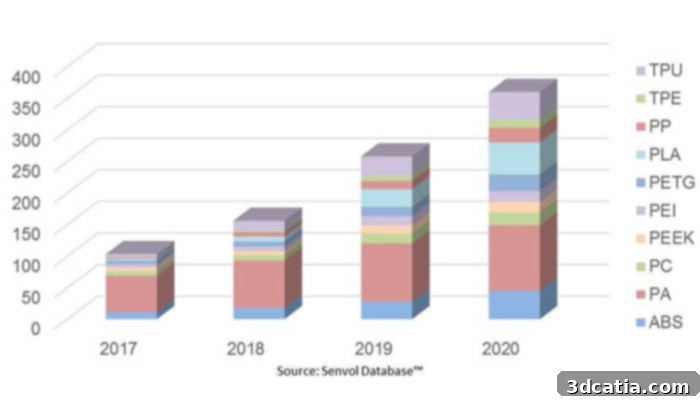
Beyond polyamides, other significant thermoplastics shaping the market include ABS (Acrylonitrile Butadiene Styrene) and PLA (Polylactic Acid). These two materials are primarily used in Material Extrusion (MEX) systems, particularly FFF, where their ease of use, wide color range, and good mechanical properties make them popular choices for prototyping, educational purposes, and even some consumer-grade functional prints. ABS is valued for its strength, impact resistance, and temperature tolerance, while PLA is praised for its biodegradability and ease of printing. An especially interesting subcategory is PEI (Polyetherimide), typically marketed under SABIC’s well-known brand name ULTEM. This high-performance plastic has gained significant traction for demanding production applications due to its exceptional thermal stability, high strength, and chemical resistance, making it suitable for aerospace, automotive, and medical components where conventional plastics fail. However, PEI is available from a limited number of suppliers, meaning the volume of products may not directly correlate with the total material consumed, as its specialized nature limits broader adoption. Another notable trend is the significant increase in the use of TPE (Thermoplastic Elastomer) and TPU (Thermoplastic Polyurethane). These are flexible, rubber-like elastomers that were initially primarily used with MEX systems for producing soft, compliant parts. More recently, however, advancements have allowed their incorporation into PBF systems, opening up new possibilities for creating complex elastomeric components with enhanced resolution and design freedom. The growing importance of these flexible materials was vividly demonstrated at events like Formnext 2019, where numerous companies showcased innovative elastomer solutions for AM. This expanding segment of flexible materials is expected to diversify further, driving new applications in consumer goods, prosthetics, and industrial sealing components.
Conclusion: The Future Trajectory of 3D Printing Materials
The continuous evolution and diversification of additive manufacturing materials are undeniably central to the industry’s sustained growth and broader industrial integration. As highlighted by the authoritative Wohlers Report and the detailed insights from the Senvol Database, the journey of 3D printing materials has been one of constant innovation, marked by a significant increase in material types, supplier growth, and enhanced performance capabilities. From the dominant variety offered by metal PBF and the expanding portfolio of polymer solutions to the high-performance attributes of composites and the emerging flexibility of elastomers, the material landscape is becoming richer and more specialized. Understanding these trends is crucial for stakeholders across the entire AM ecosystem, from material developers and system manufacturers to end-users in diverse industries. The insights provided by comprehensive reports and databases empower businesses to make informed decisions, identify new opportunities, and leverage the full potential of additive manufacturing for advanced production, prototyping, and innovation. The future of 3D printing will undoubtedly continue to be shaped by breakthroughs in material science, leading to even more robust, versatile, and application-specific options that will further cement AM’s role as a transformative technology.
You can find more detailed information on the Senvol Database HERE. We invite you to share your thoughts: Do these dynamic trends in 3D printing materials surprise you? Let us know your perspective in a comment below or join the conversation on our Facebook and Twitter pages! Don’t forget to sign up for our free weekly Newsletter, ensuring you receive all the latest news and developments in 3D printing delivered straight to your inbox!