
Unlocking the Lunar Frontier: Lonestar and BIG Launch Earth’s First Data Center on the Moon with Advanced 3D Printing
The relentless surge in global data creation and storage demands a visionary approach, pushing humanity to seek innovative solutions beyond our planet’s confines. In a groundbreaking collaboration that redefines the future of digital infrastructure, Lonestar Data Holdings Inc. has partnered with the internationally acclaimed Danish architectural firm, Bjarke Ingels Group (BIG), to introduce the Freedom Payload. This pioneering lunar data center is slated for deployment on the Moon later this year, marking a monumental step in humanity’s extraterrestrial expansion. What makes this endeavor particularly remarkable is its reliance on cutting-edge 3D printing technology, which has been instrumental in engineering a structure robust enough to withstand the Moon’s unforgiving environment while ensuring optimal functionality and unprecedented durability.
Building upon the significant achievements of its predecessor, the Independence payload – which began its operations on the lunar surface and within cislunar space earlier this year – the Freedom Payload represents a profound leap forward in lunar data storage capabilities. This ingenious data center, remarkably compact at just 1 kilogram in mass and roughly the size of a standard hardback book, is poised to serve a diverse and extensive clientele across the globe. Its intended users include governmental bodies, large-scale enterprises, and non-governmental organizations (NGOs) dedicated to critical causes such such as veteran affairs, human rights advocacy, and climate change initiatives. Beyond its primary role as a secure data repository, the Freedom Payload will also function as a vital testing ground for advanced technologies. It will facilitate the experimentation of sophisticated machine learning algorithms, evaluate the resilience of delay-tolerant networks crucial for interplanetary communication, and meticulously monitor radiation levels, collecting invaluable data directly from the Moon’s surface – insights essential for future lunar habitation and deep space missions.
(Photo Credits: BIG)
The Power of 3D Printing in Lunar Construction
The choice of 3D printing technology for the Freedom Payload is not merely a convenience but a strategic imperative. This advanced manufacturing method allows for the creation of complex geometries and integrated functionalities that would be impossible or prohibitively expensive with traditional manufacturing techniques. By leveraging additive manufacturing, BIG has been able to design a structure that seamlessly merges aesthetic form with critical function. As Lonestar articulated regarding the immense benefits of the Freedom Payload, “Utilizing advanced 3D printing technology, BIG has seamlessly merged form and function to conceive a structure capable of withstanding the Moon’s harsh conditions, all while promoting sustainable practices in extraterrestrial environments.” This statement underscores the dual advantage of 3D printing: enabling intricate designs for maximum efficiency and durability, and doing so with minimal waste, aligning with sustainable principles even in the vacuum of space. The ability to print components with specific thermal properties, radiation shielding capabilities, and integrated sensor arrays directly into the structure significantly enhances the payload’s resilience against extreme temperature fluctuations, vacuum conditions, and the pervasive lunar dust.
A Design Laden with Symbolism: Honoring Past and Future Space Exploration
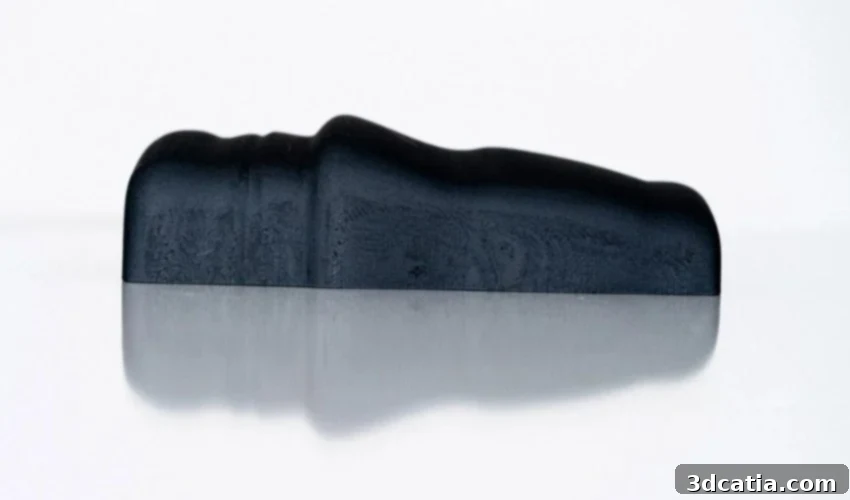
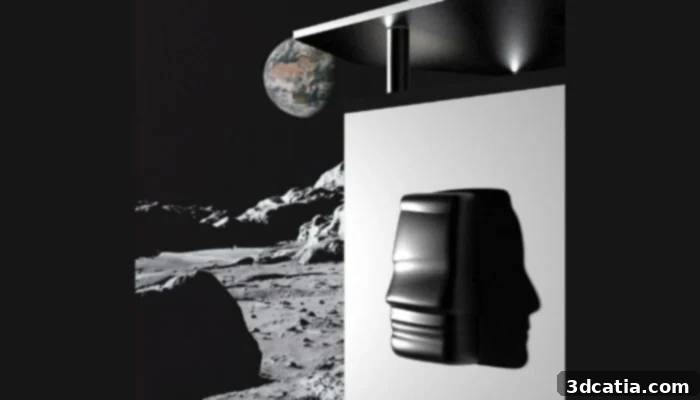
Developed in close collaboration with the visionary architects at BIG, the Freedom Payload transcends mere technological prowess; it carries a profound symbolic weight that resonates deeply with humanity’s enduring spirit of exploration. Its meticulously crafted design serves as an inspirational message, beautifully rendered in the elegant form of a sundial. This ancient time-telling instrument pays homage to both the illustrious legacy and the ambitious future of space exploration. Adding to its historical and forward-looking significance, the payload’s contours feature the distinct silhouettes of two celebrated NASA astronauts: the legendary Apollo 16 Moonwalker Charles Duke, and the esteemed retired Spacewalker Nicole Stott. This thoughtful incorporation of human figures into the design visually connects the payload to the courageous individuals who have ventured into the cosmos, bridging generations of space pioneers.
The sundial’s symbolic narrative unfolds with the progression of the lunar day. During the tranquil lunar morning, the silhouette of Apollo 16 Moonwalker Charles Duke is prominently cast, a powerful tribute to the historic achievements of the Apollo program – a golden age of human daring and technological triumph that first placed humans on the Moon. As the lunar day advances and the sun traverses the sky, the silhouette gracefully transitions, revealing retired Spacewalker Nicole Stott. This shift is not arbitrary; it beautifully symbolizes the inclusivity and forward momentum of NASA’s current and future missions under the Artemis program, aptly named after Apollo’s sister in Greek mythology. The Artemis program aims to land the first woman and first person of color on the Moon, ushering in a new era of diverse and sustainable lunar presence. Chris Stott, CEO of Lonestar, passionately articulated the profound symbolic significance of this design, stating, “[The Freedom Payload] is not just a data center, it’s a symbol for all humanity of what the future holds.” This statement encapsulates the project’s ambition to inspire and represent collective human aspirations for the stars.

Spacewalker NASA Astronaut Nicole Stott and her silhouette in the design of the payload. (Photo Credits: BIG)
The Environmental and Security Imperatives of Lunar Data Storage
Lonestar passionately asserts that the establishment of extraterrestrial data centers is not merely an ambitious technical feat but a critical necessity as humanity rapidly transitions into an increasingly digital society with ever-expanding data demands. The terrestrial data centers that power our digital world consume vast amounts of energy, contribute significantly to carbon emissions, and require substantial land resources. The Moon’s surface, in contrast, presents an exceptionally eco-friendly and sustainable solution to meet these escalating needs, offering a unique opportunity to drastically reduce the environmental impact currently borne by Earth. By moving data storage off-world, we alleviate pressure on terrestrial infrastructure, lower energy consumption associated with cooling massive server farms, and free up valuable land for other essential uses. This initiative is a proactive measure against the growing ecological footprint of our digital lives.
Beyond environmental sustainability, lunar data centers offer unparalleled advantages in terms of data security and resilience. The vacuum of space, far removed from terrestrial cyber threats and physical vulnerabilities, provides an inherently secure environment. Data stored on the Moon would be shielded from geopolitical instability, natural disasters, and many forms of cyber-attacks that plague ground-based systems. This enhanced security is vital for sensitive governmental data, critical enterprise information, and the invaluable records collected by NGOs dedicated to human rights and climate monitoring. Astronaut Nicole Stott, a vocal advocate for Earth’s preservation, powerfully encapsulates this vision: “Everything we do in space – off the Earth – is ultimately for the benefit of all life on Earth, and data is at the heart of it all. By saving our data, we save our world.” Her words highlight the profound connection between securing our digital heritage and safeguarding our planet’s future, reinforcing the idea that lunar data storage is not just about offloading data, but about creating a resilient, sustainable, and secure foundation for humanity’s continued progress.
The Path Forward: A New Era for Data and Discovery
The deployment of the Freedom Payload marks a pivotal moment, not just for Lonestar and BIG, but for the entire space industry and global digital infrastructure. This project demonstrates the tangible applications of additive manufacturing in extreme environments and heralds a new era where critical services can be hosted extraterrestrially. Imagine the implications for future lunar settlements, where local data processing can enable real-time decision-making for resource extraction, scientific research, and even future space tourism. The data collected regarding machine learning, delay-tolerant networks, and radiation monitoring will be indispensable for designing and sustaining long-duration human missions, pushing the boundaries of what is possible for human life beyond Earth. The Moon is not merely a destination but a strategic outpost, and securing our digital assets there is a fundamental step towards becoming a multi-planetary species. It ensures the preservation of human knowledge, culture, and critical information against any terrestrial unforeseen events, guaranteeing humanity’s legacy for generations to come. This is more than just a technological achievement; it’s a testament to human ingenuity and our collective ambition to explore, innovate, and thrive.
What are your thoughts on the groundbreaking design and critical function of the Freedom Payload, made possible by innovative 3D printing technology? We invite you to share your insights in a comment below or join the conversation on our LinkedIn, Facebook, and Twitter pages! Don’t miss out on the latest advancements in 3D printing and space technology – be sure to sign up for our free weekly newsletter here to receive the most current news straight to your inbox! Additionally, you can explore all our fascinating videos on our YouTube channel for more in-depth content.
To delve deeper into the Freedom Payload project and Lonestar’s ambitious vision, please click here for additional information and media resources.
*Cover Photo Credits: Lonestar