
Unlocking the Future of Defense: How Additive Manufacturing is Revolutionizing Military Capabilities Globally
Additive manufacturing, commonly known as 3D printing, has rapidly permeated numerous industrial sectors, including maritime, aerospace, and automotive. It is therefore unsurprising that its adoption within the defense sector is growing at an unprecedented rate worldwide. The military 3D printing market is projected to reach an estimated value of $1.7 billion by 2027, underscoring the critical importance and transformative potential of these technologies. In military operations, factors such as speed, reduced weight, and lower costs are paramount, making additive manufacturing an indispensable tool for enhancing operational readiness, logistical efficiency, and soldier capabilities. This article delves into some of the most compelling and innovative applications of additive manufacturing across various defense forces, showcasing how 3D printing is reshaping modern military strategies.
Revolutionizing Ground Combat and Logistics
The integration of additive manufacturing into ground combat operations is profoundly impacting vehicle development, maintenance, and overall logistical resilience. Governments and defense contractors are investing heavily in large-scale 3D printing capabilities to produce critical components faster and more economically than ever before.
The World’s Largest Metal 3D Printer for US Military Combat Vehicles
The U.S. military is at the forefront of this revolution, demonstrating its strong belief in the advantages of additive manufacturing by commissioning the world’s largest metal 3D printer. This ambitious project is a collaborative effort involving the U.S. DEVCOM Army Ground Vehicle Systems Center, ASTRO America, Ingersoll Machine Tool, Siemens, and MELD Manufacturing, situated at the Rock Island Arsenal – Joint Manufacturing and Technology Center. This monumental printer is a cornerstone of the Jointless Hull Project, whose ultimate goal is to fabricate monolithic, one-piece hulls for combat vehicles. This approach aims to eliminate weld lines, enhancing structural integrity and reducing manufacturing complexity. When initially announced, the project was anticipated to span approximately 14 months, with the final printer capable of producing metal parts measuring an impressive 30 feet long, 20 feet wide, and 12 feet high. While recent updates have been scarce, the completion of this groundbreaking facility is expected to significantly accelerate the production and modernization of combat vehicle fleets.
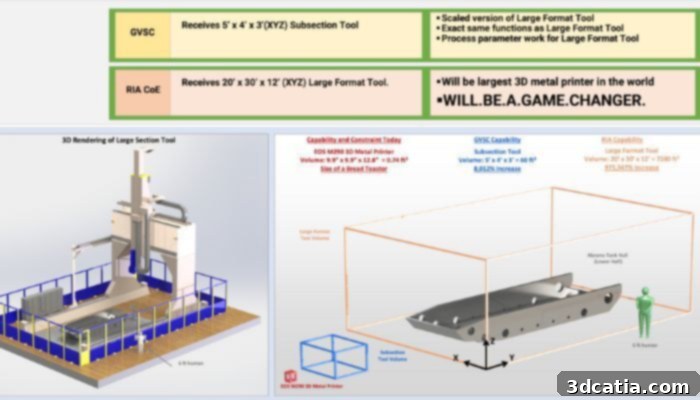
The development project of the largest metal 3D printer
ASTRO America and the 3D-Printed Combat Vehicle Hull
Further solidifying its commitment to advanced manufacturing, ASTRO America (Applied Science & Technology Research Organization) was specifically chosen by the U.S. Army for the Jointless Hull Project. This initiative, supported by the U.S. Department of Defense’s Manufacturing Innovation Institute, exemplifies a concerted effort to leverage 3D printing for developing and delivering cutting-edge hull tools for combat vehicles. The primary objectives are multifaceted: significantly reducing manufacturing time and production costs, while simultaneously decreasing vehicle weight and boosting overall performance and survivability on the battlefield. This strategic investment highlights the transformative potential of AM in creating more robust, agile, and cost-effective ground defense systems.
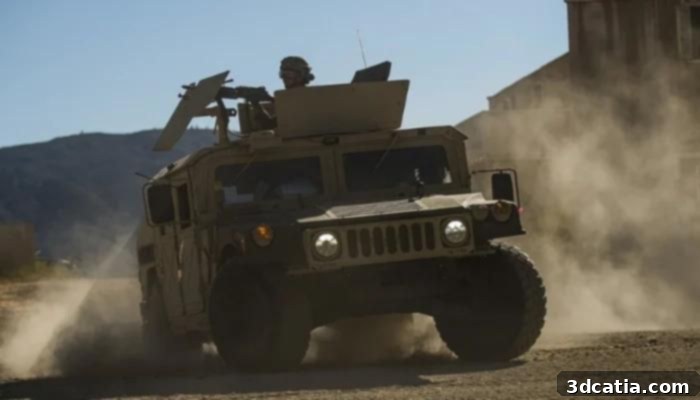
Photo credits: ASTRO America
On-Demand Spare Parts for Australian Armored Vehicles
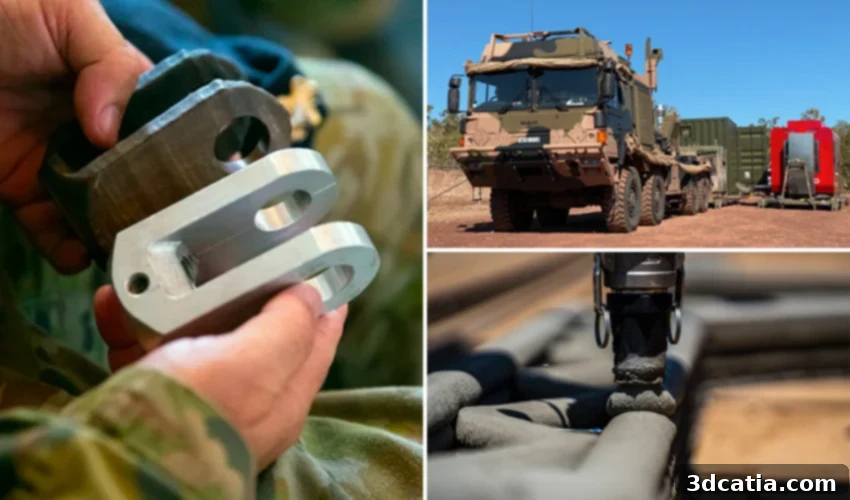
The Australian Army has embraced metal additive manufacturing, particularly solutions developed by SPEE3D, to produce essential spare parts for its armored vehicles. This capability has been rigorously tested and certified for field use, dramatically enhancing the agility and responsiveness of the Australian forces. Among the impressive components printed was a wheel cover, fabricated in just 29 minutes at an approximate cost of 100 Australian dollars. The machine deployed for this task was the WarpSPEE3D, boasting a print volume of 1000 x 700 mm and an astounding print speed of 1 kilogram per minute. By integrating additive manufacturing, the Australian Army can significantly reduce the downtime of its armored vehicles, ensuring they remain operational and ready to respond swiftly to emergency situations, thereby bolstering overall defense readiness.
Advancing Airpower and Expeditionary Operations
Additive manufacturing is also making significant inroads into air force operations, providing innovative solutions for rapid deployment, specialized equipment, and aircraft maintenance.
A 3D Printed Runway for the US Air Force
Innovation in military and defense applications extends to expeditionary infrastructure, as demonstrated by ITAMCO (Indiana Technology and Manufacturing Companies). This firm has developed a novel runway system for military expeditionary airfields using additive manufacturing. These specialized runway mats are crucial for Expeditionary Airfields (EAFs), allowing heavy military aircraft to safely land and take off on softer or unprepared ground surfaces. Historically, portable runways relied on aluminum planks, a system that eventually became outdated. To address this, the U.S. Air Force sought an innovative solution. Leveraging the EOS M290 3D printer, ITAMCO was able to create a significantly lighter, more durable, and easily deployable model, enhancing the operational flexibility of military air operations.
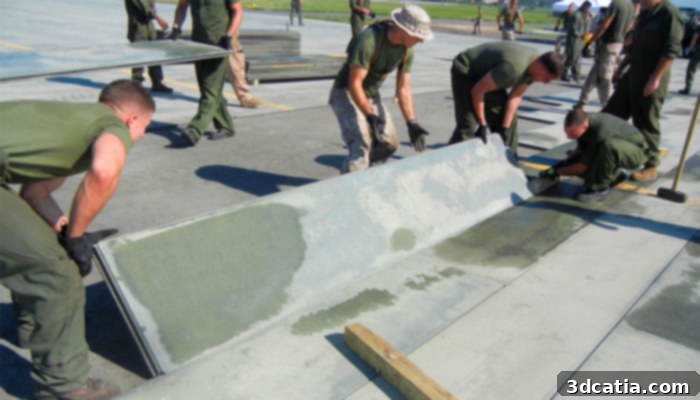
The landing strip
Spanish Air Force Upgrades Processes with 3D Printing
The Spanish Air Force is also harnessing the power of additive manufacturing to develop components with superior properties like hardness, strength, and lightness. By incorporating internal fiber reinforcement, they have successfully developed various tooling and final parts capable of withstanding the extremely demanding performance conditions inherent in high-stress aerospace environments, where there is no margin for error. In Madrid, the head of the Spanish Air Force’s helicopter workshop emphasizes that for virtually every part requirement, additive manufacturing is now the preferred method, with traditional manufacturing increasingly being eschewed. Notable applications include a specialized leak control measuring tool for helicopter landing gear and a custom-fitted key for the helicopter’s main rotor, showcasing the precision and customization benefits of 3D printing in maintaining critical aircraft systems.
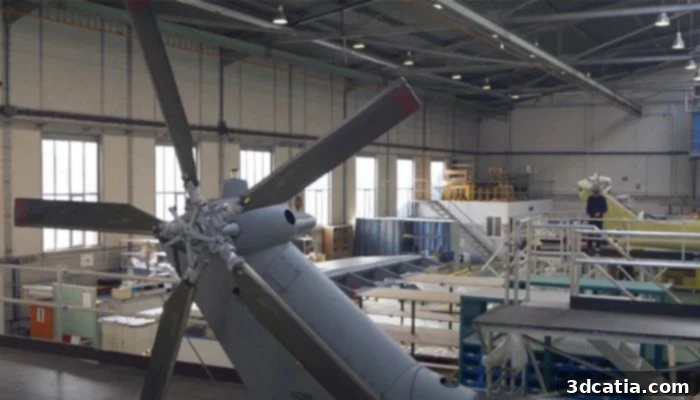
The Spanish army also uses additive manufacturing
Innovating Naval and Maritime Capabilities
The sea-faring branches of military defense are also deeply engaged in additive manufacturing, using it to enhance ship components, underwater vehicles, and on-board repair capabilities.
The U.S. Navy and the Power of 3D Printed Tools
The U.S. Navy is keenly leveraging additive manufacturing to improve maintenance and readiness. Marines have discovered that 3D printing allows them to produce innovative and highly specific tools for vehicle maintenance directly in the field or on naval vessels. A prime example involves the Marine Corps System Command, in collaboration with the Supply Battalion and industry partners, producing additively manufactured jigs for efficiently removing steering wheels from metal shafts – a recurrent maintenance challenge that often leads to significant delays. The benefits are clear: reduced maintenance time and increased operational readiness, particularly crucial given that traditional procurement of such specialized parts could entail a waiting period of approximately 25 days. 3D printing offers an immediate, on-demand solution, significantly streamlining critical repair processes.
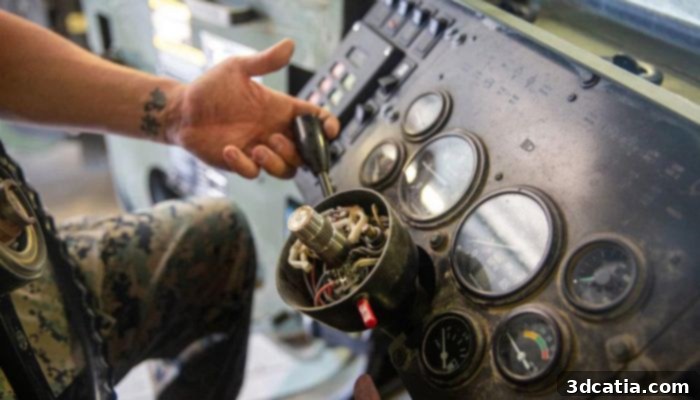
Photo credits: US Navy
Naval Group’s 3D Printed Ship Propeller: A French Defense Breakthrough
For several years, the esteemed French company Naval Group has been employing 3D printing to address various needs within its naval operations. In a notable achievement in 2021, Naval Group successfully 3D printed a ship propeller using Wire Arc Additive Manufacturing (WAAM) technology. This impressive propeller, comprising five 200 kg blades, was subsequently fitted to the Andromeda, a mine-hunting ship. The project teams highlighted that this advanced manufacturing technique drastically reduced construction time and minimized material waste compared to traditional methods. This innovation not only showcases the progress in French defense capabilities but also demonstrates how AM can deliver complex, high-performance maritime components efficiently.
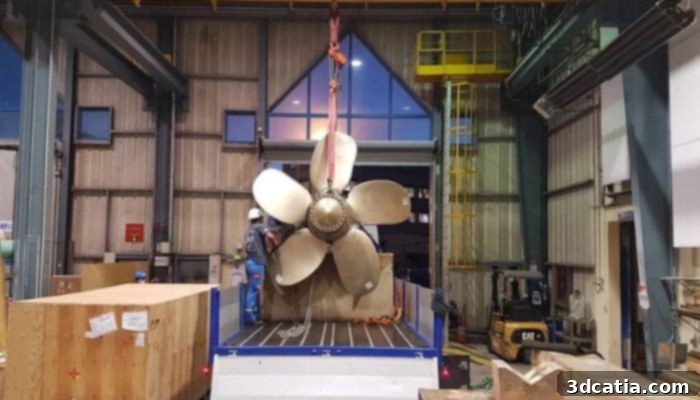
Photo credits: Naval Group
The U.S. Navy Expands Its Additive Manufacturing Footprint
The U.S. Navy has been engaged in numerous additive manufacturing projects for years, with a core objective of improving the agility and efficiency of its teams operating in distant oceanic environments, particularly concerning the rapid production of spare parts. To this end, the Naval Postgraduate School (NPS) invested in Xerox’s ElemX metal 3D printer. This machine is used to design and produce spare parts for submarines and ships, as well as essential tooling, enabling a significantly shorter supply chain and the capability to manufacture custom components on demand. NPS is not alone in advancing 3D printing in the maritime domain; MatterHackers, for example, secured a five-year contract with the U.S. Navy to supply all necessary 3D equipment, comprehensive training, and ongoing maintenance. Through this partnership, MatterHackers assisted the Navy in deploying Ultimaker S5 3D printers for creating custom parts and other diverse applications, further embedding AM into naval logistics.
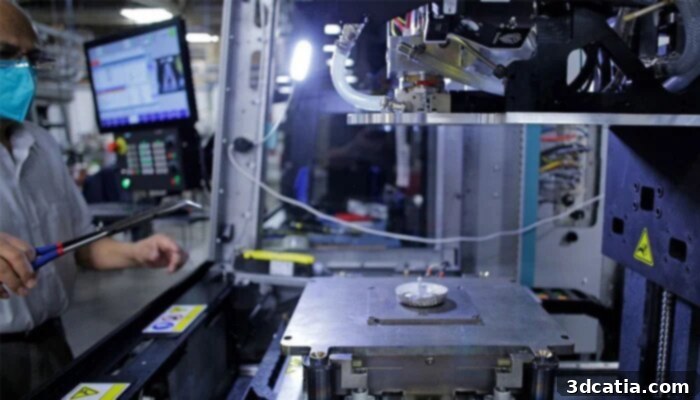
Photo credits: Xerox
3D Printed Submarine Hull: Taking Additive Manufacturing Undersea
The defense sector has continually found new ways to apply 3D printing across land, air, and sea. With a recent pioneering project, the U.S. military is literally delving into a relatively uncharted territory for 3D printing: under the sea. For this ambitious endeavor, Oak Ridge National Laboratory (ORNL) collaborated with the U.S. Navy’s Disruptive Technology Lab to create a 3D-printed submarine hull – a historic first in military applications. Utilizing ORNL’s FDM Big Area Additive Manufacturing (BAAM) technology, the team successfully produced a 30-foot concept hull composed of six carbon fiber composite material sections. This process proved to be significantly faster and more cost-effective than traditional manufacturing methods. While still in the testing phase, the initial results are highly promising, suggesting a future where 3D-printed submarines become a standard component of naval defense, offering unprecedented design flexibility and manufacturing efficiency.
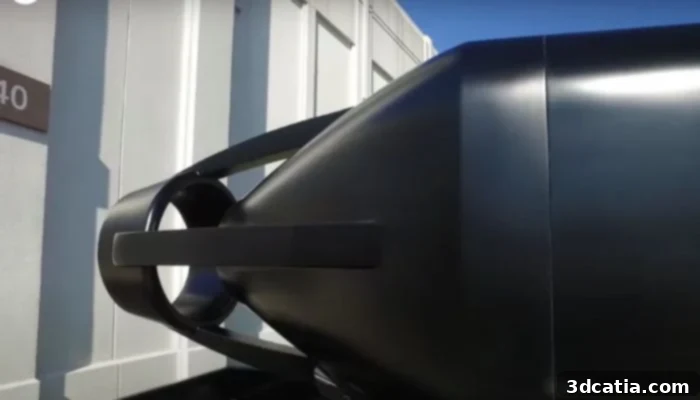
The hull printed in 3D (photo credits: ORNL)
Enhancing Soldier Protection and Future Energetics
Beyond vehicles and vessels, additive manufacturing is directly contributing to soldier safety and the development of advanced defense materials.
General Lattice and Customized Helmets for the U.S. Army
In a crucial initiative aimed at improving soldier safety, 3D design software company General Lattice has partnered with the U.S. Army to enhance the impact absorption capabilities of combat helmets. This collaboration focuses on leveraging 3D printing and advanced lattice geometries to create superior protective gear. General Lattice developed a sophisticated suite of predictive modeling tools to design and generate optimized materials for the helmet liners. These 3D-printed materials will undergo rigorous testing in real-world environments to validate their performance against the stringent requirements set by the Developmental Command Soldier Center. The goal is to significantly improve soldier protection in the field and increase the likelihood of survival following head impacts, ultimately providing a critical advantage in combat scenarios.
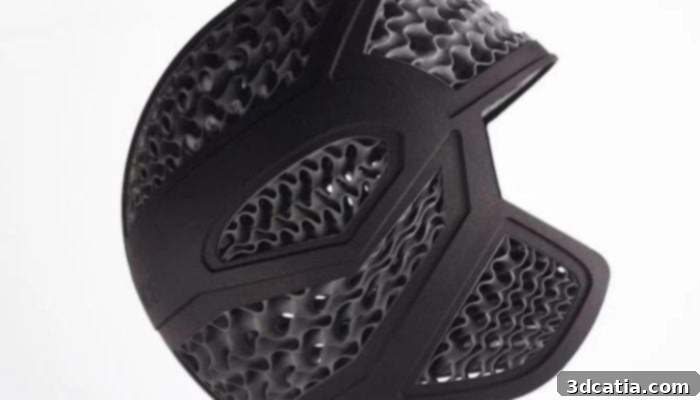
The helmet and its lattice structures (photo credits: General Lattice)
The Future Energetics Project: 3D Printing in UK Defense
The Future Energetics Project in the UK is a pioneering initiative focused on critical areas such as research, explosives testing, novel energetics fabrication, explosion modeling, chemical synthesis, thermal characterization, and hazard testing. The overarching objectives are to create new energetic materials and advanced diagnostic methods for their validation. Additive manufacturing plays a pivotal role in this project, enabling the development of new explosive formulations with unparalleled precision. This approach offers numerous benefits, including reduced storage and transportation costs, and significantly improved performance. Charges can be precisely tailored to specific operational requirements and manufactured in complex, intricate designs previously considered unthinkable. The manufacturing process employs a LabRAM resonant acoustic mixer, which utilizes acoustic energy instead of physical blades to mix materials, thereby enhancing safety. This cutting-edge 3D printing project is currently in its testing phase, promising to redefine energetic material production for defense applications.

Photo credits: Fotolia.com
Building Resilient Infrastructure and Forward Operating Bases
Additive manufacturing is also transforming military infrastructure, enabling rapid construction of vital facilities in challenging environments.
3D Printed Barracks: Creating Sturdy Lodging Anywhere for the US Military
The innovative 3D construction company ICON is well-known for its groundbreaking military projects. In a remarkable collaboration, the Austin-based firm partnered with the Texas Military Department, Logan Architecture, and Fort Structures to erect the largest 3D-printed structure in North America: training barracks at the Camp Swift Training Center in Bastrop, Texas. Utilizing ICON’s Vulcan construction system, a tablet-operated robotic printer that works with cement-based materials, this consortium successfully built the first 3D-printed barracks designed for soldiers. The completed structure is an impressive 3,800 square-foot building capable of sheltering up to 72 soldiers or airmen, providing durable and rapidly deployable lodging for their critical training and mission preparation. This initiative showcases the potential of AM to quickly establish robust infrastructure in diverse operational theaters.

Conclusion: The Indispensable Role of Additive Manufacturing in Modern Defense
The examples above vividly illustrate the profound impact of additive manufacturing across the global defense sector. From colossal metal printers fabricating combat vehicle hulls to custom tools for naval maintenance, and from rapidly deployable runways to enhanced soldier protection and even 3D-printed barracks, AM technologies are proving indispensable. They offer unparalleled advantages in terms of speed, cost reduction, weight optimization, supply chain resilience, and the ability to produce highly customized, complex geometries. As defense forces worldwide continue to face evolving threats and complex logistical challenges, the integration of 3D printing will only deepen, driving innovation, improving operational readiness, and ultimately safeguarding military personnel with cutting-edge solutions. The future of defense is undeniably being shaped by the limitless possibilities of additive manufacturing.