

Topology Optimization vs. Generative Design: Revolutionizing Product Development with AI and 3D Printing
In today’s competitive landscape, industries are relentlessly pursuing faster production cycles, components that meet increasingly stringent demands, and innovative breakthroughs that surpass current achievements. To stay ahead, manufactured products must be continually optimized to enhance their performance. This often translates into the challenging yet critical goal of reducing part weight while simultaneously increasing strength, durability, and overall functionality. This “less is more” philosophy isn’t just a manufacturing mantra; it’s a design imperative that begins right at the conceptual stage. While traditional designers constantly push boundaries, emerging technologies like artificial intelligence (AI) and machine learning (ML) are unlocking unprecedented possibilities. Among these advancements, topology optimization and generative design stand out as transformative approaches in modern engineering and design.
Both topology optimization and generative design represent sophisticated computer-aided design (CAD) strategies that leverage advanced algorithms to refine product designs. Their primary aim is to achieve greater efficiency, leading to substantial savings in costs, materials, and production time. While both methods share the overarching goal of creating optimized structures, it’s crucial to understand that they are distinct methodologies and should not be confused. This article delves into the core principles of topology optimization and generative design, exploring their unique advantages, the challenges they present, their diverse applications across various industries, and specific examples. We will also highlight their synergistic relationship with 3D printing, demonstrating how additive manufacturing unlocks their full potential.
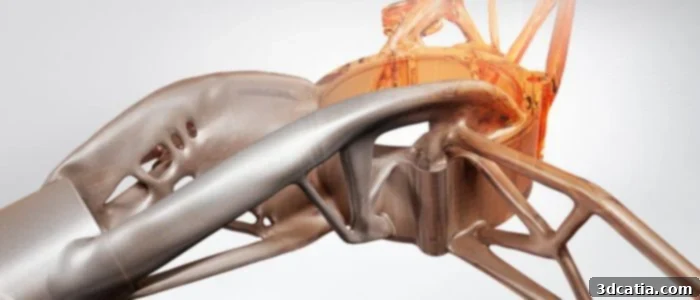
Photo Credits: Mensch und Maschine
Understanding Topology Optimization and Generative Design
Topology Optimization: Refining Existing Structures
Topology optimization is a well-established method, with its roots tracing back to the early 1990s. Its fundamental purpose is to optimize the material distribution within a defined design space for a given set of loads, boundary conditions, and constraints. Unlike generative design, topology optimization always starts with a pre-existing geometric model or a human-designed concept. The objective is to intelligently remove material from this initial design, thereby reducing weight and material usage, while ensuring that the part retains its essential functions and structural integrity, particularly where loads are applied. This process requires engineers to meticulously define specific framework conditions, such as the magnitude and direction of forces, stress points, and designated “protected zones” where material cannot be removed. Advanced computer algorithms then process these parameters, creating an optimized mesh model. The structural integrity of this newly generated design is rigorously verified through a process known as Finite Element Analysis (FEA). Finally, a skilled CAD engineer reviews and, if necessary, refines the algorithmic output to ensure manufacturability and meet precise design specifications.
Generative Design: Creating from Scratch
In stark contrast to topology optimization, generative design does not begin with an existing design concept. This is a fundamental difference between the two methods. Instead, generative design relies on engineers to define a set of high-level functional requirements and “constraints,” rather than a specific form. These constraints can be highly varied, including blocking surfaces (areas where material cannot exist), preferred materials, desired manufacturing processes (e.g., additive manufacturing, CNC machining), cost targets, weight limits, and performance criteria. Once these parameters are established, sophisticated artificial intelligence algorithms take over, exploring a vast solution space to generate hundreds, or even thousands, of unique design possibilities. The AI system iteratively refines these designs, presenting various options that meet the specified input parameters, often presenting novel geometries that a human designer might not conceive. This allows for a comprehensive exploration of design trade-offs, enabling engineers to select the most suitable option based on their preferences and priorities.
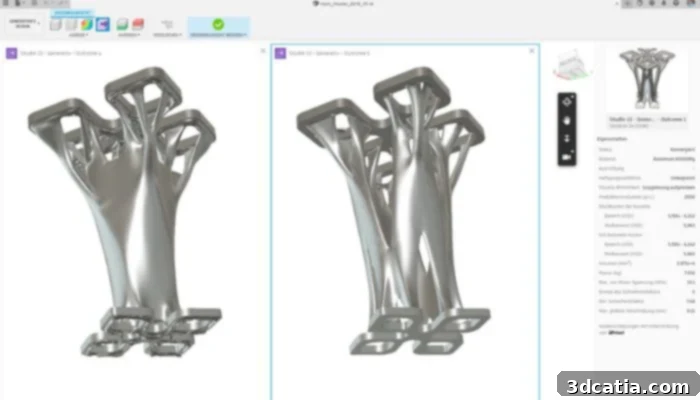
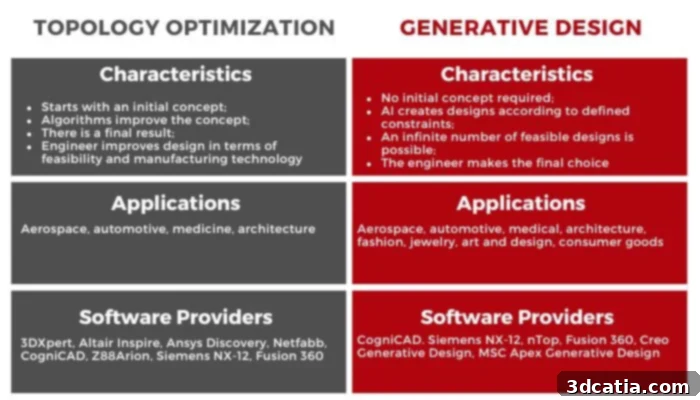
Comparison between topology optimization and generative design (photo credits: Mensch und Maschine)
Both topology optimization and generative design fundamentally support product development through computer-aided mechanisms. They excel at creating optimized designs that prioritize lightness, cost reduction, and material savings, all while maintaining or even improving the overall quality and performance of components. A fascinating aspect of the designs proposed by these technologies is their frequent inspiration from natural structures, exhibiting similarities to bone lattices, beehives, and coral formations, which are inherently efficient in nature. While topology optimization typically yields a single, refined design based on an initial shape, generative design distinguishes itself by offering a multitude of potential solutions, each adhering to the defined constraints. This expansive exploration allows engineers to evaluate a broader range of innovative forms.
The Synergistic Power with 3D Printing
Despite their distinct approaches, both topology optimization and generative design lead to the creation of highly optimal designs. However, these intricate, often organic geometries can pose significant manufacturing challenges when using traditional production methods. Many conventional processes struggle with complex internal structures, nested geometries, significant overhangs, and highly variable wall thicknesses that are often characteristic of these optimized designs.
This is precisely where the unparalleled potential of these two design tools is fully unleashed in combination with 3D printing, also known as additive manufacturing. The synergy is twofold: firstly, both solutions generate designs that would be exceedingly difficult or impossible to produce using conventional subtractive or formative manufacturing techniques. 3D printing offers the freedom to create almost any complex shape layer by layer. Secondly, and particularly for generative design, the software can explicitly account for the chosen manufacturing method from the outset. This means that if additive manufacturing is specified as a constraint, the generative design algorithms will only propose solutions that are inherently manufacturable via 3D printing technology, streamlining the entire design-to-production workflow.
In the case of generative design, the ability to specify additive manufacturing early in the process significantly reduces the need for subsequent design modifications. For topology optimization, however, the generated design still typically requires a CAD engineer to review and refine it for manufacturability, especially when considering 3D printing. For instance, if the part is to be 3D printed, the engineer might need to determine the optimal placement and design of support structures, which are often required for successful additive manufacturing depending on the specific printing method. This human intervention ensures the design is not only structurally optimal but also practical to produce, minimizing post-processing and potential print failures.
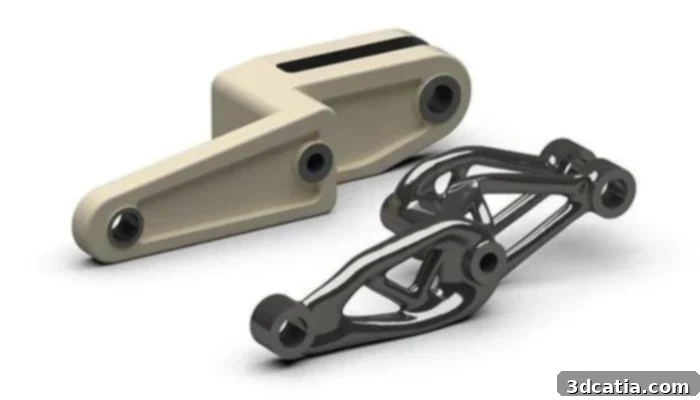
A representation of a part that has been optimized by generative design and can then be 3D printed (photo credits: Siemens PLM)
Benefits and Limitations of Advanced Design Methods
Key Advantages
One of the most compelling advantages of both topology optimization and generative design is their ability to produce highly optimized designs based on precisely defined parameters, utilizing advanced algorithms and artificial intelligence. This intelligent automation leads to significant savings in time, materials, and ultimately, costs. Generative design, in particular, empowers designers to explore hundreds or even thousands of viable design options in a fraction of the time it would take for manual iteration. Furthermore, simulations and performance tests are often integrated directly into the design generation process, allowing for immediate feedback and reducing the need for costly physical prototyping and rework later in the development cycle. Generative design also allows for cost to be explicitly defined as a constraint, guiding the AI towards solutions that fit budgetary requirements, a capability that is generally not inherent in standard topology optimization, which focuses primarily on structural performance and material reduction.
The vast array of design possibilities offered by generative design is a major differentiator, providing a diverse portfolio of solutions from which to choose. In contrast, topology optimization typically yields a single, optimized design based on the initial geometry. With topology optimization, the engineer’s role often involves further refinement and verification of this single outcome. However, with generative design, the engineer leverages their expertise to evaluate and select the best option from a multitude of algorithmically generated solutions. A significant practical benefit is that generative design processes often conclude with designs readily available in standard CAD file formats (such as STEP files), which can be directly exported for manufacturing, particularly via additive manufacturing, thus greatly simplifying the subsequent steps in the production chain. Topology optimized models, especially those with intricate mesh structures, frequently require an additional conversion step to create a solid CAD model suitable for manufacturing.
Challenges and Considerations
Despite the numerous positive incentives offered by these computer-aided design solutions, they also come with certain challenges. Firstly, the advanced software solutions required for both generative design and topology optimization can represent a significant investment, often coming with a high price tag. Beyond the initial cost, their correct and efficient application demands specialized knowledge and expertise. Engineers and designers need training to understand the underlying principles, define constraints accurately, interpret results, and effectively integrate these tools into their existing workflows.
Furthermore, while topology optimization is a more mature and well-established method, with many large companies having integrated it over the years, generative design has only recently become widely accessible and popular, driven by advancements in AI and computational power. Consequently, generative design software adoption is not yet as widespread, though its potential to identify groundbreaking solutions is immense. The learning curve for these newer generative tools can also be steeper due to their different paradigm of design exploration.
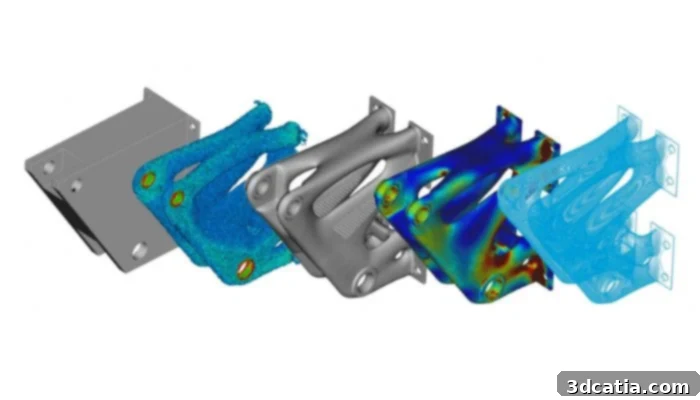
Topology optimization is mainly used to improve part weight (photo credits: Formlabs)
Crucially, both processes cannot entirely supersede the indispensable expertise of human CAD designers and engineers. Human oversight is essential for critically evaluating material properties, ensuring the chosen manufacturing technology is appropriate, and analyzing the feasibility of the generated designs. The intended end-use of the product must also be a primary consideration throughout the design process. While AI-generated designs may be functionally optimal, they often exhibit non-traditional, organic, or even unconventional aesthetics. In such cases, designers must intervene to make adjustments not only for visual appeal but also for factors like haptics (the tactile experience), acoustics, and even smell, as these sensory stimuli are profoundly influential for end-users. It is precisely at these nuanced sensory and experiential points that topology optimization and generative design currently reach their limits, unable (yet) to fully replicate the holistic understanding and creative intuition of human involvement in the design process. Nevertheless, these powerful design solutions continue to unlock an expansive range of possibilities across numerous applications, pushing the boundaries of what’s achievable in product development.
Diverse Applications Across Industries
While the fields of application for topology optimization and generative design often overlap, their distinct methodologies lead to different approaches and outcomes within various sectors. Topology optimization, operating within defined structural boundaries, systematically removes material from an existing form while continuously performing FEA simulations to enhance performance. Generative design, on the other hand, takes a more expansive approach, utilizing algorithms to develop novel and creative solutions that not only optimize material distribution but also fundamentally expand the design space itself. Both methodologies are particularly impactful in sectors where the physical properties and performance of components are paramount, such as aerospace and automotive, but their utility also extends to creative fields like architecture and fashion.
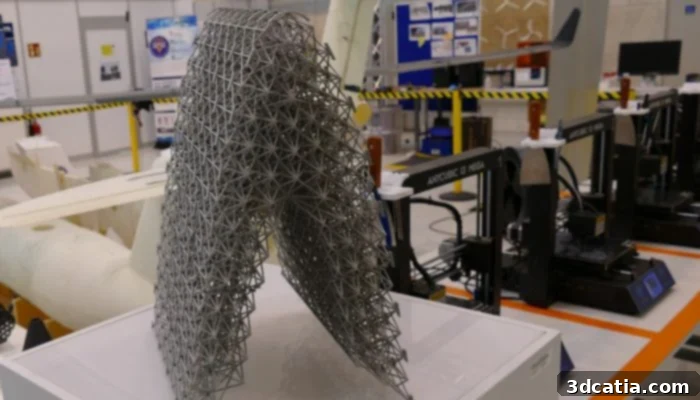
Part of an Airbus A320, developed using generative design (photo credits: Autodesk)
Aerospace Industry
In the aerospace sector, topology optimization is invaluable for enhancing existing designs to produce lighter aircraft structures, such as fuselage components, engine brackets, and reinforcing ribs. This direct reduction in weight translates into significant fuel savings and reduced emissions over the operational life of an aircraft. A notable example includes Andreas Bastian’s work on aircraft seats, which were redesigned to be 54% lighter, contributing substantially to overall aircraft weight reduction. Generative design is also extensively utilized by aviation giants like Airbus to create components that are not only stronger but also exhibit innovative, organic forms. The famous bulkhead of the Airbus A320, for instance, was manufactured using generative design inspired by natural growth processes, resulting in a part that was 45% lighter and 10 times stronger than its conventionally manufactured predecessor.
Automotive Industry
The automotive industry heavily leverages topology optimization to contribute to the development of lightweight, stable, and safe vehicles. By refining existing designs, significant weight reductions can be achieved without compromising structural integrity or safety. An impressive case study involves Fiat Chrysler’s suspension system, where topology optimization facilitated the integration of over twelve different components into a single, optimized part, resulting in a remarkable 36% weight reduction. Generative design further pushes the boundaries in automotive components by generating entirely new, high-performance solutions. This enables companies to not only improve product performance but also meet increasingly stringent environmental protection requirements by optimizing material use. Bugatti, for example, utilized generative design software to develop the Chiron’s wing control system, achieving optimized assembly and a weight reduction of over 50%. Porsche also applied generative design to create an innovative piston for its 911 GT2 RS high-performance engine, demonstrating enhanced efficiency and durability.
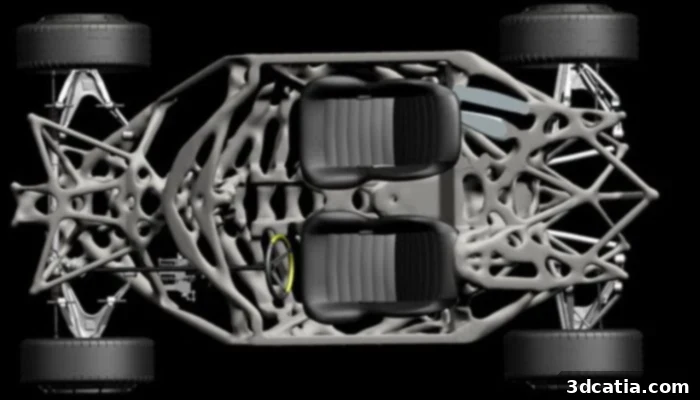
A vehicle design developed using generative design. The similarity with bone structures is particularly striking here, and optimized vehicles could resemble them in the future (photo credits: Siemens).
Medical Field
In the medical field, both modeling tools play a pivotal role in advancing patient care and product efficacy. Topology optimization is exemplified by companies like NuVasive, which uses it to design custom spinal implants featuring intricate lattice structures. These designs significantly reduce implant weight without compromising stability or load-bearing capacity, leading to better patient outcomes and reduced surgical invasiveness.
Generative design offers even more advanced solutions, particularly in the realm of osseointegration. Implants can be designed with complex porous structures that closely mimic the architecture of natural bone. This biomimicry actively encourages the ingrowth of new bone tissue onto the 3D-printed implant, dramatically improving long-term stability and reducing the risk of rejection. While topology optimization in the medical field often focuses on maximizing efficiency and reducing weight in existing implant designs, generative design excels at creating optimal adaptations to a patient’s unique anatomy, making it indispensable for manufacturing highly patient-specific prostheses and custom surgical guides, thus enabling truly personalized medicine.
Architecture and Construction
Beyond traditional engineering, generative design is transforming architecture and construction by facilitating the creation of novel, highly functional concepts for spaces and structures. It offers powerful solutions to complex design problems, enabling architects to explore forms that might be otherwise impossible to conceive manually. Topology optimization is also increasingly adopted in architecture to improve the structural efficiency of existing building forms and enhance load-bearing capacity, allowing for lighter, yet stronger, constructions. Both methods empower architects to design more efficient and sustainable structures during the initial design phase, frequently drawing inspiration from the inherent efficiencies found in natural structures. The iconic MX3D bridge, constructed over a canal in Amsterdam using robotic 3D printing and generative design, stands as a prime example of this innovative synergy.
Fashion and Jewelry Industry
The fashion and jewelry industries are rapidly embracing generative design, where the focus often shifts from purely optimizing factors like weight and strength to the creation of uniquely creative and original aesthetic shapes. Designer Julia Körner epitomizes this trend, having created innovative 3D-printed costumes for the blockbuster movie Black Panther, showcasing the technology’s ability to produce intricate, flowing forms. Anouk Wipprecht also leverages generative design, for instance, in her “ScreenDress,” which was brought to life using Multi Jet Fusion technology. In these applications, generative design is about pushing the boundaries of traditional fashion, enabling the creation of new aesthetic structures and highly customized pieces through sophisticated digital design processes, merging technology with high art.

On the left, Anouk Wipprecht’s dress, and on the right, a design by Julia Körner (photo credits: Anouk Wipprecht, Julia Körner)
Leading Software Providers in the Field
To harness the full capabilities of topology optimization and generative design, specialized software solutions are indispensable. For topology optimization, several robust tools are available. Oqton’s 3DXpert is highly regarded, particularly for designing medical implants and other complex geometries that require precise material distribution. Altair Inspire also excels, proving ideally suited for demanding applications in the automotive and aerospace industries due to its powerful optimization capabilities. Ansys Discovery and Netfabb further offer comprehensive topology optimization support, crucial for ensuring the stability and printability of 3D models. Netfabb provides a free trial version for exploration, with full licenses priced at approximately $7,690 for one year or $23,070 for a three-year subscription. Another innovative solution is CogniCAD from ParaMatters, a cloud-based platform that uniquely combines both topology optimization and generative design, specializing in complex 3D constructions. CogniCAD operates on a token-based payment system, with tokens ranging from $5.90 to $14.90 depending on the software version and usage volume.
Z88Arion® stands out as a free software package that includes three distinct optimization algorithms for topology optimization, making advanced design more accessible. Siemens NX, particularly version 12 and later, is renowned for its seamless integration of topology optimization based on convergent modeling technology. This enables flawless 3D modeling workflows and consistently delivers lighter yet more robust components. Siemens NX is a versatile platform, equally adept at handling both generative design and topology optimization tasks within a single environment.
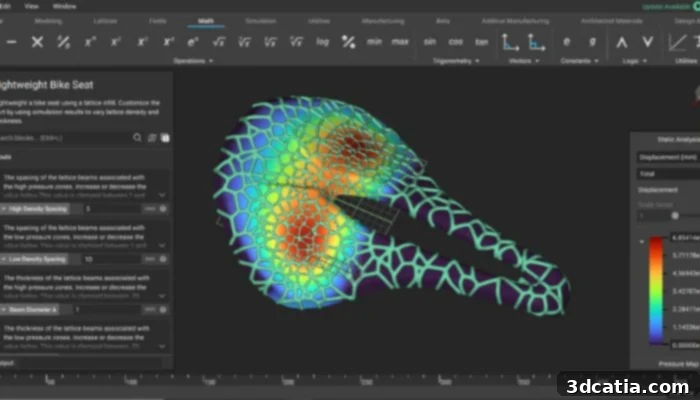
nTop is software for generative design (photo credits: nTopology)
For generative design, nTopology offers nTop, a powerful software package known for its extensive generative tools tailored for individual and highly specific requirements, especially for lattice structures and advanced geometries. Fusion 360 from Autodesk is another excellent choice, providing a comprehensive suite of functions including sketching, surface modeling, and rendering, making it suitable for both topology optimization and generative design workflows. Other notable solutions include PTC Creo Parametric and Creo Generative Design, which leverage cloud technologies to rapidly create optimized design concepts and facilitate the swift implementation of cost-effective designs. Hexagon’s MSC Apex Generative Design is also a strong contender, particularly effective for producing highly detailed and intricate structures. Similarly, tools offering “Cognitive Design” aim to accelerate the process of obtaining optimized designs by integrating AI-driven insights.
Selecting the right software is a critical decision and directly impacts the success of topology optimization and generative design projects. Generally, generative design solutions currently tend to be more expensive than dedicated topology optimization software, reflecting their newer technology and broader design exploration capabilities. However, with a rapidly expanding market, businesses and individuals can find suitable options tailored to their specific budget and project objectives. In all cases, engineers and designers are strongly encouraged to invest time in familiarizing themselves with the chosen software. While some interfaces are highly intuitive, a deep understanding of the software’s capabilities, limitations, and underlying algorithms, coupled with strong engineering expertise, is absolutely essential to fully leverage the profound design advantages that topology optimization and generative design offer.
Both topology optimization and generative design represent monumental shifts in how products are conceived, designed, and manufactured. By harnessing the power of computational algorithms and artificial intelligence, engineers and designers can now create structures that are lighter, stronger, more efficient, and often more innovative than ever before. Their combined potential, especially when paired with the transformative capabilities of 3D printing, promises to drive unprecedented innovation across nearly every industry, pushing the boundaries of what is mechanically and aesthetically possible. As these technologies continue to evolve, the distinction between human creativity and machine intelligence will increasingly blur, leading to a new era of collaborative design and manufacturing excellence.
Do you use topology optimization or generative design in your work? We’d love to hear about your experiences and insights! Let us know in a comment below or connect with us on our LinkedIn, Facebook, and Twitter pages! Don’t forget to sign up for our free weekly newsletter here for the latest 3D printing news delivered straight to your inbox! You can also find all our engaging videos on our YouTube channel.