
Weekly 3D Printing Roundup: Breakthroughs in Construction, Aerospace, and Industrial Innovation
As another eventful week concludes and we look forward to new possibilities, it’s time once again to highlight the most compelling and insightful 3D printing videos that have emerged. This week’s selection offers a comprehensive look at the cutting edge of additive manufacturing, spanning diverse applications from groundbreaking construction techniques to advanced aerospace engineering and innovative industrial solutions. We’ll start with an exclusive 3Dnatives deep dive into the intricate workings of concrete 3D printers, revealing how these revolutionary machines are reshaping the built environment. Following this, we journey to the stars with Relativity Space, exploring the critical role of Design for Additive Manufacturing (DfAM) in crafting sophisticated 3D printed rocket engines that push the boundaries of space exploration. Next, we witness a practical, real-world application of concrete 3D printing with the inauguration of the first 3D printed house in Columbus, Ohio, demonstrating the technology’s tangible impact on affordable housing. Our journey continues into the automotive sector, where Shape Corp is leveraging 3D printing to achieve superior welding processes. Finally, we gaze into the future of additive manufacturing with 3DXTECH, as they share their strategic vision and exciting partnership with Automation Alley, aimed at expanding AM adoption. Prepare for an enlightening viewing experience and have a fantastic weekend filled with inspiration!
Understanding Concrete 3D Printers: Revolutionizing Construction
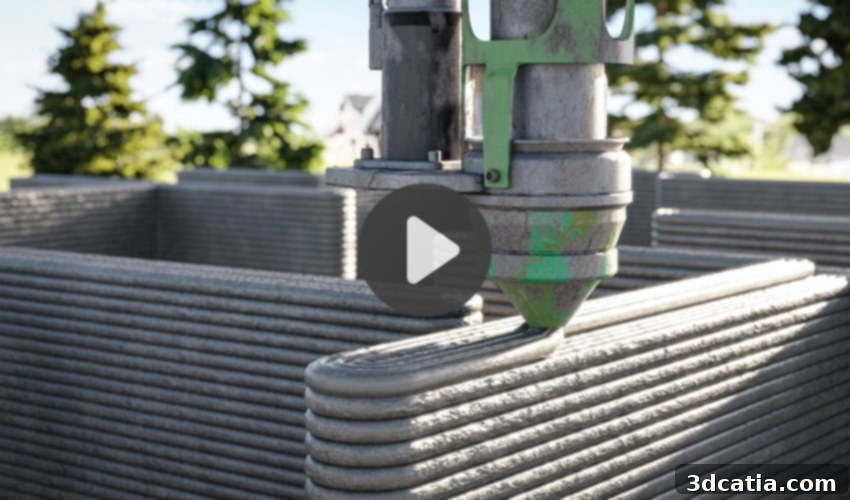
It’s becoming increasingly rare to pass a week without encountering a new story about the transformative influence of 3D printing within the construction industry. Additive manufacturing is rapidly evolving as a cornerstone for creating not only more affordable and structurally sound housing but also enabling unprecedented levels of architectural creativity and design freedom. The core of this revolution lies in concrete 3D printers, sophisticated machines capable of constructing entire homes and structures that not only meet but often exceed stringent regulatory and performance requirements. These advanced systems extrude specialized concrete mixtures layer by layer, building walls and structural elements with remarkable speed and precision, significantly reducing construction time and labor costs. They represent a paradigm shift from traditional building methods, offering solutions to global housing shortages, reducing material waste, and facilitating custom, complex geometries that were once prohibitively expensive or impossible to achieve. In this compelling video, an original production by 3Dnatives, we are invited to take an in-depth look at the innovative engineering behind these machines. The video meticulously explains how leading companies are conceptualizing, developing, and deploying concrete 3D printers, alongside a detailed breakdown of their operational mechanics and the crucial material science involved. It’s an essential watch for anyone keen to understand the technological backbone of tomorrow’s urban landscapes.
Relativity Space Showcases DfAM’s Power for Rocket Engines
In the rapidly expanding realm of commercial spaceflight, Relativity Space has emerged as an undeniable titan. From its origins as an ambitious startup, the company has rapidly ascended to become one of the foremost pioneers in the creation of entirely 3D printed rockets, notably with their Terran 1 rocket having undergone testing just last year, and the larger, reusable Terran R currently in development. Their innovative approach to manufacturing has captivated the aerospace industry, proving that additive manufacturing can not only build complex structures but also achieve unparalleled speed and efficiency. Central to their success is the rigorous application of Design for Additive Manufacturing (DfAM) principles. DfAM is not merely a design methodology; it’s a holistic approach that optimizes parts specifically for the additive manufacturing process, allowing for part consolidation, lightweighting, enhanced thermal management, and improved structural integrity – all critical factors for high-performance rocket engines. Now, space enthusiasts and engineering aficionados can gain an exclusive peek into their groundbreaking work. In their latest installment of the “Since You Asked” video series, Relativity Space features engineer Dan Christensen, who expertly breaks down the intricacies of DfAM. He illustrates precisely how the company leverages these principles to create incredibly sophisticated and robust rocket engines. What’s even more impressive is the astonishing pace of their innovation: from initial design conceptualization to rigorous testing, these cutting-edge engines are brought to fruition in an astounding three months, a testament to the synergistic power of DfAM and additive manufacturing.
Columbus, Ohio Unveils Its First 3D Printed House: A Landmark in Affordable Housing
Having just explored the fascinating mechanics behind concrete 3D printers, it’s incredibly inspiring to now witness this groundbreaking technology translate into tangible, real-world solutions. The next video takes us to Columbus, Ohio, where the state is buzzing with excitement over the development of its very first 3D printed home. This project is not merely an architectural curiosity; it represents a significant step forward in addressing the pressing need for more affordable and sustainable housing options. The local news channel WBNS 10TV provides an excellent, up-close look at the construction in progress, vividly showcasing the concrete 3D printer in action as it meticulously layers the foundation and walls of the new residence. Located on the 1500 block of East 26th Street in Linden, this home embodies the promise of additive construction. The video captures the dynamic progress of the build, allowing viewers to see the efficiency and precision of the process firsthand. More importantly, it features interviews with local neighbors and community members, gathering their perspectives on this innovative development and its potential impact on the neighborhood. Their insights highlight how this project is being championed as a viable pathway to creating housing that is not only cost-effective but also built with speed and minimal environmental footprint, offering a glimpse into the future of urban development and community revitalization.
Shape Corp Embraces Additive Manufacturing for Enhanced Robot Welding
For those immersed in the automotive industry, the name Shape Corp is synonymous with innovation and excellence. As a global Tier 1 automotive supplier, Shape Corp has carved out a niche specializing in critical areas like crash management systems and advanced energy solutions, playing a vital role in enhancing vehicle safety and performance. In a strategic move to further optimize their manufacturing processes, the company recently forged a powerful partnership with Stratasys, a leader in industrial 3D printing, to integrate additive manufacturing into their operations. This collaboration has seen Shape Corp adopting the robust F900 FDM 3D printer to produce high-precision 3D printed surrogate parts. These surrogates are not end-use components but rather crucial tools designed to facilitate more efficient setup and calibration of their robotic welding systems. In traditional manufacturing, the setup and calibration of robotic welders for complex automotive parts can be a time-consuming and costly process, often involving physical trial and error with expensive production parts. By utilizing 3D printed surrogates, Shape Corp can rapidly create accurate, low-cost replicas of parts. This allows for quick and precise fixture setup and robot training without tying up production lines or wasting valuable materials. The benefits are substantial: significant reductions in downtime, accelerated tooling validation, and substantial savings in both time and money. This strategic application of additive manufacturing demonstrates its immense value not just for producing final parts, but also for streamlining and de-risking critical manufacturing processes. Delve deeper into this innovative approach by watching the video from Stratasys below, which elaborates on how this partnership is setting new benchmarks in automotive production efficiency.
3DXTECH’s Vision: Charting the Future of Additive Manufacturing Adoption
As a prominent American manufacturer, 3DXTECH is committed to expanding the reach and showcasing the profound benefits of additive manufacturing to an ever-wider audience. Their mission extends beyond simply producing high-performance materials; it encompasses fostering a deeper understanding and broader adoption of AM technologies across various industries. In pursuit of this ambitious goal, 3DXTECH has announced a significant strategic partnership with Automation Alley, a leading Industry 4.0 knowledge center based in Michigan. This collaboration is designed to create a powerful synergy, aimed at educating and assisting local Michigan manufacturers in seamlessly adopting additive manufacturing processes. The initiative seeks to demystify AM, demonstrating its practical advantages and illustrating how integrating these technologies can significantly enhance competitiveness, drive innovation, and unlock new business opportunities for companies of all sizes. The partnership will focus on providing resources, expertise, and tailored solutions to help manufacturers identify the specific AM technologies—whether it’s material selection, printer types, or workflow optimization—that best align with their unique operational needs and long-term strategic objectives. This endeavor is crucial for bolstering regional manufacturing capabilities and ensuring that local businesses are at the forefront of the technological revolution. To gain a deeper understanding of this impactful project, learn about the collaborative efforts between 3DXTECH and Automation Alley, and discover how they are guiding companies toward finding optimal additive manufacturing solutions, watch the informative video below.
This week’s roundup truly underscored the incredible versatility and accelerating pace of innovation within the additive manufacturing landscape. From the foundational principles of concrete 3D printing and its inspiring applications in affordable housing, to the advanced engineering marvels in aerospace through DfAM, and the smart industrial solutions transforming automotive manufacturing, 3D printing continues to redefine what’s possible. The forward-thinking vision shared by 3DXTECH further emphasizes the ongoing commitment to making these powerful technologies accessible to more businesses, driving economic growth and technological advancement. We hope these videos have provided valuable insights and sparked your imagination about the future of manufacturing. Did you gain new knowledge on how a concrete 3D printer operates? Which of this week’s top 5 videos resonated most with you? We’d love to hear your thoughts! Share your comments below or connect with us on our LinkedIn, Facebook, and X (formerly Twitter) pages! And don’t miss out on the latest advancements in the industry; be sure to sign up for our free weekly newsletter here to receive the freshest 3D printing news directly in your inbox. For a continuous stream of innovative content, you can also explore all our videos conveniently available on our YouTube channel.