
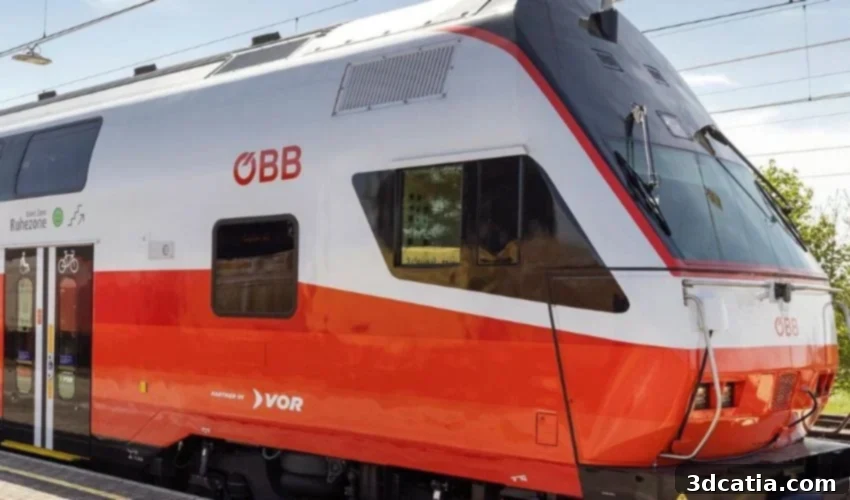
Revolutionizing Rail Safety: How 3D Printing and EN 45545 Certified Flame-Retardant Materials are Transforming the Railway Industry
The pursuit of enhanced safety in public transportation has always been a paramount concern, particularly within the railway sector. Tragic incidents, such as the Kaprun cable car fire in November 2000 and the devastating fire on a DB night train from Paris to Munich in 2002, underscored the critical need for more robust fire protection measures. These events, among Europe’s worst train fire disasters, amplified calls for the widespread integration of flame-retardant components in rail vehicles. In response, railroad operators and federal railway authorities across the continent sought to elevate fire safety standards by mandating the use of certified materials in critical components. This collective commitment culminated in the introduction of the European railway standard EN 45545 in 2013, which, after a transitional phase, fully replaced various national standards by 2016, establishing a unified and significantly more stringent framework for fire and smoke safety.
The implementation of EN 45545 marked a monumental leap forward in achieving superior flame retardancy and, consequently, greater long-term safety across European rail networks. However, as global technology continues its rapid evolution, particularly with the advent of advanced manufacturing techniques, EN 45545 presents a unique set of challenges for many parts manufacturers and railway operators. Additive manufacturing, commonly known as 3D printing, has emerged as a game-changer for producing spare parts, bespoke components, and short production runs efficiently. Yet, this innovative manufacturing method often struggles with an inadequate supply of certified materials that meet the stringent requirements of EN 45545. This material gap places a significant burden on railway operators, who must identify the right partners capable of supplying both the expertise and the compliant materials necessary to leverage the benefits of additive manufacturing while adhering to critical safety standards. The Austrian Federal Railways (ÖBB), a proactive adopter of modern technologies, successfully navigated this challenge by partnering with TIGER Coatings, a renowned material manufacturer and service provider. TIGER Coatings demonstrated its capability to produce components from advanced flame-retardant materials using 3D printing, offering a groundbreaking solution. Let’s delve deeper into this compelling success story and explore how this collaboration is shaping the future of rail safety.
The flame-retardant material from TIGER Coatings complies with the stringent EN 45545 standard, ensuring superior fire protection for rail applications. (photo credits: TIGER Coatings)
EN 45545: From Standard Introduction to Modern Challenges in Rail Manufacturing
At its core, EN 45545 was established with a singular, vital objective: to protect both staff and passengers from the devastating consequences of fires within rail vehicles. This comprehensive European standard meticulously unifies fire and smoke safety regulations across the continent, ensuring a consistent level of safety irrespective of where a train operates. Specifically, subsection EN 45545-2 delves into the critical requirements for materials used in rail vehicle parts. This section introduces a nuanced categorization system, distinguishing between three Hazard Levels: HL 1, HL 2, and HL 3. These levels are determined by factors such as the train’s operating environment, its design, and passenger capacity, reflecting varying degrees of risk exposure. Consequently, materials selected for train equipment must rigorously satisfy the demands of these risk categories, in addition to meeting specific criteria defined by product classes and their intended location of use within the vehicle. For instance, seals and hoses, depending on whether they are installed inside or outside the train and whether they fall under HL 1, 2, or 3, must exhibit distinct values concerning flammability, smoke emission, and toxicity. The paramount challenge for rail operators and manufacturers lies precisely in sourcing and certifying materials that not only meet these intricate and multifaceted criteria but also align with modern production methodologies, especially those involving advanced technologies like 3D printing.
The Austrian Federal Railways (ÖBB) found itself confronting this exact predicament. For several years, ÖBB has been a pioneer in integrating 3D printing into its operations, utilizing additive manufacturing for critical maintenance work, efficient spare parts production, and the ecological manufacturing of small series components. This strategic adoption has allowed ÖBB to optimize its supply chain and reduce lead times significantly. A notable instance of this innovative approach involved the creation of a baby carriage safety retrofit ring. This crucial component is designed to prevent baby carriages in ÖBB’s double-decker pushchair train 8633 from unintentionally opening doors, a critical safety feature for passengers. The challenge was multifaceted: the ring needed to be produced in a small series, ensuring cost-effectiveness for a limited batch, and, most importantly, had to fully comply with the rigorous EN 45545 fire protection standards. Recognizing the specialized material and manufacturing expertise required, ÖBB engaged TIGER Coatings. Leveraging its extensive knowledge and access to classified, high-performance materials suitable for additive manufacturing, TIGER Coatings successfully delivered a solution that met all the specified safety and production requirements, solidifying its role as a key innovator in the rail industry.
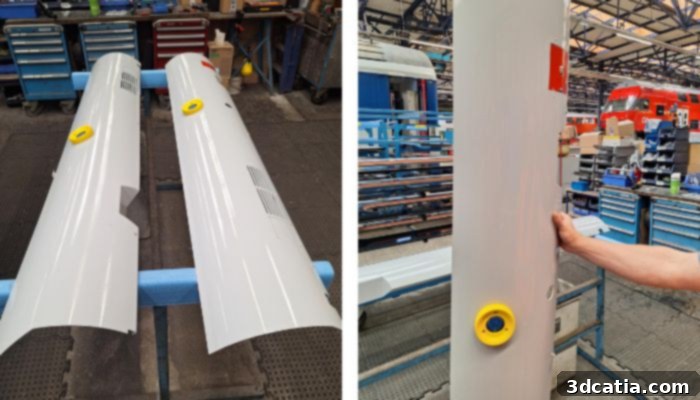
The vital retrofit ring, ensuring passenger safety, was manufactured in small quantities from the advanced flame-retardant material developed by TIGER Coatings, meeting all EN 45545 requirements. (photo credits: TIGER Coatings)
Based in Wels, Austria, TIGER Coatings brings over five decades of invaluable experience and profound expertise in polymer science and technology to the forefront of the additive manufacturing industry. More than just a 3D printing service provider, TIGER Coatings stands out as a visionary material developer, offering a cutting-edge portfolio of innovative materials under its TIGITAL® 3D brand. These specialized materials are designed for advanced additive manufacturing systems, including Selective Laser Sintering (SLS) and Carbon Fiber-reinforced Additive Manufacturing (CBAM) printing. This dual capability—both a material developer and a service provider—positions TIGER Coatings uniquely to address the complex needs of industries requiring highly specialized and certified components.
The TIGITAL® 3D portfolio for SLS 3D printing encompasses various distinct series, each meticulously engineered to unlock specific high-performance application fields through their extraordinary properties. Among these, the HPP series (High Performance Polymers) is distinguished by its exceptional rigidity and improved print quality, making it ideal for structural components that demand high mechanical strength and precision. The Top Performance Polymer series (TPP) offers UV-resistant and insulating materials, finding critical applications in sensitive areas such as transportation and electronics, where environmental resilience and electrical insulation are paramount. However, for direct application in the rail industry, the PPP series (Premium Performance Polymers) is of particular and indispensable relevance.
These Premium Performance Polymers are engineered to meet the most stringent international and European standards for fire protection, making them exceptionally suitable for use in public transport. Beyond mere compliance, the flame-retardant materials within the PPP series are not only comprehensively EN-45545 certified across various hazard levels but also hold the prestigious UL 94-V0 certification. This latter certification is particularly significant, as it indicates that the material, when tested, stops burning within 10 seconds after two applications of a flame, and no flaming drips are produced. What truly sets TIGER Coatings’ material apart in the additive manufacturing landscape is its unique achievement: it is currently the *only* material in the world capable of meeting the rigorous UL 94-V0 standard with a wall thickness of just 2 mm for SLS-printed parts. This remarkable characteristic is critical for applications where lightweight design and minimal material usage are essential without compromising fire safety. It was precisely this unparalleled material that was chosen and successfully utilized to 3D print the baby carriage safety retrofit rings for Austrian trains, providing an innovative and fully compliant solution for a critical safety component.
TIGITAL® 3D Materials: Driving Innovation in SLS 3D Printing for Rail
The choice of Selective Laser Sintering (SLS) as the manufacturing process for the ÖBB components was highly strategic, proving to be an exceptionally suitable method due to its inherent advantages. SLS is renowned for its outstanding productivity, high reproducibility of parts, exceptional precision, and superior dimensional accuracy, making it ideal for producing complex geometries with consistent quality. These characteristics were perfectly aligned with the demanding requirements of the rail industry. With its existing range of EN 45545 certified TIGITAL® 3D materials, TIGER Coatings already fulfilled one of ÖBB’s most crucial criteria for this specialized order, demonstrating their proactive approach to developing industry-compliant solutions. The partnership not only addressed a specific need but also showcased the potential for additive manufacturing in critical infrastructure.
While the benefits of the SLS process are numerous, those familiar with additive manufacturing are also aware of the often-significant costs associated with it. SLS powder, particularly high-performance variants like those required for EN 45545 compliance, can be quite expensive. Therefore, a critical advantage for economic viability is the ability to efficiently reuse a substantial proportion of the non-sintered powder from each build. This factor directly impacts material consumption and overall production costs. The material portfolio offered by TIGER Coatings excels in this regard, boasting an impressively high re-use rate for its residual powder. Crucially, this high re-use capability does not come at the expense of material integrity; the processed powder consistently retains its key properties, including essential flame retardancy, UV protection, and mechanical strength, through multiple cycles. This innovative approach to material utilization significantly reduces waste and makes SLS 3D printing a more sustainable and cost-effective option for industrial applications, even for highly specialized, certified parts.
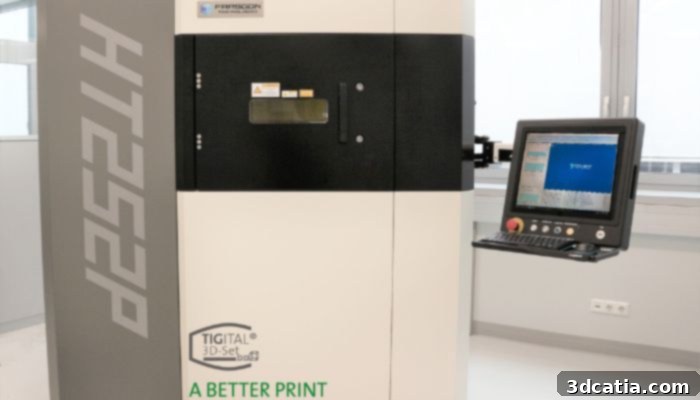
TIGER Coatings leveraged the precision and efficiency of a Farsoon HT252P printer to produce the highly specialized spare parts, demonstrating a close working relationship with the machine manufacturer. (photo credits: TIGER Coatings)
For the production of the critical baby carriage safety retrofit rings, TIGER Coatings utilized the advanced HT252P printer from Farsoon, a company with which it maintains a close and collaborative working relationship. This synergy between material developer and machine manufacturer ensures optimized printing parameters and superior part quality. A total of 110 parts were meticulously produced for ÖBB, demonstrating the efficiency and scalability of this additive manufacturing approach for small-to-medium batch production. Furthermore, all necessary post-processing – a vital step in achieving final part specifications and aesthetics – was expertly conducted in-house at TIGER Coatings. This integrated approach ensures complete quality control from material selection to final product. Although the parts were initially printed in black, TIGER Coatings’ extensive background as a leading powder coating manufacturer provided a unique advantage. This expertise allowed them to offer components that could be seamlessly coated with multifunctional, durable coatings in a wide array of colors. This capability is crucial for aesthetic integration within train interiors and for adding further protective layers, highlighting TIGER Coatings’ holistic approach to component manufacturing.
The manufactured retrofit rings are now being successfully installed in ÖBB’s 8633 commuter double-decker reversible train. Their primary function is to actively prevent the unintended opening of doors by baby carriages, thereby significantly enhancing passenger safety. This specific component stands as a prime example of the successful application of TIGITAL® 3D material, showcasing its suitability not only for this particular safety ring but also for a broader range of similar critical components within rail vehicles. These could include ventilation grilles, robust housings for electronic systems, ergonomic handles, custom brackets, and various other spare parts that require precise geometries and high performance. The demand from rail operators for small quantities of parts, often featuring complex geometries or requiring individual, customized dimensions, is consistently increasing. Traditional manufacturing methods often struggle to meet these demands cost-effectively or with the necessary speed. Additive manufacturing, combined with TIGER Coatings’ certified TIGITAL® 3D material, provides the perfect solution, enabling rapid production of tailor-made components that fully comply with existing safety standards like EN 45545, thus streamlining maintenance and upgrades for modern rail fleets.
While rail vehicles represent a significant and impactful area of application, the potential for TIGITAL® 3D materials extends far beyond this sector. In a continuous drive for innovation, TIGER Coatings is actively committed to further enhancing its material portfolio. Future developments aim to achieve even higher temperature stability and increased elasticity, pushing the boundaries of material performance. These advancements are expected to unlock entirely new fields of application across diverse industries, including aerospace, automotive, and various industrial sectors where extreme conditions and specific mechanical properties are required. By continually refining their materials, TIGER Coatings is not only solving current industry challenges but also actively shaping the future of high-performance additive manufacturing. To explore more about the company’s groundbreaking materials, services, and ambitious future plans, you can find detailed information HERE.
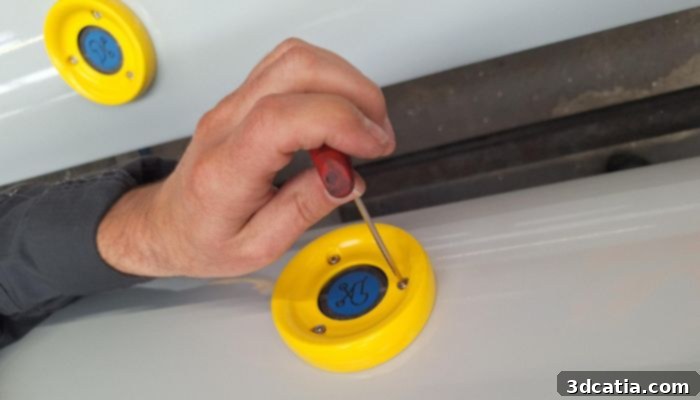
The precisely manufactured part effectively prevents the buttons for opening the doors, strategically placed next to baby carriages in Austrian trains, from being accidentally pushed, significantly enhancing passenger safety. (photo credits: TIGER Coatings)
What are your thoughts on TIGER Coatings and their innovative flame-retardant materials for additive manufacturing? We invite you to share your insights and opinions in a comment below, or connect with us on our LinkedIn, Facebook, and Twitter pages! Don’t miss out on the latest advancements and news in the 3D printing industry; remember to sign up for our free weekly newsletter here to receive updates directly in your inbox. Additionally, you can find all our engaging videos and comprehensive content on our YouTube channel.
*Cover Photo Credits: Double-decker push-pull train (DOSTO) at the platform, ÖBB – Harald Eisenberger