
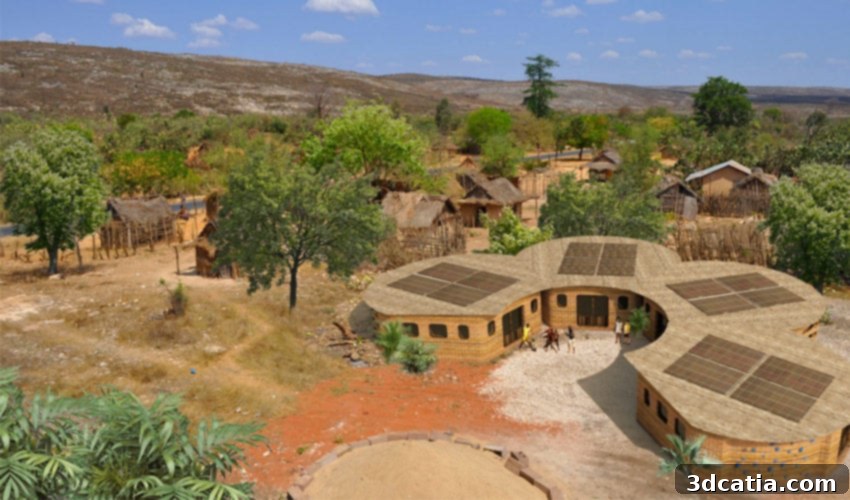
Thinking Huts: Pioneering 3D Printed Schools to Bridge the Global Education Gap
Thinking Huts stands at the forefront of a global movement, passionately committed to revolutionizing access to education through the innovative application of 3D printing technologies. This ambitious non-profit organization envisions a world where a lack of infrastructure no longer hinders a child’s right to learn. By leveraging the speed, efficiency, and sustainability of additive manufacturing, Thinking Huts aims to rapidly multiply the number of available educational infrastructures in underserved communities worldwide. Beyond merely constructing buildings, their holistic approach also seeks to ignite local economic growth by creating job opportunities and fostering skills development within these communities. Simultaneously, the initiative champions more ecological and sustainable construction practices, setting a new standard for humanitarian development.
Our previous coverage in January highlighted a significant milestone for Thinking Huts: the groundbreaking construction of their first pilot school. This pioneering project, located in Fianarantsoa, Madagascar, was slated to open its doors later that year, provided global health circumstances allowed. At the heart of this transformative organization is its visionary founder, Maggie Grout. Driven by an unwavering conviction in the immense potential of 3D printing, Maggie intends to expand this project of 3D printed schools far beyond Madagascar, aiming for a global reach. Her core philosophy is to seamlessly integrate high value-added technological solutions with profound humanitarian values, thereby empowering countless more children to access quality education. We recently had the privilege of sitting down with Maggie Grout to delve deeper into her inspiring vision and understand the future trajectory of Thinking Huts.
3DN : Can you introduce yourself as well as your link to Additive Manufacturing (AM)?
Hello, my name is Maggie Grout, and I am the founder and CEO of Thinking Huts. Our organization operates as a nonprofit with a singular, vital mission: to dramatically increase global access to education. We achieve this by deploying innovative, humanitarian-driven technology solutions, primarily leveraging the power of Additive Manufacturing (AM). In our context, AM translates directly into the construction of 3D printed schools, strategically placed within communities where the need for educational infrastructure is most critical. My personal connection to AM stems from a deep belief in its transformative capacity to solve real-world problems. I recognized early on that this technology wasn’t just about creating prototypes or small objects; it had the potential to revolutionize construction, particularly in environments facing significant resource and logistical constraints. This led to the fundamental idea of using AM to build durable, cost-effective, and rapidly deployable schools, thus directly linking my passion for education with cutting-edge technological innovation. Thinking Huts is the embodiment of this synthesis, employing AM as a powerful tool for social good.

Maggie Grout (photo credits: Thinking Huts)
3DN : How did the idea of creating Thinking Huts come about?
The initial spark for 3D printing schools ignited about six years ago, during a pivotal moment in my life. I was only 15 years old at the time, yet already deeply impassioned by a vision to significantly expand access to education globally. The concept didn’t emerge from a formal research project but rather from a casual yet profound conversation. I recall a particularly nostalgic moment spent in my dad’s office, where we were discussing the fascinating future of technology and its potential applications. It was during this discussion, envisioning the possibilities that advanced technologies like 3D printing could unlock, that I posed a seemingly simple yet ultimately groundbreaking question: “What if we 3D printed them?” – referring, of course, to schools. That single question served as the conceptual genesis of Thinking Huts. It wasn’t just a fleeting thought; it represented a sudden realization of how an emerging technology could directly address a pressing humanitarian challenge. From that day forward, the idea took root and began to grow, evolving into the comprehensive mission that defines Thinking Huts today: transforming the landscape of educational infrastructure through innovative 3D printing.
3DN : Why did you turn to 3D printing to create your schools?
I firmly believe that 3D technologies offer a multitude of advantages, extending far beyond the traditional boundaries of manufacturing and into critical sectors like construction. In the specific context of Thinking Huts, 3D printing provides an unparalleled suite of benefits that directly address the challenges of building educational infrastructure in underserved regions. Firstly, it allows us to construct significantly more schools in substantially less time. Traditional construction methods are often slow, labor-intensive, and susceptible to logistical delays, especially in remote areas. 3D printing bypasses many of these bottlenecks, enabling rapid deployment and quicker access to learning environments for children.
Secondly, and critically for a non-profit operating in resource-scarce environments, 3D printing demonstrably reduces overall construction costs. This cost-efficiency is achieved through several factors: optimized material usage minimizing waste, reduced labor hours for structural elements, and a streamlined construction process that requires fewer specialized tools on-site. The financial savings allow us to allocate more resources directly to educational programs and build more schools with the same budget, maximizing our impact.
Finally, and perhaps most compellingly, the added benefit of 3D printing is its inherent sustainability compared to conventional construction methods. By precisely depositing materials layer by layer, we generate significantly less waste. Furthermore, the technology opens doors to utilizing innovative, eco-friendly building materials, including modified concrete mixtures that emit less CO2, and in the future, potentially bio-based or recycled local materials. This commitment to sustainable practices ensures that while we are building for the future of education, we are also protecting the planet for future generations. The combination of speed, cost-effectiveness, and environmental responsibility makes 3D printing not just a viable option, but the ideal solution for Thinking Huts’ mission.
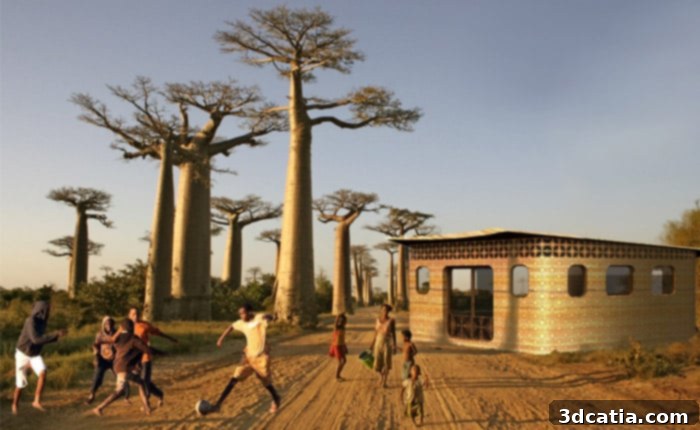
Thinking Huts’ first school will be in Madagascar (photo credits: Thinking Huts)
3DN : What are the challenges you face?
Navigating the landscape of innovative humanitarian projects comes with its unique set of hurdles, and for Thinking Huts, the greatest of these challenges primarily revolves around funding. Applying a high-growth, cutting-edge technology like large-scale 3D printing to humanitarian goals, especially in developing regions, requires significant initial investment. Securing this funding is complex because we’re not just building structures; we’re establishing a new paradigm for construction and education, which requires convincing donors and partners of the long-term viability and impact of this novel approach. We are constantly working to demonstrate the scalability and sustainability of our model to attract the necessary financial support to expand our reach.
Another significant challenge I’ve encountered is the widespread lack of awareness and understanding regarding 3D printing in the construction sector. Many people still associate 3D printing exclusively with desktop-sized machines creating small, plastic-based objects. This perception makes it difficult for some to conceptualize the architectural scale of 3D printing – the idea of printing entire buildings with concrete. Educating the public, potential partners, and even local communities about the robustness, safety, and permanence of 3D printed structures is a continuous effort. We invest considerable time in demystifying the technology and showcasing its capabilities to build trust and acceptance.
Furthermore, for Thinking Huts, a core aspect of our mission is to create a genuine synergy between this advanced technology and the local communities we serve. This isn’t merely about dropping off a machine and printing a building. We are deeply committed to fostering local empowerment. This means actively seeking ways to employ local labor throughout the construction process, not just for the finishing touches but integrating them into various stages where their skills can be developed and utilized. Our goal is to involve the economies of these developing communities directly, providing training and opportunities that support technology transfer and skill-building. This approach ensures that the impact of Thinking Huts is not just the physical school, but also the lasting economic and educational benefits for the people living there. It’s a delicate balance of introducing advanced tech while ensuring it genuinely serves and uplifts the community.
3DN : What are the specifications for 3D printed schools from Thinking Huts?
Our first prototype, a single classroom unit which we affectionately call a “Hut,” will be approximately 765 square feet. This design is intentionally conceived as a hybrid model, combining the robust structural integrity offered by 3D printed concrete walls with other components meticulously crafted from locally-sourced materials. This hybrid approach ensures both efficiency and integration with local economies and building practices. The concrete mixture we employ for the 3D printed walls is not just standard material; it’s a specially modified compound formulated to emit significantly less CO2 during its production and application, which is of paramount importance to our environmental objectives. This commitment to reducing our carbon footprint underscores our dedication to sustainable development.
Looking ahead, as material science continues to advance and evolve, we hold a strong aspiration to transition towards even more sustainable alternatives. Our vision is to adapt our material palette based upon the indigenous resources and sustainable materials available in the local environment of future project sites. This iterative approach allows us to remain flexible and continuously improve our ecological impact. We forecast that the core structural elements of one of these schools will take less than a week to build, demonstrating the incredible speed and efficiency of our 3D printing method. While we have estimated timelines, we will acquire a precise number of hours and a more refined understanding of the construction process once we complete our pilot school in Madagascar, which we are planning to build in the second half of this year, contingent on the global pandemic situation. This pilot project is crucial for gathering essential data, optimizing our processes, and proving the scalability and effectiveness of our innovative building methodology.
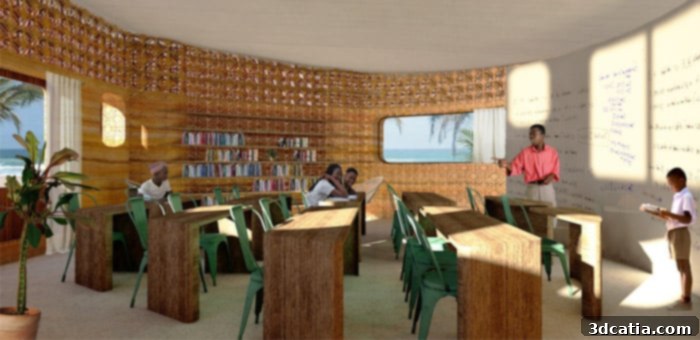
A future classroom (photo credits: Thinking Huts)
3DN : What are Thinking Huts’ future projects?
Following the successful completion and evaluation of our pilot school, we are already charting an ambitious course for expansion within Madagascar. Our immediate plans involve building three more schools in a more rural commune known as Ibity. This expansion will allow us to further refine our processes, adapt to varying local conditions, and solidify our presence in Madagascar. Beyond this initial pilot phase, our commitment to Madagascar remains strong; we will continue building our innovative 3D printed schools in close partnership with communities across the island, ensuring each project meets specific local needs and fosters genuine community ownership.
However, our larger vision extends significantly beyond Madagascar. We are driven by the ambition to scale up our operations around the world, taking the proven model of 3D printed schools to other regions grappling with educational infrastructure deficits. It is incredibly encouraging and exciting to already be receiving considerable partnership interest from various organizations and individuals in countries such as Zimbabwe, Malawi, Pakistan, India, and South Africa. This global interest validates our approach and highlights the universal need for rapid, sustainable, and cost-effective educational solutions. These expressions of interest are not just inquiries; they represent potential avenues for collaborative impact, allowing us to leverage local expertise and resources while deploying our innovative construction technology. Our future projects will focus on building robust partnerships, conducting thorough needs assessments, and adapting our designs to suit diverse cultural and environmental contexts, all with the ultimate goal of bringing quality education to every child, everywhere.
3DN : Any last words for our readers?
My final words are both an aspiration and a call to action. I sincerely hope that we will witness a significant increase in women in leadership roles, especially within traditionally male-dominated technology industries like 3D printing. Diversity in leadership brings varied perspectives, fosters innovation, and ultimately leads to more equitable and effective solutions for global challenges. The insights and leadership that women bring are invaluable, and empowering them in these fields will only accelerate progress. By working together, embracing diversity, and combining our unique strengths and visions, we truly can create a profound and lasting global impact. Every individual contribution, whether through support, advocacy, or direct involvement, adds to this collective effort. I encourage everyone to learn more and make sure to support the project HERE. Your engagement is vital to our mission.
What are your thoughts on the groundbreaking work of Thinking Huts and their innovative approach to education? Let us know your opinions and insights in a comment below, or join the conversation on our vibrant social media platforms: Facebook, Twitter, and LinkedIn pages! Don’t miss out on the latest advancements and breaking news in the additive manufacturing sector; sign up for our free weekly Newsletter here to receive the freshest 3D printing news delivered straight to your inbox!