
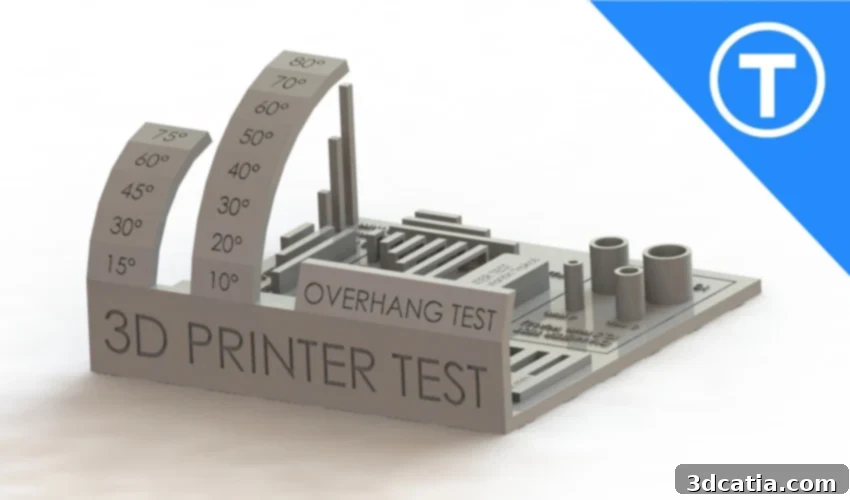
Thingiverse: Your Premier Free Hub for 3D Printing Models and Digital Designs
For anyone immersed in the fascinating world of additive manufacturing and 3D printing, the name Thingiverse resonates deeply. It stands as a pivotal online platform, hosting millions of diverse 3D files contributed by a continuously expanding global community of users. These meticulously crafted models are readily exportable in the ubiquitous STL format, enabling effortless printing on virtually any 3D printer. The vast majority of these designs are protected by Creative Commons licenses, fostering an environment of sharing and collaboration. Thingiverse has undeniably cemented its position as one of the most significant file-sharing sites within the 3D printing ecosystem. Its popularity is further amplified by a vibrant user community that actively engages through liking, commenting on, and providing detailed descriptions for 3D models. Crucially, the platform owes much of its widespread appeal to being entirely free to use, making it an indispensable resource for both seasoned professionals and budding enthusiasts in the 3D printing domain.
Thingiverse embarked on its journey in November 2008, a brainchild of Zach Smith, forged in collaboration with MakerBot, a prominent manufacturer of FDM 3D printers. In 2013, MakerBot, along with Thingiverse, was acquired by the industry giant Stratasys, signaling the platform’s strategic importance. Over more than a decade, Thingiverse has amassed an astonishing repository of millions of files, encompassing an eclectic mix of functional gadgets, practical tools, essential spare parts, and even whimsical toys and intricate figurines. It’s vital to recognize that Thingiverse’s utility extends beyond the confines of the additive manufacturing market. Its evocative tagline, “Digital Designs for Physical Objects,” perfectly encapsulates its expansive scope. While 3D printing is the primary method for bringing these digital designs to life, other design and fabrication techniques, such as laser cutting, CNC machining, or even traditional crafting, can also be employed to create the downloaded models. This broad appeal is precisely why the platform attracts a diverse array of makers, DIY enthusiasts, educators, and hobbyists from all walks of life. However, confining the Thingiverse community solely to DIY enthusiasts would be an oversight. The platform features a dedicated section geared towards education, offering numerous projects specifically designed to introduce novices to the principles and practices of 3D printing, catering to users of all ages and experience levels.
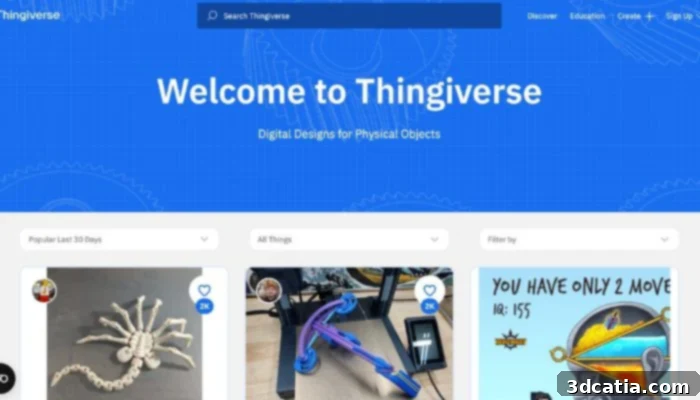
Thingiverse provides free access to a vast library of 3D models.
How to Access and Download Free STL Files on Thingiverse
To unlock the full potential and comprehensive functionalities of the Thingiverse database, creating a user account is highly recommended, though not strictly required for basic browsing. The good news is that this account creation process is entirely free, requiring only a few simple steps. Once registered, users gain the ability to personalize their experience: they can save their own uploaded 3D files, meticulously organize their design collections, mark favorite models for easy retrieval, and, of course, effortlessly download any of the millions of models they wish to produce. Each 3D file page on Thingiverse is a treasure trove of information designed to facilitate a successful print. You’ll typically find high-quality photos of the final printed part, invaluable printing advice (such as recommended extrusion temperature, bed adhesion methods, print speed settings, and infill percentages), and often the specific model of the 3D printer used by the creator. This holistic approach ensures that the community has all the necessary details at their fingertips. Furthermore, to streamline the entire process, the creators of most 3D models generously provide step-by-step instructions and crucial tips, ensuring that the printing experience is as smooth and trouble-free as possible for users, minimizing common pitfalls and maximizing success rates.
Thingiverse meticulously organizes its vast collection of 3D models into several intuitive categories, which are intended to simplify the search process for users. These include categories like 3D printing itself, art, fashion, practical gadgets, various hobbies, household items, learning resources, complex models, essential tools, and engaging toys and games. However, despite this categorization, users sometimes report difficulties in locating precisely what they’re looking for. This can be attributed to various factors, such as inconsistent tagging by creators, models being poorly referenced, or even designs that are defective or incomplete upon download. Consequently, a search query might yield files that are not entirely relevant to the initial request or that are simply deficient in quality, requiring users to sift through results more thoroughly. To mitigate these challenges, seasoned Thingiverse users often recommend employing very specific keywords, exploring user-curated collections, and checking the “Makes” section on model pages to see successful prints by others, which can be an indicator of a quality design.
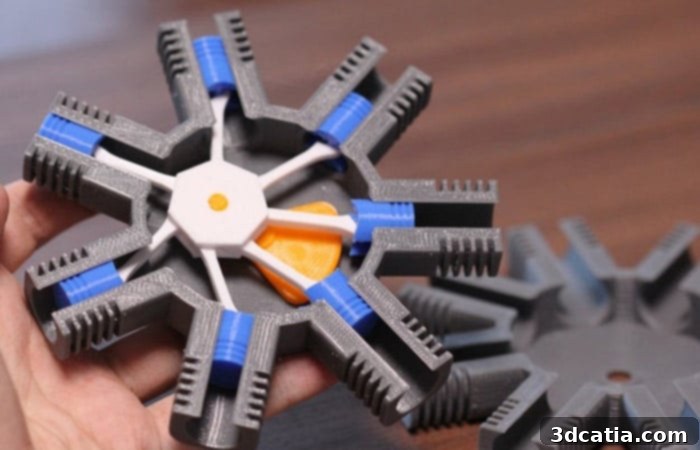
Thingiverse offers a wide range of 3D models, from simple to highly complex designs. (Photo Credit: Thingiverse)
The Open-Source Philosophy of Thingiverse: Benefits and Challenges
From its very inception, the open-source ethos has been a foundational pillar of Thingiverse. This philosophy champions the idea that anyone can freely upload their 3D files for the community, and equally, anyone can download them, provided they adhere to the specified Creative Commons licenses when present. In principle, this approach is overwhelmingly positive, fostering an unparalleled environment of sharing, encouraging immense creativity, and driving rapid innovation across the 3D printing landscape. It democratizes access to design, allowing hobbyists, students, and professionals alike to experiment, learn, and build without proprietary barriers. The sheer diversity of designs, from highly functional prototypes to artistic sculptures, truly showcases the power of a collaborative, open community.
However, this extreme openness also introduces certain inherent challenges. One significant concern revolves around quality control: since anyone can upload, there’s often no rigorous verification process to ensure that a file is truly 3D printable, structurally sound, or designed efficiently. Users might download models only to discover they are riddled with errors, poorly optimized for printing, or simply unprintable. Additionally, Thingiverse hosts an immense database, now exceeding 1.7 million 3D models, which, while impressive, can make the selection process daunting. Navigating this vast ocean of designs to find a high-quality, relevant model can be a time-consuming task. Logically, within such an expansive database, the issue of duplicates is prevalent, further complicating searches and contributing to clutter. Another point to consider is the platform’s primary language: the site is predominantly in English, which can present a language barrier for a significant portion of the global maker community, potentially limiting its accessibility and full utilization for non-English speakers.
Thingiverse in Education and the Global Maker Community
Thingiverse’s impact on education and the broader maker community is profound. Its dedicated education section provides invaluable resources for teachers looking to integrate 3D printing into their curricula, offering lesson plans and age-appropriate projects that inspire students to learn about design, engineering, and digital fabrication. From elementary school children exploring basic shapes to university students working on complex prototypes, Thingiverse serves as a practical, hands-on learning tool. Beyond formal education, the platform empowers individual learners and hobbyists to acquire new skills, fostering a culture of self-directed learning and experimentation. The vibrant community aspect further enriches this educational environment; users frequently engage in discussions, offer troubleshooting advice, share successful “Makes” of others’ designs, and even remix existing models to create improved or personalized versions. This collaborative spirit transforms Thingiverse into more than just a file repository—it becomes a living, breathing network where knowledge is shared freely, and collective creativity thrives, pushing the boundaries of what’s possible with desktop manufacturing.
Exploring Alternatives to Thingiverse for Your 3D Printing Needs
While Thingiverse remains the largest and most widely recognized database for free 3D printable files, the evolving landscape of additive manufacturing has given rise to several compelling alternatives. These platforms cater to diverse needs and preferences, offering different models for content curation, licensing, and access. For instance, sites like Cults3D and MyMiniFactory often feature a more curated selection of high-quality designs, many of which are premium (paid) models, alongside a selection of free ones. These platforms typically implement stricter quality control measures, ensuring that downloaded files are print-ready and accurately represented. PrusaPrinters, operated by Prusa Research, offers a robust community platform with an excellent system for users to share print settings and “Makes,” often providing a high degree of reliability due to its strong association with a leading 3D printer manufacturer. Other platforms like YouMagine maintain a strong commitment to open-source principles, similar to Thingiverse, but sometimes with a different user experience or community focus. While not all alternatives will be completely free, exploring these options allows users to compare various approaches to 3D file sharing, potentially finding models with higher guaranteed quality, better support, or specific design aesthetics that align more closely with their individual projects. Understanding these differences can help makers make informed choices about where to source their next 3D printing design.
Tips for Maximizing Your Thingiverse Experience
To truly get the most out of your time on Thingiverse, a few best practices can significantly enhance your experience. Firstly, always take the time to read the comments section on any model you’re considering. Fellow users often share invaluable insights, troubleshooting tips, successful print settings, or even highlight potential issues with the design. Secondly, explore the “Makes” tab; this section showcases actual prints of the model by other users, providing visual proof of concept and demonstrating variations in materials or printer settings. This is often the best indicator of a design’s printability and quality. Thirdly, familiarize yourself with the Creative Commons licenses associated with each model. Understanding whether a design can be used for commercial purposes, modified, or requires attribution is crucial for respecting intellectual property rights and ensuring ethical use. Finally, consider contributing back to the community. Whether it’s uploading your own designs, sharing your successful “Makes” with photos and print settings, or offering helpful advice in the comments, active participation enriches the platform for everyone.
The Future of Thingiverse and 3D Printing
As 3D printing technology continues its rapid evolution, so too will platforms like Thingiverse. While it has faced its share of challenges over the years, its enduring legacy as the largest free database of 3D models is undeniable. The future may see enhanced AI-driven search capabilities, improved quality control mechanisms through community moderation or automated checks, and perhaps a more multilingual interface to truly serve its global audience. As 3D printers become more accessible and sophisticated, the demand for high-quality, user-friendly digital designs will only grow, ensuring that platforms that foster community and open-source collaboration remain vital to the additive manufacturing ecosystem. Thingiverse’s role as a democratizer of design and a catalyst for innovation will likely continue to shape how we conceive, create, and share physical objects in the digital age.
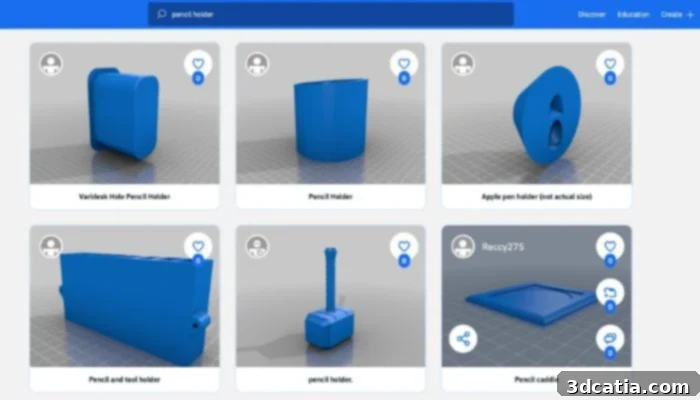
We encourage you to visit the Thingiverse platform today to explore its vast collection and discover your next favorite 3D models! Do you regularly use Thingiverse for your 3D printing projects? We’d love to hear about your experiences – share your thoughts in a comment below or connect with us on our Linkedin, Facebook, and Twitter pages! Don’t forget to sign up for our free weekly Newsletter here to get the latest 3D printing news delivered straight to your inbox! You can also find all our engaging videos and tutorials on our YouTube channel.