
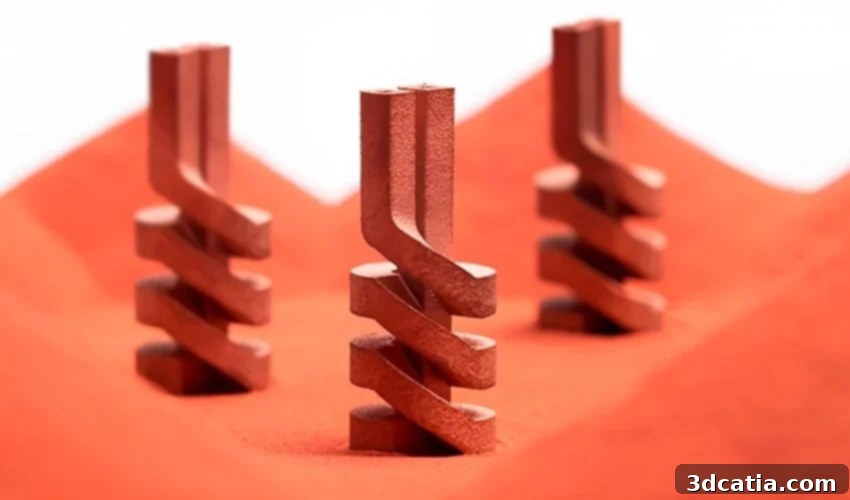
The Ultimate Guide to Copper 3D Printing: Properties, Technologies, and Advanced Applications
Recognized for its distinctive reddish-orange luster and exceptional physical characteristics, copper (Cu) stands as a foundational metal across countless industries. Its unparalleled electrical and thermal conductivity, combined with remarkable ductility and malleability, make it indispensable for applications ranging from sophisticated electronics to robust industrial components. The advent of 3D printing technology has opened new frontiers for copper, enabling the creation of intricate, customized designs with unprecedented complexity and functionality. This comprehensive guide delves into the unique properties of copper, explores its transformative benefits in additive manufacturing, details the various 3D printing technologies compatible with this versatile metal, highlights its diverse applications, and introduces the leading manufacturers driving innovation in the market. Discover how copper 3D printing is revolutionizing product development and enabling advanced engineering solutions.
Understanding Copper: Material Characteristics and Significance
Copper, denoted by the chemical symbol Cu and atomic number 29, is a transition metal celebrated for its extraordinary performance. Ranking as the third most widely utilized metal globally, surpassed only by iron and aluminum, copper’s significance continues to grow, particularly within the realm of additive manufacturing. Its widespread adoption is primarily attributed to its outstanding intrinsic properties. Foremost among these is its superior electrical conductivity, second only to silver, making it a critical material for electrical wiring, circuitry, and a vast array of electronic components. Furthermore, copper boasts excellent thermal conductivity, efficiently transferring heat, which is vital for thermal management solutions. Its inherent ductility allows it to be drawn into thin wires without breaking, while its malleability means it can be hammered or rolled into thin sheets without fracturing. These combined attributes make copper an ideal candidate for creating high-performance parts through advanced manufacturing processes like 3D printing.
Key Copper Alloys for Additive Manufacturing
While pure copper offers exceptional properties, various copper-based alloys are often employed in 3D printing to fine-tune characteristics for specific applications. These alloys introduce subtle yet significant variations in mechanical strength, corrosion resistance, or processability. Below, we outline some of the most common copper alloys used in additive manufacturing and their distinct features:
- Cu (Pure Copper): Revered for its unsurpassed electrical and thermal conductivity, pure copper is the preferred choice for applications where maximum conductive efficiency is paramount, such as high-performance electrical connectors, induction coils, and heat exchangers. Its high reflectivity can pose challenges in some laser-based 3D printing processes, necessitating specialized machine parameters.
- CuCrZr (Copper-Chromium-Zirconium): This alloy significantly enhances the mechanical properties of copper, particularly improving resistance to deformation at elevated temperatures and increasing hardness. It is frequently chosen for parts requiring both high conductivity and robust mechanical integrity, such as welding electrodes and certain aerospace components.
- CuCP (Phosphorized Copper): By introducing phosphorus, this alloy gains superior corrosion resistance and maintains good ductility. It is often used in applications exposed to harsh environments or requiring improved castability in traditional manufacturing, and its benefits extend to additive manufacturing for similar corrosive resistance needs.
- CuSn (Tin-Plated Copper / Bronze): Also known as bronze, tin-plated copper alloys improve both corrosion resistance and hardness compared to pure copper. These alloys are often used in bearings, gears, and electrical connectors where wear resistance is critical alongside good conductivity.
- CuNi30 (Copper-Nickel 30): Containing 30% nickel, this alloy offers substantially improved corrosion resistance, especially in marine environments, and enhanced mechanical properties, including higher tensile strength and fatigue resistance. It is ideal for naval architecture, offshore applications, and high-stress components in demanding industrial settings.
From Raw Ore to 3D Printing Material: The Copper Supply Chain
The journey of copper from its natural state to a material suitable for advanced additive manufacturing is a complex, multi-stage process. It typically begins in vast open-pit or underground mines, where copper ore—rock containing copper minerals—is extracted from the earth. Once mined, the ore undergoes initial processing: it is crushed and ground into fine particles, a crucial step that liberates the copper-bearing minerals from other inert rocks. This reduction in particle size maximizes the surface area for subsequent chemical and physical separation processes.

Copper powder, a key feedstock for metal 3D printing technologies (photo credits: Inoxia)
Following comminution, a series of sophisticated metallurgical processes are employed to refine the copper. These include concentration (often flotation), smelting (melting to separate the copper from impurities), and electrochemical refining (electrolytic purification to achieve very high purity levels). It is during these advanced transformation stages that the raw ore is converted into metallic copper and its various alloys, with carefully controlled degrees of purity. For additive manufacturing, this refined copper is then processed into specific forms: extremely fine metal powders (for powder bed fusion and binder jetting) or precisely manufactured wires (for directed energy deposition and certain extrusion-based systems). The consistency and quality of these feedstocks are paramount for achieving high-quality 3D printed copper parts.
The Dynamic World of Copper 3D Printing: Benefits and Challenges
Additive manufacturing with copper presents a unique blend of remarkable opportunities and specific technical challenges. On the benefits side, copper’s inherent corrosion resistance is a significant advantage, extending the lifespan of 3D printed parts, particularly in aggressive or humid operating environments. When processed with optimized parameters, 3D printed copper components can achieve competitive mechanical properties, including desirable levels of hardness and wear resistance, allowing them to withstand demanding operational conditions. Furthermore, 3D printing unlocks unprecedented design freedom, enabling the creation of complex internal geometries, intricate lattice structures, and optimized topological designs that are impossible with traditional manufacturing methods. This capability is particularly valuable for enhancing the performance of heat exchangers, electrical components, and custom tooling by maximizing surface area or optimizing fluid flow paths.
However, copper 3D printing also comes with its share of difficulties that require careful consideration and specialized approaches. Copper’s extremely high thermal conductivity, while a key advantage in end-use applications, can complicate the additive manufacturing process. During cooling, rapid heat dissipation can lead to significant thermal gradients, potentially causing internal stresses, warping, and dimensional inaccuracies in parts. Another challenge, especially for laser-based systems, is copper’s high reflectivity to common laser wavelengths (like those used in L-PBF), which can lead to inefficient energy absorption and difficulties in achieving full material fusion and dense parts. Additionally, copper’s relatively low melting point compared to many other metals used in AM can necessitate precise temperature control to prevent over-melting or insufficient layer bonding. Oxidization during processing also needs to be meticulously managed, often requiring inert gas atmospheres, to maintain material purity and part quality. Despite these hurdles, ongoing research and development by manufacturers and researchers are continuously advancing techniques to effectively mitigate these challenges, making copper 3D printing an increasingly viable and valuable manufacturing solution for critical industries.
Key 3D Printing Technologies for Copper
The versatility of additive manufacturing has led to the development of several compatible technologies for processing copper and its alloys. The most prevalent methods typically involve powder-based systems, though wire and liquid-based approaches are also gaining traction. Each technology offers distinct advantages and is suited for different application requirements:
Powder Bed Fusion (L-PBF, DMLS, SLM)
Metal powder bed fusion, encompassing technologies such as Laser Powder Bed Fusion (L-PBF), Direct Metal Laser Sintering (DMLS), and Selective Laser Melting (SLM), is a cornerstone of metal additive manufacturing. These processes are widely employed to produce high-density, strong, and precise final parts and prototypes from a broad spectrum of metal alloys, including specialized copper variants. In L-PBF, a high-power laser selectively melts layers of fine metal powder based on a digital design, fusing particles together to form a solid object. The quality, strength, and density of parts produced by this technology often surpass those achieved through traditional metalworking techniques. For copper, advancements in laser technology (e.g., green or blue lasers with better absorption by copper) and sophisticated process controls are helping to overcome the material’s high reflectivity and thermal conductivity, enabling the reliable production of complex, high-performance copper components.
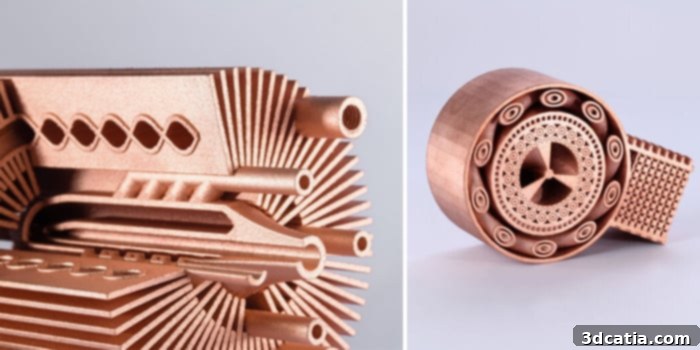
Intricate 3D-printed copper parts, demonstrating the capabilities of additive manufacturing (photo credits: EOS)
Electron Beam Melting (EBM)
Electron Beam Melting (EBM) is another powerful powder bed fusion technique that utilizes a high-energy electron beam instead of a laser to melt and fuse metallic powders. Operating in a vacuum environment, EBM is particularly well-suited for processing reactive metals and alloys with high melting points. For copper alloys, EBM offers an alternative approach to L-PBF, often providing superior material integrity and reduced residual stresses due to its higher processing temperatures and preheating capabilities. This makes EBM an excellent option for high-end prototyping and small-series production of copper parts, especially where superior mechanical performance and material consistency are critical.
Binder Jetting
Binder jetting is a metal 3D printing technology that involves depositing a liquid binding agent onto a powder bed, layer by layer, to selectively bond metallic powder particles. Unlike powder bed fusion, binder jetting does not melt the metal, meaning the process does not contend with copper’s high reflectivity and thermal conductivity during printing. After printing, the “green” part (bound powder) must undergo post-processing, typically including debinding (removing the binder) and sintering (heating to densify the metal particles) in a furnace. While pure copper has traditionally been challenging to process to high density with binder jetting, several companies have developed proprietary binder and sintering solutions to achieve fully dense, high-quality copper components. This method offers significant advantages in terms of geometric freedom, scalability, and potentially lower cost per part compared to laser-based methods, making conductive metal part production more accessible.
Directed Energy Deposition (DED)
Directed Energy Deposition (DED) is a versatile additive manufacturing process where material is fed into a melt pool created by a focused energy source (laser or electron beam) as it is deposited. Depending on the specific DED machine, the feedstock can be either metal powder or wire. A key distinguishing feature of DED is its ability to add material through a real-time melting process, allowing for exceptional flexibility in creating complex geometries, repairing existing high-value components, and even applying metallic coatings. For copper, DED enables the creation of large-scale parts and hybrid manufacturing applications where copper features can be added to existing structures or repaired, offering significant cost savings and extending the lifespan of critical components in industries like aerospace and heavy machinery.
Emerging Technologies: Extrusion and Vat Photopolymerization for Copper
While commonly associated with polymers, two other additive manufacturing technologies – extrusion 3D printing (FFF/FDM) and vat photopolymerization – have seen innovative adaptations for processing copper. For extrusion-based systems, companies like Markforged have pioneered solutions that enable the creation of metal parts using specialized metal composite filaments. Their Metal X system, for instance, utilizes an FFF 3D printer to extrude metal powder encapsulated within a plastic binder, depositing it layer by layer. After printing, these “green” parts undergo a crucial post-processing sequence involving washing to remove primary binder and then sintering in a furnace. This thermal treatment removes the remaining binder and consolidates the metal powder, resulting in a fully dense, functional copper part with all its desired properties. This approach offers a more accessible and often safer way to produce metal components.
Similarly, vat photopolymerization, traditionally used for resins, has been adapted by innovative companies for metal additive manufacturing. Companies such as Holo, Admatec, and Incus have developed specialized metal 3D printers that utilize liquid lithography manufacturing principles. These systems employ a photosensitive resin loaded with fine copper powder. A light source (laser or projector) selectively cures the resin, solidifying layers of the powder-resin mixture. After printing, the parts undergo similar debinding and sintering steps as binder jetting or Markforged’s process to achieve fully metallic, dense copper components. These emerging technologies are expanding the accessibility and application range of copper 3D printing, especially for parts requiring fine detail and complex geometries.
Main Applications of 3D Printed Copper
Given copper’s outstanding properties, particularly its superior thermal and electrical conductivity, 3D printed copper parts are finding extensive applications across a multitude of high-tech industries. The ability to create custom, geometrically optimized components through additive manufacturing significantly enhances performance in many of these areas.
One of the most prominent application areas is in components requiring exceptional electrical conductivity. Many companies leverage 3D printed copper to produce highly efficient parts such as induction coils, which benefit from optimized geometries for improved electromagnetic fields; motor windings for electric vehicles, where intricate designs can lead to increased power density and efficiency; electromagnetic coils used in various sensing and actuation systems; precise waveguides for high-frequency electronics; and advanced antennas that require complex, integrated forms for superior signal transmission and reception. The freedom to design internal cooling channels or complex geometries within these parts further enhances their electrical performance by managing heat effectively.
Beyond electrical applications, copper is invaluable for thermal management and heat exchange components. Its high thermal conductivity makes it an ideal material for cooling plates, heat sinks with optimized fin geometries for maximum surface area, and highly efficient heat pipes. These 3D printed components are crucial in dissipating heat from sensitive electronics, high-power devices, and industrial machinery, preventing overheating and improving overall system reliability. Examples include advanced temperature exchangers, specialized cooling devices for high-performance computing, and conformal cooling mold inserts that enhance injection molding processes by providing uniform and efficient cooling. The ability to create internal structures like lattice infills further boosts heat transfer efficiency in these applications.
Finally, the aerospace and defense industries are increasingly adopting 3D printed copper for critical components. This metallic material is frequently utilized for propulsion systems, including rocket engine parts such as combustion chambers, nozzles, and igniters. In these extreme environments, copper’s ability to manage high temperatures and thermal stresses is paramount. Additive manufacturing allows for the integration of complex cooling channels directly into these components, significantly improving their performance, lifespan, and overall efficiency, contributing to lighter and more powerful aerospace systems.
Leading Innovators: Copper Materials and Machine Manufacturers
The rapid advancements in copper 3D printing are fueled by a robust ecosystem of companies specializing in both advanced copper alloys and compatible additive manufacturing solutions. Depending on the chosen 3D printing technology, copper is supplied in various forms, primarily as highly refined metal powders or precision-engineered wires. A number of leading material science companies offer a diverse portfolio of copper and copper alloy powders for the additive manufacturing market.
Copper Material Suppliers
Key players in the copper material supply chain include industrial giants like Sandvik, known for its high-quality metal powders tailored for additive manufacturing; Höganäs, a world leader in metal powders offering a range of copper-based materials; Safina, specializing in precious and non-ferrous metal products; and Mitsubishi Materials, a diversified materials company with a strong focus on advanced metal solutions. Additionally, some additive manufacturing machine builders like EOS, 3D Systems, and emerging companies such as Elementum, also develop and provide their own optimized copper alloys to ensure seamless compatibility with their printing systems and maximize part performance.
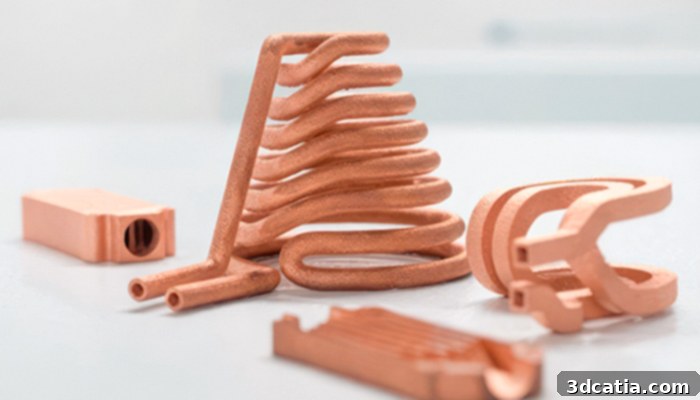
The market for copper 3D printing is rapidly expanding with numerous companies developing advanced alloys and compatible additive manufacturing solutions (photo credits: Beamler).
Manufacturers of Copper-Compatible 3D Printers
Beyond the material itself, a significant number of companies are at the forefront of developing sophisticated additive manufacturing machines capable of processing copper and its alloys. These innovators are crucial in making copper 3D printing accessible and effective. The aforementioned Markforged (with its Metal X system for extrusion of bound metal powder), Holo, Admatec, and Incus (pioneers in vat photopolymerization for metals), and 3D Systems (offering comprehensive metal AM solutions including DMLS and EBM) are key players. The landscape further includes renowned manufacturers such as Colibrium Additive (formerly GE Additive), known for its robust metal 3D printers; Desktop Metal, especially through its acquisition of ExOne, which offers leading binder jetting solutions; SLM Solutions, a specialist in selective laser melting; Renishaw, providing precision additive manufacturing systems; Optomec, a leader in directed energy deposition; and DMG Mori, a prominent machine tool builder expanding into metal additive manufacturing. The continuous innovation from these companies is pivotal to expanding the capabilities and industrial adoption of copper 3D printing.
Have you explored the potential of copper 3D printing in your projects? We’d love to hear about your experiences and insights! Share your thoughts in a comment below or connect with us on our LinkedIn, Facebook, and Twitter pages. Don’t miss out on the latest advancements in additive manufacturing – subscribe to our free weekly Newsletter here to get the freshest 3D printing news delivered straight to your inbox! You can also find all our engaging videos and educational content on our YouTube channel.
*Cover Photo Credits: GKN Powder Metallurgy