
Pioneering Space: Relativity Space’s Terran 1, The First 3D-Printed Rocket, Faces Launch Delays with Future Aspirations
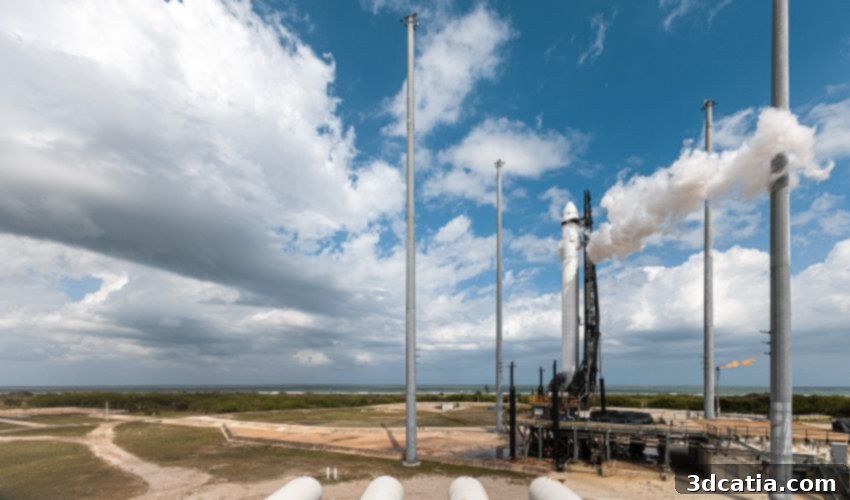
The world of space exploration is one of innovation, ambition, and often, nail-biting anticipation followed by unexpected delays. Such has been the recent experience for American aerospace company Relativity Space, whose groundbreaking Terran 1 rocket, heralded as the world’s first 3D-printed rocket, has faced multiple launch scrubs. Initially scheduled for March 8th from the iconic Cape Canaveral, Florida, this unmanned mission, aptly named GLHF (Good Luck, Have Fun), aimed to redefine rocket manufacturing and launch capabilities. Despite the initial disappointment of two scrubbed attempts – the first on March 8th and a subsequent one on March 11th – due to technical issues arising mere seconds before liftoff, the Terran 1 rocket remains robust and healthy. Relativity Space reassures enthusiasts and investors alike that a new launch date is on the horizon, embodying the resilient spirit of space pioneering.
The excitement surrounding the Terran 1’s inaugural flight was palpable across the aerospace industry. It wasn’t just another rocket launch; it was a testament to the transformative power of metal 3D printing in rocket manufacturing. The March 8th attempt, meticulously planned and widely observed, saw the launch sequence halted at a critical juncture. As the countdown reached its final moments, an anomaly was detected: the propellant’s thermal conditions on the second stage, specifically within the Aeon Vac engine, exceeded the stringent limits required for safe space flight. This crucial parameter, vital for engine performance and structural integrity during the immense stresses of launch, led to an automatic abort, safeguarding the vehicle and future mission success.
Undeterred, Relativity Space swiftly prepared for a second launch window on March 11th. However, this attempt also encountered its own set of technical hurdles. The first abort on this day was attributed to a “corner case in the stage separation automation,” which triggered an abort at T-0.5 seconds. A corner case refers to an infrequent or extreme operating condition that falls outside the normal testing parameters, highlighting the incredibly complex and unpredictable nature of rocket launch systems. Such a last-second abort underscores the precision and numerous interdependencies required for a successful liftoff. Following this, a second attempt on March 11th was scrubbed due to low fuel pressure, registering just one Pound per Square Inch (PSI) below the minimum threshold. Even such a minute deviation from the required specifications can have significant implications for engine thrust and stability, prompting the cautious decision to abort. These meticulously monitored parameters ensure that every component is performing optimally, preventing potential catastrophic failures. Each scrub, while disappointing, provides invaluable data, allowing engineers to fine-tune systems and enhance overall reliability for future attempts.

Cape Canaveral, Florida, is the launch base for many rocket missions (Photo credit: NASA)
At the heart of Relativity Space’s ambition is the Terran 1 itself, a marvel of modern engineering and additive manufacturing. A staggering 90% of the rocket’s dry mass was constructed using advanced 3D printing technologies. This revolutionary approach combines large-scale metal printing, facilitated by Relativity’s proprietary Stargate printers, with Direct Metal Laser Sintering (DMLS) for crafting smaller, geometrically complex components that demand intricate detail and high precision. The result is a sleek, 35-meter-tall vehicle, meticulously designed and built to withstand the extreme forces of space flight. The Terran 1 is propelled by a sophisticated natural gas and liquid oxygen propulsion system, featuring nine Aeon-1 engines on its first stage for powerful liftoff and a single, highly efficient Aeon Vacuum engine on its second stage for orbital maneuvers. This dual-stage design maximizes performance and adaptability.
According to Relativity Space, the strategic adoption of 3D printing technology has yielded several transformative advantages. Most notably, it has led to an astounding 100 percent reduction in part count for the rocket’s structure. This simplification drastically reduces the number of individual components that need to be manufactured, assembled, and inspected, inherently decreasing potential failure points and streamlining the entire production process. Furthermore, this innovative manufacturing approach has significantly lowered lead times, enabling faster iteration and production cycles compared to traditional aerospace manufacturing methods that rely on extensive tooling and complex supply chains. The benefits extend to reduced overhead costs, as 3D printing minimizes waste, eliminates the need for expensive molds and jigs, and allows for greater design flexibility. Ultimately, the company asserts that the final product is not only more efficient to produce but also inherently more reliable due to its consolidated, monolithic structure and fewer connection points, marking a significant leap forward in rocket design and manufacturing paradigms.
Relativity Space is not alone in harnessing the power of 3D printing for aerospace applications; the technology is rapidly gaining traction across the industry. Many other leading organizations and companies have successfully integrated additive manufacturing into their projects, leveraging its ability to create complex, lightweight, and high-performance parts. A prime example is NASA, whose Perseverance Rover, which made a historic landing on Mars in 2021, carried 11 metal 3D-printed components. These parts, critical for various functions on the rover, demonstrated the reliability and resilience of additive manufacturing in the harsh environment of space. Companies like SpaceX also extensively utilize 3D printing for various engine components and structural elements, driving down costs and accelerating development timelines. The adoption of 3D printing allows engineers to design parts with optimized geometries that are impossible to achieve with traditional subtractive manufacturing methods, leading to significant weight savings and enhanced performance—crucial factors in spaceflight where every gram counts.
The journey for Relativity Space and their Terran 1 rocket is far from over. Despite the initial setbacks, the company’s commitment to proving the capabilities of an entirely 3D-printed rocket remains unwavering. Their innovative approach represents a significant step towards a future where rockets can be manufactured with unprecedented speed and flexibility, potentially enabling more frequent and cost-effective access to space. The lessons learned from these initial launch attempts are invaluable, providing critical data that will undoubtedly contribute to the ultimate success of the Terran 1. As Relativity Space prepares for its next launch attempt, the aerospace community and space enthusiasts worldwide eagerly await to witness this historic endeavor. The GLHF mission is more than just a rocket launch; it’s a bold statement about the future of manufacturing and space exploration, demonstrating that even complex setbacks are merely steps on the path to groundbreaking achievements. We look forward to seeing the Terran 1 take flight and usher in a new era of space travel. For those eager to delve deeper into the specifics of these pioneering rockets, comprehensive information is available on the company’s official website HERE.
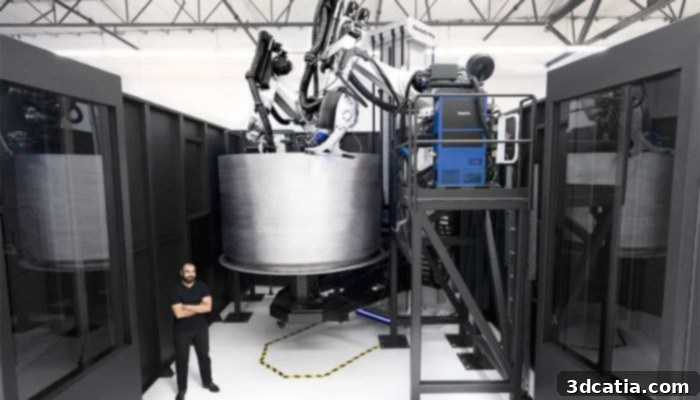
The Stargate printers are used for metal 3D printing (Photo credit: Relativity Space)
Will you be watching along for Relativity Space’s historic new launch attempt? Share your thoughts and predictions with us! Let us know in a comment below or join the conversation on our LinkedIn, Facebook, and Twitter pages! Don’t forget to sign up for our free weekly Newsletter here, ensuring you receive the latest 3D printing news straight to your inbox! You can also find all our compelling videos on our YouTube channel, offering visual insights into the cutting-edge developments in additive manufacturing and beyond.
*Cover photo credit: Trevor Mahlmann/ Relativity Space