
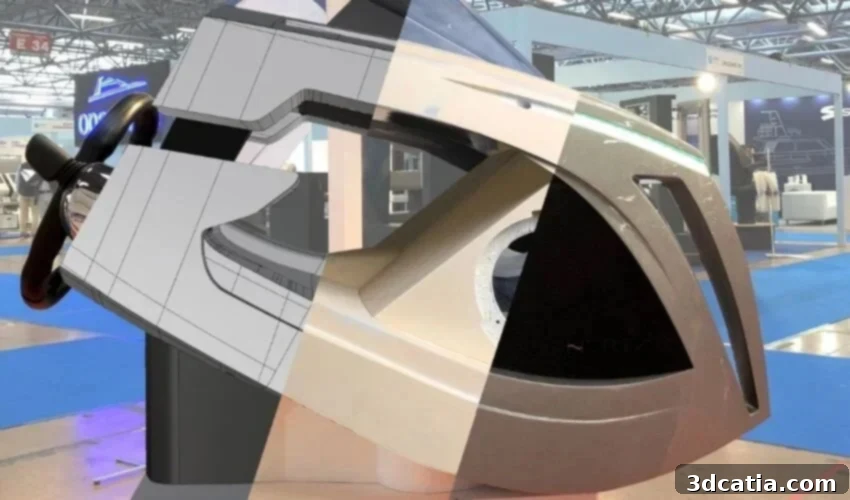
Revolutionizing Marine Design: How Superfici Harnesses 3D Printing for the Maritime Industry
The maritime industry, a sector renowned for its exacting standards, intricate designs, and the critical need for durable, high-performance components, is increasingly discovering the transformative potential of additive manufacturing. From luxury yachts to specialized vessels, the demands for high surface quality, meticulous attention to detail, robust materials, and bespoke designs are paramount. This is precisely where 3D printing excels, offering a viable and often indispensable alternative to conventional production methods. By enabling unparalleled customization, reducing lead times, and facilitating the creation of complex geometries, additive manufacturing is rapidly becoming a cornerstone for innovation in marine applications. To delve deeper into the ‘why’ and ‘how’ of 3D printing’s application in the maritime sector, we recently engaged in a conversation with Superfici, a pioneering Italian company that has distinguished itself as one of the first to successfully integrate fully 3D-printed parts onto ships. Paolo Nazzaro, CEO and co-founder of Superfici, graciously shared his insights and expertise with us.
3DN: Could you please introduce yourself and share your background?
Hello, I’m Paolo Nazzaro, and I am one of the proud founding partners of Superfici, alongside my esteemed colleagues Davide Telleschi and Guido Zannoni. My professional journey is rooted in nautical design, a field I’ve explored extensively, culminating in a PhD focused on nautical and sustainable product design. My academic contributions extend to the University of Genoa, where I have served as an adjunct professor for the Nautical and Marine Design degree since 2015. My initial encounter with the revolutionary capabilities of 3D printing dates back to 2010. This pivotal experience occurred during an internship with a company specializing in the development of advanced diving equipment. It was there that I had the invaluable opportunity to utilize one of the company’s nascent professional 3D printers to create a variety of prototypes. This early exposure to additive manufacturing deeply influenced my understanding of its potential and ultimately laid the groundwork for my future endeavors with Superfici.
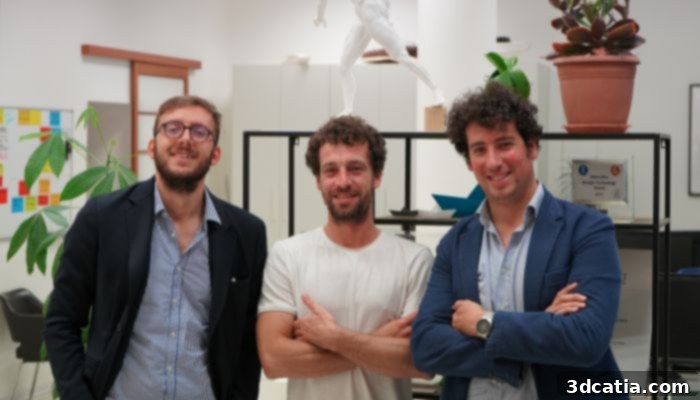
The founders of Superfici
3DN: What is the core mission and vision behind Superfici?
Superfici was established in 2016, originating in the beautiful Liguria region of Italy. Our foundational idea was ambitious yet clear: to strategically introduce and embed additive manufacturing technologies into the deeply entrenched shipbuilding sector. This presented a significant challenge, as the maritime world is notoriously linked to time-honored, traditional, and often artisanal manufacturing processes. Our mission at Superfici is to bridge this gap, bringing cutting-edge innovation to an industry ripe for disruption. We observed a substantial, unmet demand within this sector for the production of highly detailed models and components, requiring precision and complexity that traditional methods struggled to deliver efficiently or cost-effectively. This realization prompted Superfici to embark on extensive research into advanced materials and sophisticated surface treatment techniques. Through the diligent development of these processes, we have cultivated the essential know-how, enabling us to reliably supply a diverse range of high-quality components that are now directly installed on various sizes of boats and yachts. Today, Superfici proudly stands as a comprehensive specialist, offering end-to-end 3D services tailored specifically for the dynamic and demanding maritime industry.
3DN: What were the compelling reasons that led Superfici to opt for additive manufacturing in this specific industry?
The naval sector, particularly in segments like luxury yachting and custom vessel construction, is inherently characterized by small-quantity production runs, often demanding highly individualized products. This environment is constantly driven by an intense pursuit of customization and rapid stylistic evolution. The continuous search for novel constructive proposals, coupled with the desire to realize increasingly complex and aesthetically distinctive shapes, makes it an exceptionally fertile ground for the strategic integration of additive manufacturing. Modern shipyards are under constant pressure to differentiate their offerings from competitors, striving to provide unique and signature features. However, these ambitious design visions are frequently hampered by the inherent difficulties of traditional construction methods and the prohibitive costs associated with producing highly customized components. 3D printing emerges as a powerful solution to overcome these challenges. It provides the flexibility to create intricate designs without the need for expensive tooling or lengthy fabrication processes. While the technology must still meet the exceptionally high surface quality and aesthetic standards expected in marine environments, its ability to produce highly customized, complex parts efficiently makes it an increasingly viable, and indeed, essential option for innovation and differentiation within the maritime industry.
3DN: Which 3D printing processes and materials does Superfici primarily utilize for its marine applications?
At Superfici, our operational strategy primarily leverages two distinct yet highly effective 3D printing technologies: Fused Deposition Modeling (FDM) and resin 3D printing. To support our diverse project requirements and maintain production agility, Superfici has invested in a robust fleet of 15 3D printers, varying in size and capability. This extensive in-house capacity allows us to handle a wide range of component dimensions and production volumes efficiently. Regarding materials, our commitment to quality and consistency is paramount. We have cultivated a unique and direct partnership with a specialized manufacturer located in northern Italy, who produces high-performance thermopolymers exclusively under our own brand name. This bespoke arrangement ensures that we have absolute control over the material specifications and quality, which is crucial for marine applications where environmental resilience is key. The primary materials we employ are ABS (Acrylonitrile Butadiene Styrene), ASA (Acrylonitrile Styrene Acrylate), and PETG (Polyethylene Terephthalate Glycol). ABS is favored for its mechanical strength and impact resistance, while ASA offers superior UV resistance and weatherability, making it ideal for exterior marine parts. PETG provides excellent chemical resistance and durability. Our direct and collaborative relationship with the manufacturer is instrumental in guaranteeing a consistently very high level of quality for all our components, ensuring they meet the stringent performance requirements of the maritime sector.
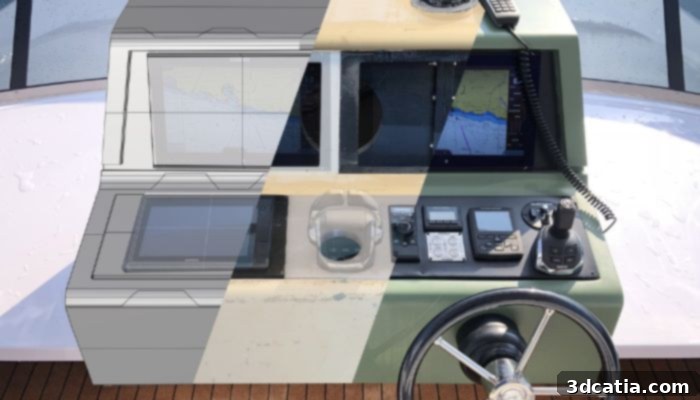
The first control cabin for a 30m Amer 94′ motor yacht, fully 3D printed by Superfici in 2018
3DN: How do you foresee the evolution and impact of 3D printing within the maritime sector in the coming years?
The future of 3D printing in the maritime sector is incredibly promising and dynamic. We anticipate additive manufacturing will increasingly cater to the diverse and evolving needs of shipyards and marine designers. One significant trend we are already observing, and expect to intensify, is the production of larger and more intricately articulated parts. As 3D printer technologies advance, capable of handling bigger build volumes and incorporating multiple materials, the scope for fabricating substantial, complex marine components will expand exponentially. This will allow for the consolidation of multiple parts into single, optimized designs, leading to stronger, lighter, and more efficient structures. Beyond direct part manufacturing, another transformative possibility lies in the creation of molds for boat building. This area presents a monumental opportunity for the industry. Currently, the vast number of obsolete molds used in traditional composite manufacturing poses a substantial problem regarding both disposal and storage, often leading to environmental and logistical burdens. The ability to create these molds efficiently using additive manufacturing, particularly with recyclable thermoplastic materials, could introduce immense benefits. This approach would not only significantly reduce waste and storage requirements but also allow for rapid iteration and customization of hull and deck designs, drastically cutting down development times and costs. Furthermore, on-demand production of molds could allow for greater agility in adapting to market trends and client specifications, ushering in an era of more sustainable and responsive shipbuilding practices.
3DN: Could you share some of Superfici’s most outstanding or notable projects to date?
Throughout our journey, Superfici has been privileged to complete a series of groundbreaking projects that underscore the potential of additive manufacturing in marine design. Among these, one particularly proud achievement was the realization of the very first 3D-printed dashboard, meticulously crafted and subsequently mounted on a luxurious yacht at the esteemed San Remo Amer shipyard. This project demonstrated the aesthetic and functional superiority achievable through 3D printing for critical interior components. Another significant endeavor involved the comprehensive development of a dashboard for SACS inflatable boats. This entire project was conceived from the ground up, specifically designed to fully harness and exploit the boundless potential offered by additive manufacturing, resulting in an optimized, lightweight, and highly integrated design. Finally, we are particularly excited to showcase what we believe is a truly innovative piece: the first 3D-printed steering wheel that integrates a multi-functional display directly into its center. This cutting-edge design was brought to life using advanced generative design techniques, allowing for organic shapes and optimal functionality while seamlessly incorporating digital interfaces directly into the control mechanism. These projects collectively exemplify our commitment to pushing the boundaries of what is possible in marine design and manufacturing.
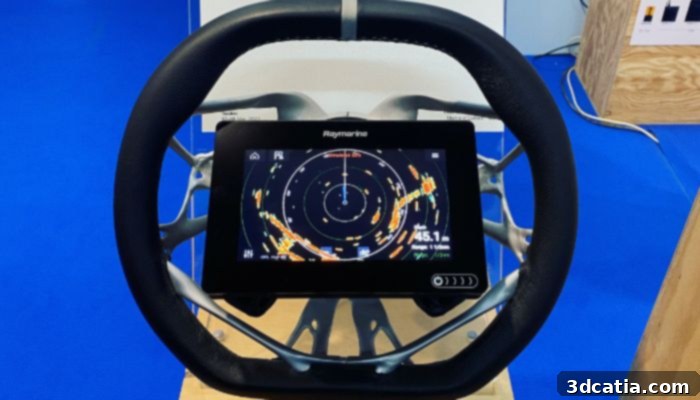
A 3D-printed steering wheel
Beyond these completed milestones, Superfici is actively engaged on multiple fronts, tirelessly working to introduce fresh, innovative ideas and solutions to shipyards across the industry. Our core mission remains unwavering: to continually integrate additive manufacturing more deeply into standard production processes, transforming traditional shipbuilding. As a company, Superfici is in a constant state of evolution. At the very heart of our operational philosophy and strategic direction lies a profound dedication to research and development. This commitment ensures that we not only respond to the current needs of the maritime sector but also proactively shape its future by exploring new materials, advanced printing techniques, and novel applications for 3D printing in marine environments.
3DN: Do you have any final thoughts or key messages for our readers, especially regarding the challenges and future prospects?
Indeed, I do. The maritime industry presents a unique set of challenges that demand exceptional expertise and innovation from additive manufacturing providers. The main challenges we consistently encounter stem from the sheer diversity and complexity of requests we receive, often pushing the boundaries of current capabilities. Furthermore, the ever-increasing size and intricacy of the parts required imply a highly demanding production approach, requiring precision at every stage. Beyond the manufacturing process itself, our products must demonstrate unparalleled resilience against the harsh external stresses characteristic of the marine environment. This includes prolonged exposure to high temperatures, the corrosive effects of salt water, and the constant threat of impacts. Moreover, the boat itself is a complex, dynamic body that is constantly in motion, twisting and turning in multiple directions, which introduces significant structural and material fatigue considerations. All these factors necessitate a great deal of preliminary study, rigorous testing, and, crucially, strict adherence to stringent industry standards and certifications. This meticulous approach is not merely beneficial; it is absolutely essential for ensuring the safety, reliability, and longevity of our products in this challenging environment. We invite everyone interested to explore more about our work and innovations on the Superfici website, which you can find HERE.
What are your thoughts on Superfici’s pioneering efforts in the maritime sector? Do you believe additive manufacturing is indeed gaining significant prominence and adoption within the marine industry? We encourage you to share your perspectives in a comment below or engage with us on our LinkedIn, Facebook, and Twitter pages! Don’t miss out on the latest advancements and news – remember to sign up for our free weekly newsletter here, delivering the most current 3D printing news directly to your inbox! Additionally, you can discover all our insightful videos and content on our dedicated YouTube channel.
*Cover Photo Credits: Superfici