

Sustainable Desalination: How 3D-Printed Aerogels Turn Saltwater into Drinkable Water with Sunlight
Access to clean drinking water is a fundamental human right, yet a significant portion of the global population still lacks this essential resource. The severity of the global water crisis is exacerbated by climate change, population growth, and increasing industrial demands, making innovative solutions more critical than ever. One promising avenue for providing potable water is the treatment of seawater through desalination. However, traditional desalination plants, while effective, are notorious for their substantial energy consumption and high operational costs. These factors present major drawbacks in terms of both financial sustainability and environmental impact, particularly due to the carbon footprint associated with their energy demands and the challenging disposal of highly concentrated brine.
Addressing these inherent limitations, researchers at the esteemed Hong Kong Polytechnic University have introduced a revolutionary new method for water purification. They have developed a cutting-edge 3D-printed aerogel that harnesses the boundless power of sunlight to efficiently transform saltwater into clean drinking water. This groundbreaking innovation not only offers a sustainable alternative to conventional desalination but also paves the way for scalable and accessible water purification technologies, potentially bringing potable water to communities worldwide that currently suffer from severe water scarcity.
The Challenge of Traditional Desalination and Existing Solar Evaporators
For decades, the scientific community has actively explored solar-powered desalination as a greener, more sustainable alternative to energy-intensive industrial plants. Many existing techniques leverage solar-powered evaporators, typically constructed from various porous materials. The underlying principle is elegantly simple and environmentally friendly: saltwater is introduced to the material, which then absorbs sunlight. This solar energy rapidly heats the water, causing it to evaporate while simultaneously leaving behind the dissolved salts. The resulting pure water vapor is subsequently collected and condensed, transforming back into desalinated, drinkable water. This method ideally bypasses the need for high-pressure pumps and complex energy systems, relying instead on a freely available and renewable energy source.
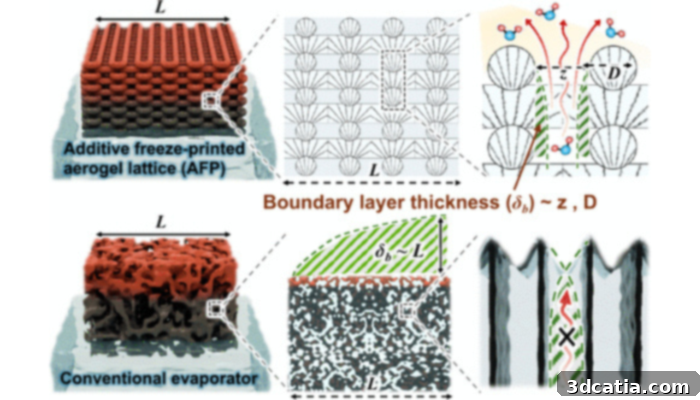
However, a significant and persistent hurdle has consistently limited the widespread adoption and practical application of these solar evaporators: scalability. While such systems demonstrate effectiveness on a small, laboratory scale, attempts to enlarge these systems for practical use have consistently revealed a critical inefficiency. The volume of purified water output does not increase proportionally with the size of the evaporator. This fundamental flaw is primarily due to the physical characteristics of larger, thicker porous materials, especially those containing tiny, intricate pores. In these designs, the water vapor often becomes trapped within the material’s labyrinthine structure, impeding its rapid release and efficient collection. This vapor trapping dramatically reduces the overall efficiency of the system and significantly slows down the purification process. Consequently, despite their promising potential, these earlier solar-driven methods have struggled to deliver sufficient quantities of water for larger communities or sustained operations, rendering them impractical for addressing the global water crisis on a truly meaningful and impactful scale.
Credit: ACS Energy Letters, Xiaomeng Zhao, Yunfei Yang, Xuemin Yin, Zhuo Luo, Kit-Ying Chan, Xi Shen
The Innovative Solution: 3D-Printed Aerogel with Optimized Structure for Enhanced Evaporation
To comprehensively address the inherent scalability issues and vapor trapping problems that plagued previous solar evaporators, the dedicated research team at the Hong Kong Polytechnic University, under the expert leadership of Professor Xi Shen, embarked on an intensely innovative research and development journey. Their groundbreaking work culminated in the creation of a unique aerogel meticulously fabricated from a sophisticated composite of cellulose nanofibers and carbon nanotubes. This specific combination of advanced materials is absolutely crucial for the aerogel’s superior performance: cellulose, a naturally abundant and biodegradable polymer, provides the essential structural integrity and porosity, while the integrated carbon nanotubes significantly enhance the material’s capacity for light absorption and thermal conductivity. This dual functionality makes the aerogel exceptionally efficient at converting incoming solar energy directly into heat, precisely where it is needed for evaporation.
The true genius behind this aerogel’s unparalleled performance lies not solely in its advanced material composition but predominantly in its meticulously engineered, highly optimized microstructure. This intricate architecture is achieved through a novel and precise manufacturing process known as “frozen 3D printing.” Unlike conventional 3D printing techniques where layers are simply extruded and stacked, this advanced method involves printing each delicate layer of the material and then immediately flash-freezing it. This rapid solidification ensures that the fragile, intricate structure of each individual layer is perfectly preserved before the subsequent layer is deposited. This precise, layer-by-layer flash-freezing technique enables the creation of highly specialized three-dimensional structures characterized by continuous, unobstructed vertical channels and remarkably ultra-thin walls. The resulting material adopts a distinctive sponge-like appearance, permeated by numerous vertical holes, each precisely engineered to be approximately 20 microns wide. This intricate, open-pore architecture is deliberately designed to facilitate the unimpeded, rapid flow of water vapor, thereby directly and effectively addressing the pervasive vapor-trapping problem that severely hampered the efficiency of earlier solar evaporator designs. The continuous vertical channels act as direct, low-resistance pathways, guiding the water vapor quickly upwards and efficiently out of the material, which dramatically enhances both the efficiency and the speed of the saltwater desalination process.
Solar Power and 3D Printed Aerogel Structures Provide Clean Drinking Water
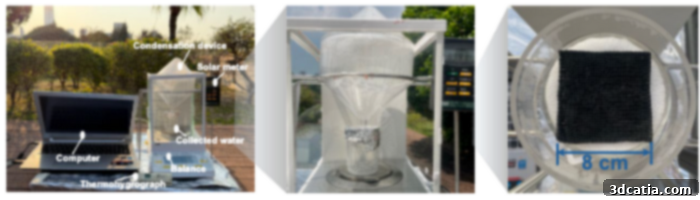
The effectiveness and robustness of these innovative 3D-printed aerogel structures were rigorously tested and documented. According to a comprehensive study meticulously published in the prestigious journal ACS Energy Letters, the researchers conducted extensive outdoor testing using square-shaped aerogel structures, carefully prepared in various sizes to assess scalability. In these meticulously designed experiments, the aerogel “sponges” were precisely placed into cups containing real seawater, collected from natural sources. To optimize the collection of pure vapor and to prevent any potential contamination from the external environment, each cup was then carefully covered with a sheet of transparent plastic film. As direct sunlight struck the surface of the aerogel, its embedded carbon nanotube components efficiently absorbed the solar energy, rapidly and effectively heating the underlying saltwater contained within the material’s pores. This concentrated thermal energy instigated the phase change, causing the water molecules to evaporate, while the dissolved salts, having a much higher boiling point, were efficiently left behind, unable to vaporize.
The resulting water vapor, now desalinated and pure, rose upwards and collected on the cooler underside of the transparent plastic cover. From this condensation surface, the purified water was meticulously guided and funneled into a separate, clean collection container using a small, precisely positioned funnel. This experimental setup effectively mimicked a simplified, yet highly controlled, real-world solar still, thereby allowing for accurate measurement of the desalinated water output and thorough quality analysis under ambient environmental conditions. The initial findings emanating from these rigorous outdoor tests were exceptionally promising, unequivocally demonstrating the aerogel’s significant potential to produce potable water reliably, efficiently, and sustainably, utilizing only the power of the sun.
Exceptional Performance and Unprecedented Scalability Verified
The results obtained from the rigorous outdoor tests are indeed extremely promising, offering a clear and viable path forward for truly sustainable desalination technologies. The researchers successfully demonstrated the consistent ability to produce not just a few drops, but several tablespoons of high-quality drinking water, and critically, its purity and overall quality remained remarkably stable over an extended period of operation. This sustained stability is a vital characteristic for any practical drinking water solution, ensuring consistent safety and an agreeable taste for consumers. More importantly, the innovative design and intricate microstructure of the aerogel profoundly proved its worth in effectively addressing the core, long-standing challenge of scalability in solar evaporators. The team precisely observed that water vapor escaped quickly and with exceptional efficiency through the aerogel’s continuous vertical channel structure, even when the overall surface area of the aerogel device was significantly increased. This crucial observation unequivocally confirms that the approach is genuinely scalable, a pivotal factor that has previously hampered the practical implementation and widespread adoption of similar solar-driven water purification technologies.
In a particularly telling and impactful experiment, the performance loss observed when scaling up the aerogel system was remarkably low, registering at an astonishingly small figure of only around 5 percent. This negligible performance degradation represents a monumental improvement and a significant scientific leap compared to the performance degradation seen with other traditional porous materials, which often experience losses exceeding 40 percent under similar scaling conditions. This minimal performance drop signifies that the aerogel’s unique and optimized structure effectively prevents internal vapor trapping and successfully maintains its high efficiency across varying operational scales, making it an ideal candidate for large-scale deployment to meet significant water demands without compromising its output or purification effectiveness. This breakthrough in scalability, coupled with its solar-driven nature, fundamentally positions the 3D-printed aerogel as a leading contender in the global race for developing truly sustainable, accessible, and widespread clean water solutions for humanity.
Credit: ACS Energy Letters, Xiaomeng Zhao, Yunfei Yang, Xuemin Yin, Zhuo Luo, Kit-Ying Chan, Xi Shen
Future Outlook and Real-World Application
While the initial results from both laboratory and controlled outdoor environments are exceedingly promising, the next critical phase for the dedicated research team involves conducting extensive and rigorous tests under authentic, unpredictable real-world environmental conditions. This crucial stage will entail evaluating the aerogel’s performance across a wide range of natural variables, including fluctuating ambient temperatures, varying humidity levels, different wind conditions, and the unavoidable presence of environmental contaminants, such as dust, algae, or micro-organisms, all of which might impact its long-term efficacy and operational stability. A particularly crucial aspect of this phase is to definitively determine the durability and operational lifespan of the aerogel material—specifically, understanding how often it would practically need to be replaced or regenerated, and how consistently well its performance holds up over extended periods of continuous, demanding use. Gaining a comprehensive understanding of these factors is absolutely essential for accurately assessing the material’s practical viability, its ongoing maintenance requirements, and its overall long-term cost-effectiveness for widespread and successful adoption.
If these extensive real-world tests unequivocally confirm the impressive results observed in the laboratory and initial outdoor trials, this innovative 3D-printed aerogel technology holds immense transformative potential to revolutionize access to clean water. Its impact could be particularly profound in remote and off-grid communities that lack existing infrastructure, as well as in disaster-stricken areas where traditional water infrastructure is severely compromised or entirely destroyed. Its inherent reliance solely on abundant solar energy means significantly reduced operational costs and a remarkably minimal environmental footprint when compared to existing energy-intensive desalination methods. This sustainable and autonomous approach could powerfully empower communities to produce their own potable water locally, fostering greater self-sufficiency, improving public health outcomes, and enhancing overall resilience globally. Further research efforts will also be directed towards continually optimizing the aerogel’s material composition and fine-tuning the intricate 3D printing parameters to further enhance efficiency, significantly reduce manufacturing costs, and ensure maximum longevity and performance in diverse and challenging operational environments. For those interested in delving deeper, the comprehensive study provides extensive details and findings HERE.
Engage with the Future of Sustainable Water Solutions
What are your profound thoughts on the groundbreaking potential and future implications of 3D-printed aerogels for revolutionizing the production of clean drinking water? We warmly invite you to share your valuable insights, perspectives, and opinions in a comment below, or join the ongoing conversation on our vibrant LinkedIn and engaging Facebook pages! Your thoughtful feedback is invaluable as we collectively explore the cutting edge of sustainable and impactful technologies. Additionally, to ensure you stay fully informed on the very latest advancements, groundbreaking news, and key developments in the dynamic and rapidly evolving world of 3D printing, don’t forget to sign up for our entirely free weekly Newsletter, which will be delivered directly and conveniently straight to your inbox. For a compelling visual journey through these exciting innovations and more, you can also find all our comprehensive videos on our dedicated YouTube channel, offering a deeper dive into the technologies shaping our future.